
Hello everyone,
About two years ago, I bought an old house built in 1964 and completely renovated it. We moved in about 1.5 years ago. Now, I would like to insulate the ceiling of the top floor.
The roof consists of roof tiles, roofing felt, and wooden boarding – so it is completely uninsulated. Installing insulation between the rafters does not really make sense because I cannot convert the attic anyway. The height would only allow for a 1.4 m (4.6 ft) wide strip where you can stand upright. So unfortunately, that’s not really worthwhile.
My plan is to insulate the ceiling with 160 mm (6.3 inches) thick glass wool. A few very light items will still be stored up there, so I will lay down some wooden boards to stack the few light things on.
Cost-wise, this is the cheapest option, and I think it will make a noticeable difference in my old house.
What I don’t know is whether I need a vapor barrier or vapor retarder between the floor and the insulation. Can anyone tell me?
The ceiling is made of reinforced concrete, and there is even a few centimeters of screed on top. The apartment below has Heraklith boards on the underside. So, the layers from bottom to top are:
Plaster
Heraklith board (approx. 4 cm (1.6 inches))
Reinforced concrete slab
Screed
Then insulation with or without a vapor barrier/retarder in between.
My second question is: There is a door leading to the attic that opens inward. This means I cannot install insulation in the door’s swing area. Will this cause any problems?
So, hopefully someone can answer these two questions.
The total cost will be about 700€. I think (hope) this will definitely pay off within a few years.
Thanks in advance.
EDIT:
Oh yes, maybe one more small question: Does it make a big difference if I use 140 mm (5.5 inches) or 160 mm (6.3 inches) insulation? The extra cost would be about 70€.
Best regards,
Specki
About two years ago, I bought an old house built in 1964 and completely renovated it. We moved in about 1.5 years ago. Now, I would like to insulate the ceiling of the top floor.
The roof consists of roof tiles, roofing felt, and wooden boarding – so it is completely uninsulated. Installing insulation between the rafters does not really make sense because I cannot convert the attic anyway. The height would only allow for a 1.4 m (4.6 ft) wide strip where you can stand upright. So unfortunately, that’s not really worthwhile.
My plan is to insulate the ceiling with 160 mm (6.3 inches) thick glass wool. A few very light items will still be stored up there, so I will lay down some wooden boards to stack the few light things on.
Cost-wise, this is the cheapest option, and I think it will make a noticeable difference in my old house.
What I don’t know is whether I need a vapor barrier or vapor retarder between the floor and the insulation. Can anyone tell me?
The ceiling is made of reinforced concrete, and there is even a few centimeters of screed on top. The apartment below has Heraklith boards on the underside. So, the layers from bottom to top are:
Plaster
Heraklith board (approx. 4 cm (1.6 inches))
Reinforced concrete slab
Screed
Then insulation with or without a vapor barrier/retarder in between.
My second question is: There is a door leading to the attic that opens inward. This means I cannot install insulation in the door’s swing area. Will this cause any problems?
So, hopefully someone can answer these two questions.
The total cost will be about 700€. I think (hope) this will definitely pay off within a few years.
Thanks in advance.
EDIT:
Oh yes, maybe one more small question: Does it make a big difference if I use 140 mm (5.5 inches) or 160 mm (6.3 inches) insulation? The extra cost would be about 70€.
Best regards,
Specki
G
garfunkel19 Nov 2017 17:10If you want to install insulation on the screed/reinforced concrete, you don’t need a vapor barrier because moisture won’t come through the concrete slab.
You can also calculate the U-value yourself. Just type "U-value" into Google along with your project details—I find it a very useful tool.
I would go for 160mm (6.3 inches) right away, or even more, depending on the additional cost. I think it’s worth it.
I also consider the area under the door less critical. It could be a thermal bridge, but I doubt it would be significant enough to cause problems.
Of course, it would be better to insulate there as well. Maybe the door can be shortened a bit or something similar.
In any case, I would want to insulate there too.
You can also calculate the U-value yourself. Just type "U-value" into Google along with your project details—I find it a very useful tool.
I would go for 160mm (6.3 inches) right away, or even more, depending on the additional cost. I think it’s worth it.
I also consider the area under the door less critical. It could be a thermal bridge, but I doubt it would be significant enough to cause problems.
Of course, it would be better to insulate there as well. Maybe the door can be shortened a bit or something similar.
In any case, I would want to insulate there too.
Hi, I recently did exactly the same. Everything about the vapor barrier has already been said. However, I installed 2 x 120mm (4.7 inches) layers crossed to avoid thermal bridges. The door area is annoying, but not a big deal. Still, I would improvise something there.
And yes, it’s definitely worth it. To exaggerate, your ceiling is currently like a large cooling plate. The payback period is just a few years at most.
And yes, it’s definitely worth it. To exaggerate, your ceiling is currently like a large cooling plate. The payback period is just a few years at most.
Thank you all in advance for your responses.
This definitely encourages me to continue with my plans.
Attached is a simple sketch of what the attic looks like.
Here you can see the staircase and the door, along with the area that cannot be insulated.
Everything shown in yellow can be insulated.
If anyone has tips or opinions regarding my questions, please feel free to share them.
Best regards,
Specki
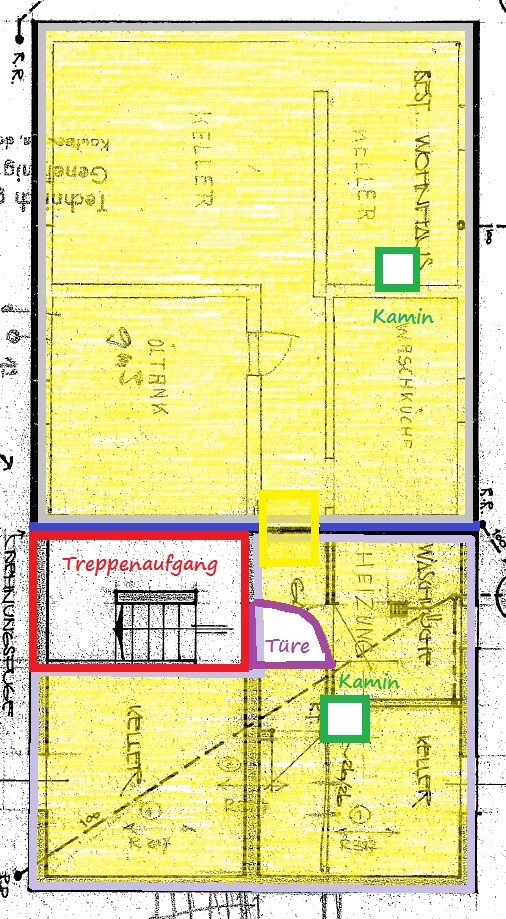
This definitely encourages me to continue with my plans.
Attached is a simple sketch of what the attic looks like.
Here you can see the staircase and the door, along with the area that cannot be insulated.
Everything shown in yellow can be insulated.
If anyone has tips or opinions regarding my questions, please feel free to share them.
Best regards,
Specki
Joedreck schrieb:
However, I have overlapped two layers of 120mm (5 inches) each in a cross pattern to avoid thermal bridges. Does stacking two layers really add that much more compared to a single thicker layer? It will definitely be noticeably more expensive...
That means you have 240mm (9.5 inches) total, which I think is quite substantial.
Regards
Specki
To be honest, I’m not sure if cross-bracing helps much. I wanted to avoid or at least minimize mistakes.
True, 240mm (9.4 inches) is a lot. But not too much, in my opinion. Since heat rises, the ceiling of the top floor is the part of the house where the greatest heat loss occurs. For a slightly higher investment, I think I’ll have peace of mind for 40 years.
True, 240mm (9.4 inches) is a lot. But not too much, in my opinion. Since heat rises, the ceiling of the top floor is the part of the house where the greatest heat loss occurs. For a slightly higher investment, I think I’ll have peace of mind for 40 years.
Similar topics