
Hello,
my tenant sent me the following photo from my basement apartment. Apparently, there are moisture problems.
This concerns an exterior wall.
What is the correct procedure here (four-family house with four owners)? Should I first hire a building expert at my own expense to determine the cause (it could also be due to incorrect ventilation, etc.)?
How would you proceed in this situation?
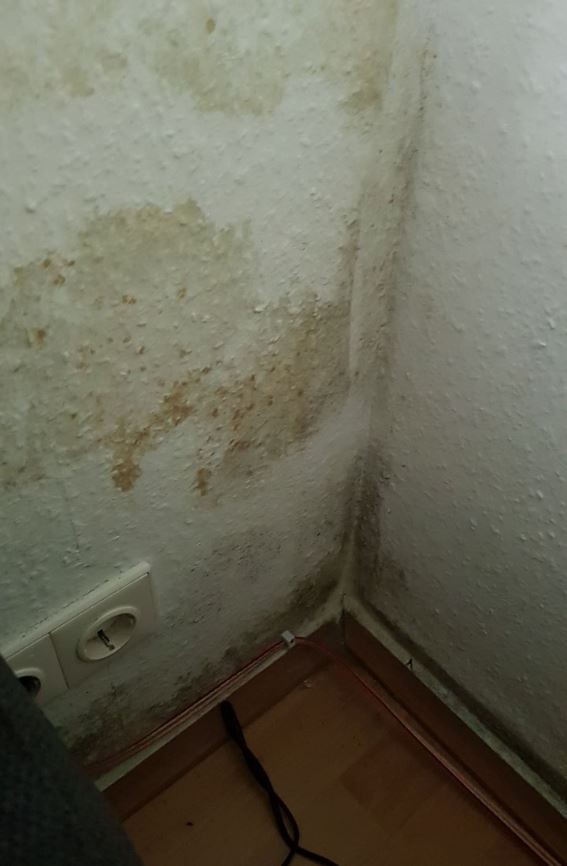
my tenant sent me the following photo from my basement apartment. Apparently, there are moisture problems.
This concerns an exterior wall.
What is the correct procedure here (four-family house with four owners)? Should I first hire a building expert at my own expense to determine the cause (it could also be due to incorrect ventilation, etc.)?
How would you proceed in this situation?
C
chand19865 Oct 2017 16:07Steffen80 schrieb:
I also have those so-called "experts" among my acquaintances who always say, "Why don’t you buy rental apartments...?" blabber blabber... I just sit back, let them talk nonsense, and enjoy my solid profit in my stock portfolio. If I want, I can sell everything tomorrow at the push of a button...Well.
If you have a good portfolio, what kind of long-term return on equity do you get? Respectable, but...
When good real estate was cheap (a few years ago), you could buy apartments with very little equity and high leverage, achieving returns on capital of 4%+ and more. Returns on equity after the loan was paid off by tenants (!) were amazing. Renovation costs offer significant tax benefits if timed well.
But yes, the commitment to manage property is a completely different, bigger, and more immediate responsibility than with stocks. Anyone who claims it’s easy is wrong. Anyone who claims it yields nothing or less than stocks is also wrong :-p.
Do what you can, not what others tell you.
Those willing to put in the work and acquire the necessary knowledge (!) can, of course, scale real estate investments larger than with stocks.
With a single apartment, you obviously have concentration risk. It can work out well but doesn’t have to – as we see here.
Still, depending on the return versus the expected sales price, I would consider whether it’s better to repair damages and continue renting or to sell.

S
Steffen805 Oct 2017 17:08chand1986 schrieb:
Well.
If you have a good investment portfolio, what kind of long-term return on equity can you expect? Respectable, but...
When there were affordable good properties available (a few years ago), you could buy apartments with very little equity, meaning high leverage, achieving returns on investment of 4%+ on equity. Equity returns after tenants have paid off the mortgage(!) were phenomenal. Renovation costs provided significant tax benefits if timed well.
But yes, the responsibility to manage a property is quite different — bigger and more immediate — than with stocks. Anyone who claims it is very easy is mistaken. Anyone who says it brings no or lower returns than stocks, well, also :-p .
Do what you can and not what others say.
Anyone willing to put in the work and gain the necessary knowledge(!) can of course scale more with real estate than with stocks.
With a single apartment you of course have concentration risk. It can work out well, but it might not — we see this here.
Still, depending on the return compared to the achievable sales price, I would weigh whether to fix issues and continue renting or to sell.My statement refers to the current market environment and recent years. Ten or more years ago, of course, it looked different — no question.
R
R.Hotzenplotz7 Oct 2017 19:48The tenant has to move out of the apartment so that the renovation can be carried out.
He has already emptied the apartment.
He has now spoken with the tenant protection association and wants to commission his own expert report, which is scheduled to be done in three weeks. During that time, we are not supposed to start the renovation, even though there is an urgent danger.
Is this something you have to accept? The painter says the mold is spreading so aggressively that by then it will no longer be just on the wallpaper but will have penetrated the wall or the laminate floor.
He has already emptied the apartment.
He has now spoken with the tenant protection association and wants to commission his own expert report, which is scheduled to be done in three weeks. During that time, we are not supposed to start the renovation, even though there is an urgent danger.
Is this something you have to accept? The painter says the mold is spreading so aggressively that by then it will no longer be just on the wallpaper but will have penetrated the wall or the laminate floor.
R
R.Hotzenplotz8 Oct 2017 07:50I don’t understand either what he is trying to achieve. I even confirmed to him in writing that he will not be charged any costs for the renovation.
It can only be about the rent payment until the end of the contract. If he terminates now, he would still have to pay rent until the end of January, even though he will no longer move in. I suspect that’s what he wants to sort out.
He argues that there was a small dark spot visible at the time of moving in, which, in his view, presumably caused the problem. Since such a spot (just mold spores) was also found in the bedroom after the furniture was removed, he claimed this is proof that the mold was already there before moving in.
His couch also got mold damage on the back. Maybe he wants that replaced too. No idea.
Most likely, it’s about the fact that, since the apartment had to be emptied for the renovation, he wants to use that as a reason to terminate without notice.
It can only be about the rent payment until the end of the contract. If he terminates now, he would still have to pay rent until the end of January, even though he will no longer move in. I suspect that’s what he wants to sort out.
He argues that there was a small dark spot visible at the time of moving in, which, in his view, presumably caused the problem. Since such a spot (just mold spores) was also found in the bedroom after the furniture was removed, he claimed this is proof that the mold was already there before moving in.
His couch also got mold damage on the back. Maybe he wants that replaced too. No idea.
Most likely, it’s about the fact that, since the apartment had to be emptied for the renovation, he wants to use that as a reason to terminate without notice.
Similar topics