
Hi, we had our electrical consultation on Friday to discuss where everything should be installed.
Attached is a plan showing how we planned it with the electrician. Almost all our wishes were included; there were hardly any suggestions for improvement.
In the pictures, the power outlets are marked in orange.
For internet/telephone, we only have 2 lines. He wanted to charge 108€ per outlet for more lines, so we are now doing it ourselves, meaning there will be an internet connection in every room.
Living room: 4-2-4 power outlets plus TV, and 2 plus another 2 outlets.
Hallway: 1 outlet at the front and at the back, plus a telephone connection.
Utility room: besides the appliances themselves, for washing machine and dryer there are 2 individual outlets.
Guest WC: 1 outlet.
Home office: 3 power outlets plus telephone and TV, and 2 times 1 outlet.
Upstairs:
Children’s rooms: 3 outlets plus TV and 2 times 2 outlets.
Dressing room: 2 individual outlets in the middle at the top (for Ikea Pax light). Also, the light switch for the bedroom is in the dressing room... is that a good setup? (Red dot-arrow)
Bedroom: 3 outlets plus TV, and next to the bed, 3 outlets on each side (would it be better to have these lower or slightly higher so they are above the bedside table? Since baby monitors, phones, etc. are plugged in daily.)
Storage room: 2 individual outlets.
Bathroom: 2 outlets on the left side of the vanity wall. Additionally, a ceiling light in front of the shower. Are there any suggestions for improvement here? Should one outlet be left there with a spotlight that shines into the shower, or use that one outlet to install LED spots in the ceiling?
Hallway at the back: 1 outlet.
So, now the pictures follow, which hopefully are clear.
I would appreciate your feedback and suggestions for improvements.
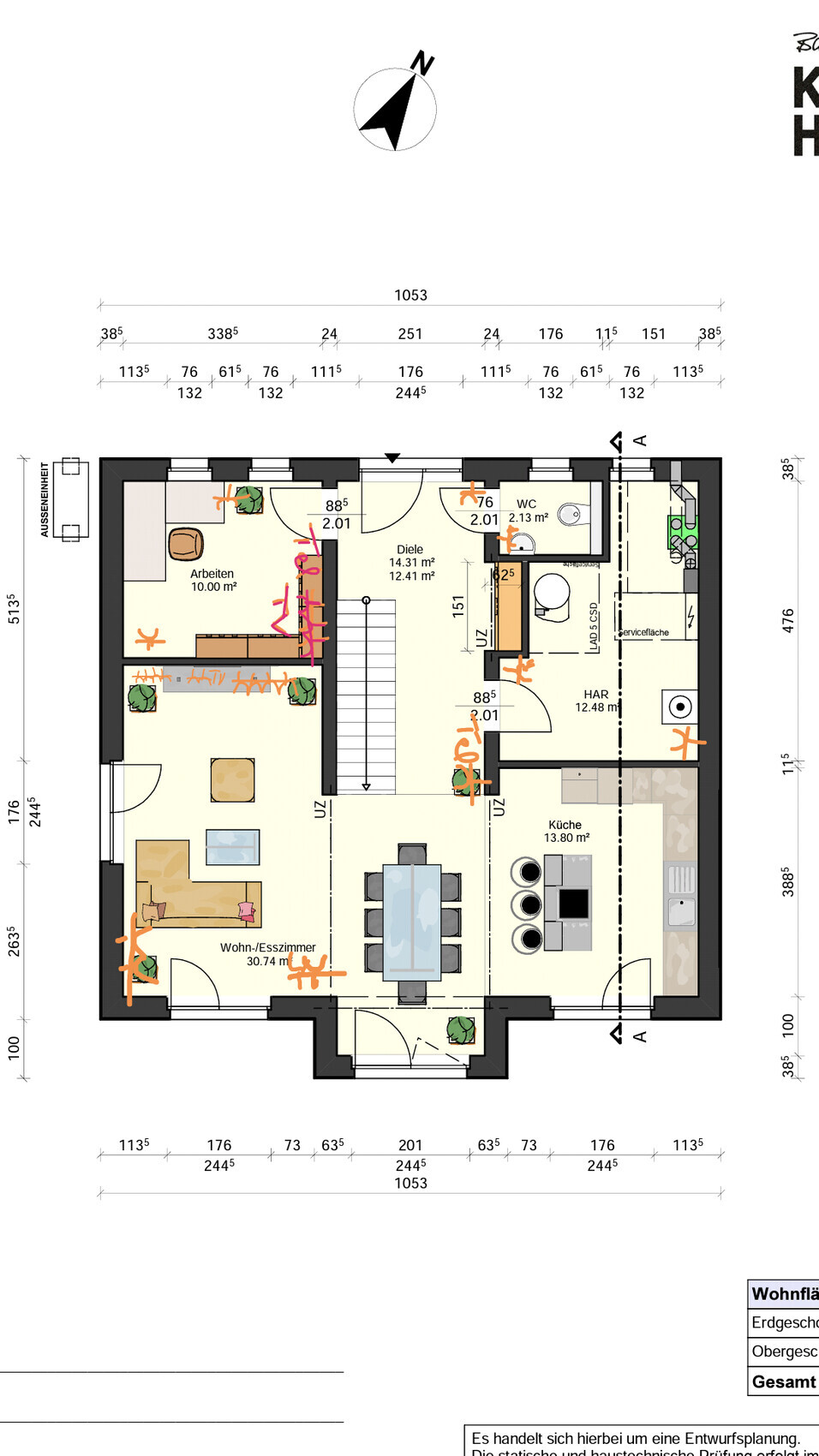
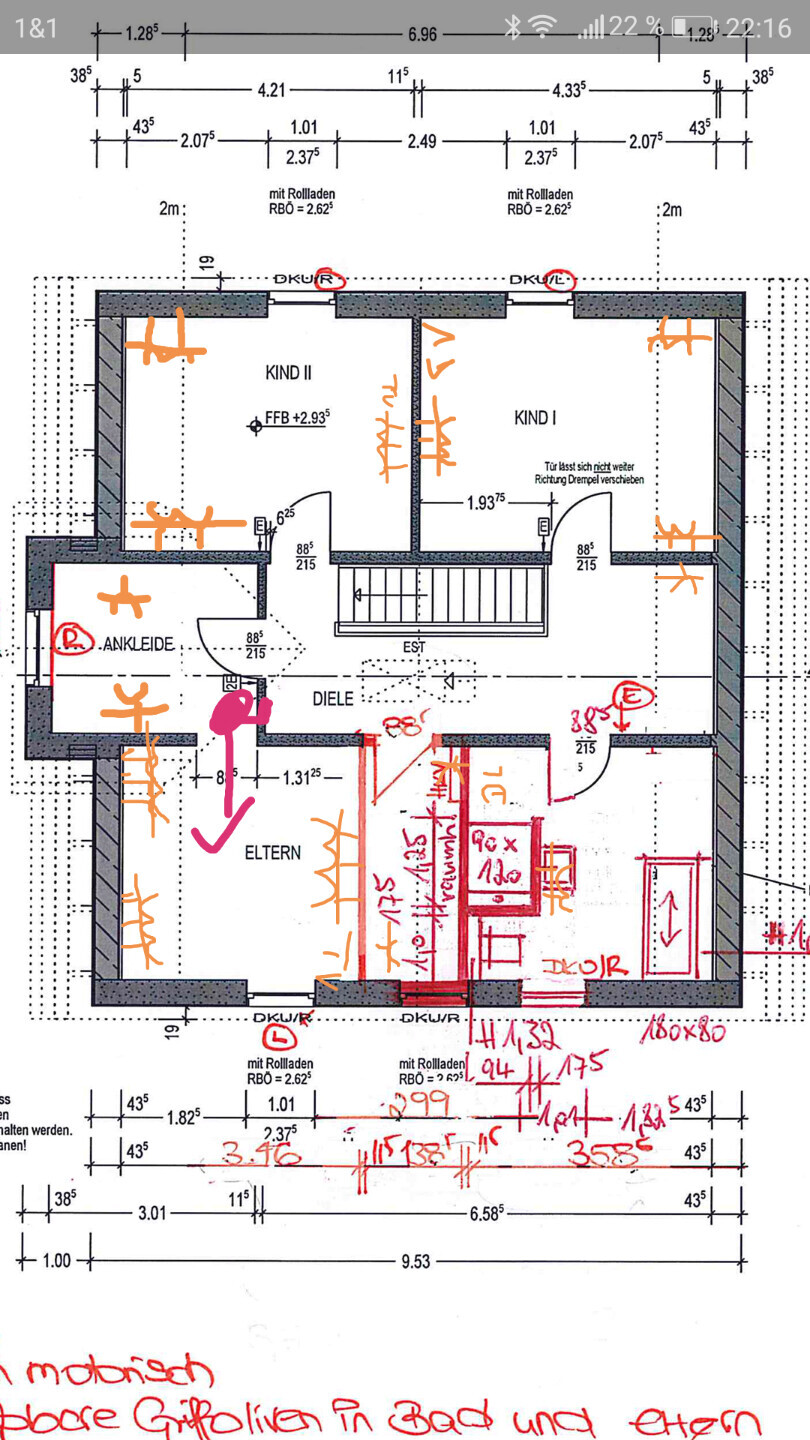
Attached is a plan showing how we planned it with the electrician. Almost all our wishes were included; there were hardly any suggestions for improvement.
In the pictures, the power outlets are marked in orange.
For internet/telephone, we only have 2 lines. He wanted to charge 108€ per outlet for more lines, so we are now doing it ourselves, meaning there will be an internet connection in every room.
Living room: 4-2-4 power outlets plus TV, and 2 plus another 2 outlets.
Hallway: 1 outlet at the front and at the back, plus a telephone connection.
Utility room: besides the appliances themselves, for washing machine and dryer there are 2 individual outlets.
Guest WC: 1 outlet.
Home office: 3 power outlets plus telephone and TV, and 2 times 1 outlet.
Upstairs:
Children’s rooms: 3 outlets plus TV and 2 times 2 outlets.
Dressing room: 2 individual outlets in the middle at the top (for Ikea Pax light). Also, the light switch for the bedroom is in the dressing room... is that a good setup? (Red dot-arrow)
Bedroom: 3 outlets plus TV, and next to the bed, 3 outlets on each side (would it be better to have these lower or slightly higher so they are above the bedside table? Since baby monitors, phones, etc. are plugged in daily.)
Storage room: 2 individual outlets.
Bathroom: 2 outlets on the left side of the vanity wall. Additionally, a ceiling light in front of the shower. Are there any suggestions for improvement here? Should one outlet be left there with a spotlight that shines into the shower, or use that one outlet to install LED spots in the ceiling?
Hallway at the back: 1 outlet.
So, now the pictures follow, which hopefully are clear.
I would appreciate your feedback and suggestions for improvements.
So, here comes a really basic question, please bear with me.
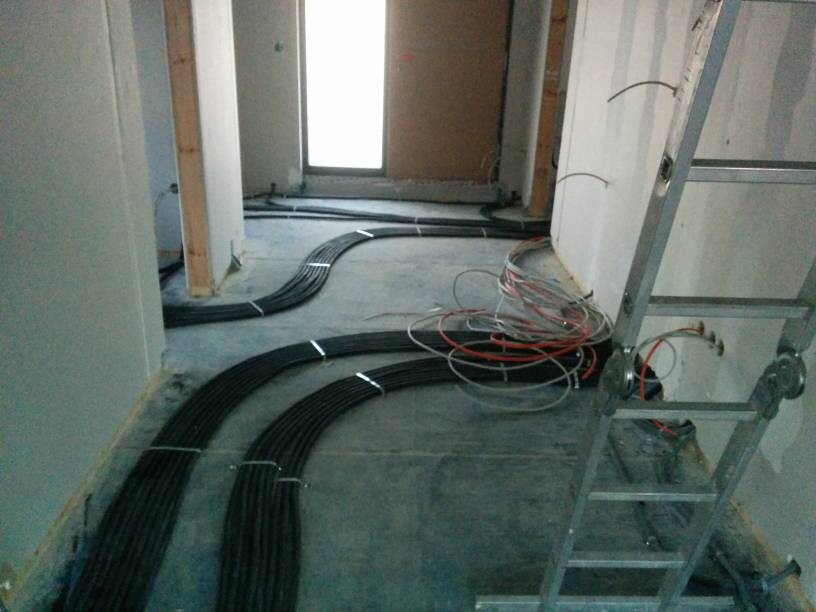
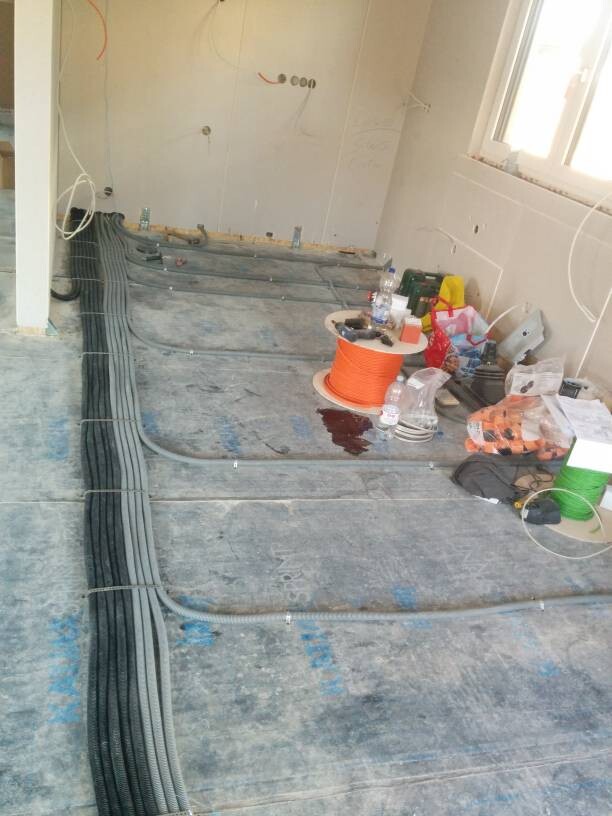
Is it common practice for the cables/conduits to be laid on the rough floor?
I'm currently bothering my architect a bit to finish the electrical scope of work because I always assumed with KNX that all the cables would go into the precast concrete ceiling together with the mechanical ventilation system, and then be covered with cast-in-place concrete.
The reason I'm bothering him is that I thought the electrician and the concrete contractor would have to work simultaneously...
Is it common practice for the cables/conduits to be laid on the rough floor?
I'm currently bothering my architect a bit to finish the electrical scope of work because I always assumed with KNX that all the cables would go into the precast concrete ceiling together with the mechanical ventilation system, and then be covered with cast-in-place concrete.
The reason I'm bothering him is that I thought the electrician and the concrete contractor would have to work simultaneously...

ruppsn schrieb:
Is it common to lay the conduits / empty pipes on the raw floor? I believe this is common practice, but not absolutely necessary.
Theoretically, all supply lines could be installed within the ceilings and then brought up through the concrete at the relevant locations (e.g., power outlets per room, satellite, or network connections).
This way, the remaining wiring can be chased into the walls, avoiding the need to run them on the concrete ceilings.
However, we chose to lay the wiring on the floor because it requires less chasing and therefore fewer cables inside the walls. Additionally, it offers more flexibility for making changes later on.
In our case, only the supply lines for lighting and the motors for the roller shutters / blinds are embedded in the concrete ceilings because we also have ventilation ducts there, making the space for conduits very tight.
Our structural engineer was definitely quite frustrated about this.
B
Bieber081520 Sep 2017 22:39305er schrieb:
Unfortunately, I can’t find anywhere that it must be a conduit and not just a protective tube, or that it has to be replaceable. I was never able to find that either...305er schrieb:
Yesterday I had an independent expert [...] Did this expert specifically address the issue of conduit/replaceability/protective tube?Hello truce,
thank you for your quick reply.
Yep, our structural engineer also already has sweat beads on his forehead every time there’s news from us.
If you place the electrical installation on the structural floor slab, what will be your floor buildup height?
Which layer would compensate for the cables with the following buildup (160mm (6.3 inches))—meaning which layer would have less material above the conduits? Or does the entire buildup increase by the diameter of the conduits?
15mm (0.6 inches) surface finish (industrial parquet)
65mm (2.6 inches) cement screed
20mm (0.8 inches) impact sound insulation
50mm (2 inches) floor insulation board
10mm (0.4 inches) vapor barrier
I somehow find your option more appealing...
thank you for your quick reply.
truce schrieb:
The structural engineer was definitely shocked
Yep, our structural engineer also already has sweat beads on his forehead every time there’s news from us.
If you place the electrical installation on the structural floor slab, what will be your floor buildup height?
Which layer would compensate for the cables with the following buildup (160mm (6.3 inches))—meaning which layer would have less material above the conduits? Or does the entire buildup increase by the diameter of the conduits?
15mm (0.6 inches) surface finish (industrial parquet)
65mm (2.6 inches) cement screed
20mm (0.8 inches) impact sound insulation
50mm (2 inches) floor insulation board
10mm (0.4 inches) vapor barrier
I somehow find your option more appealing...
ruppsn schrieb:
If you place the electrical installation on the ceiling slab (RFB), how thick is your floor construction then?
In a 160mm (6.3 inches) setup, which layer would compensate for the cables (meaning having less material above the conduit pipes)? Or does the entire build-up increase by the diameter of the conduit pipes?In our case, there is 2 x 40mm (1.6 inches) insulation on the ground floor and 1 x 50mm (2 inches) insulation on the upper floor.
The conduit pipes, as well as the plumbing pipes, should all be completely embedded within these layers.
The screed installer, or whoever lays the insulation, will have the fun, though.
They have to cut out all the pipes and then refill with loose insulation.
So, no matter which option you choose, someone is bound to be less than happy.
We also installed our electrical wiring with extra conduits due to the increased cable volume for KNX. The conduits are embedded within the insulation. An electrician later mentioned that conduits aren’t necessary for NYM cables, but I preferred to have them anyway. We wouldn’t have had enough space in the ceiling otherwise.
Regards
Regards