
S
spike197829 Aug 2017 09:56Hello everyone,
I have a question. I would like to pave a corner in our garden.
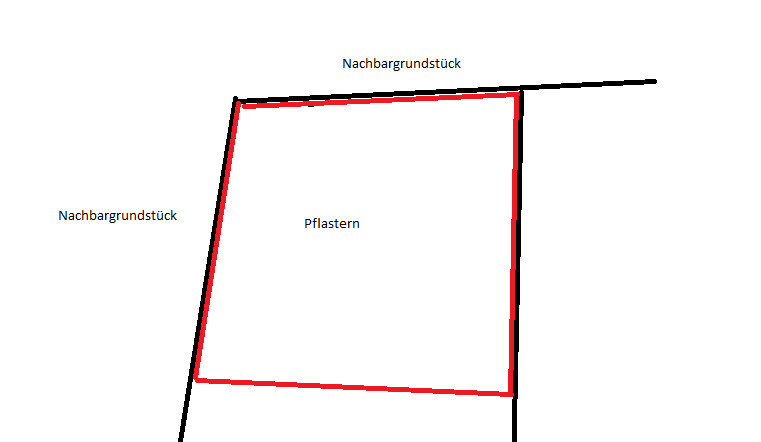
I want to border this area with edge stones. The problem is that our property is on a slope, so the area doesn’t have right angles. I’ve attached a simple sketch. The red area is the part to be paved. If I try to make all sides perfectly square, there’s a lot of extra space at the edges, which looks a bit odd.
What would be the best way to pave this area so that it looks good in the end?
I’ve thought of two options:
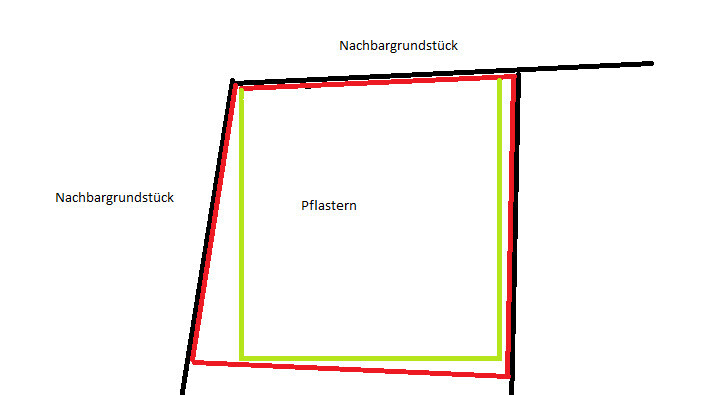
1) Create right angles at the front left and right sides and then pave within those (see screenshot: possible_option1.png)
2) Place the edge stones following the slope of the property without forcing right angles and then pave the entire area
How would you approach this?
Thanks and best regards,
Spike
I have a question. I would like to pave a corner in our garden.
I want to border this area with edge stones. The problem is that our property is on a slope, so the area doesn’t have right angles. I’ve attached a simple sketch. The red area is the part to be paved. If I try to make all sides perfectly square, there’s a lot of extra space at the edges, which looks a bit odd.
What would be the best way to pave this area so that it looks good in the end?
I’ve thought of two options:
1) Create right angles at the front left and right sides and then pave within those (see screenshot: possible_option1.png)
2) Place the edge stones following the slope of the property without forcing right angles and then pave the entire area
How would you approach this?
Thanks and best regards,
Spike

S
spike197829 Aug 2017 12:33Cutting would not be an issue. My main concern was how to set the edging stones (in my case, dropped kerbs) since I don’t have any right angles anywhere. Regards, spike1978

To be honest, I would expect manufacturers of paving stones that sell a lot to DIYers to already provide instructions. This issue is actually common because even a rectangular plot of land practically loses its right angles as soon as it slopes in more than one direction. The more pronounced this effect is, the more it makes sense to avoid large formats—especially if the surface is uneven. It can also be less noticeable if the stones themselves are not perfectly rectangular. The popularity of hexagonal shapes is not accidental.
There’s a good reason why you don’t want to hire the least experienced people for paving work. It’s one of many tasks that look easy until you have to do them yourself.
https://www.instagram.com/11antgmxde/
https://www.linkedin.com/company/bauen-jetzt/
spike1978 schrieb:For those, it mainly means that they will have to be cut at every corner as well, because they don’t go perfectly vertical into the ground.
My main concern was how to install the edge stones (in my case deep curb stones),
There’s a good reason why you don’t want to hire the least experienced people for paving work. It’s one of many tasks that look easy until you have to do them yourself.
https://www.instagram.com/11antgmxde/
https://www.linkedin.com/company/bauen-jetzt/
S
spike197829 Aug 2017 13:09Number 2 is also my favorite. Now I just need to find suitable paving stones. I was actually looking at the TerrAntik paving stones from EXX. However, these are not particularly small either.
One more question about laying the paving stones: Is it best to start from the inside and work outward, or should I just begin normally from one side?
One more question about laying the paving stones: Is it best to start from the inside and work outward, or should I just begin normally from one side?
Similar topics