
ᐅ Incorporating a Larger Shower into the Floor Plan – What Size Should You Choose?
Created on: 26 Aug 2017 13:56
B
Bertram100
Hello,
I am currently working on the floor plan for my apartment, which is part of a larger construction project with centralized planning. I have only limited options to make changes to the layout.
The bathroom is quite small (220 x 180cm (87 x 71 inches)). How large should a shower be to allow comfortable use without bumping into anything?
At the moment, I shower standing in a bathtub that is 180cm (71 inches) long and open at the front. It’s difficult for me to compare or measure.
What is a practical and comfortable size for a shower?
I am currently working on the floor plan for my apartment, which is part of a larger construction project with centralized planning. I have only limited options to make changes to the layout.
The bathroom is quite small (220 x 180cm (87 x 71 inches)). How large should a shower be to allow comfortable use without bumping into anything?
At the moment, I shower standing in a bathtub that is 180cm (71 inches) long and open at the front. It’s difficult for me to compare or measure.
What is a practical and comfortable size for a shower?
B
Bertram10026 Aug 2017 20:11I need to explain that I’m planning a side entry into the shower: the shower will be 80x100cm (if possible, 90x100cm) placed in the corner. The entry will be on the open narrow side, with the shower controls centered on the 100cm (39 inches) side. This way, I will be standing with my view and back parallel to the 100cm (39 inches) side, while the shorter 80cm (31.5 inches) side represents the depth of the shower.
That’s why 90cm (35.5 inches) instead of 80cm (31.5 inches) would be really nice. However, this depends on the thickness of the shower wall. Up to 10cm (4 inches), I still have room for a 90cm (35.5 inches) depth; if it’s thicker than 10cm (4 inches), I’ll have to stick with an 80cm (31.5 inches) depth. That works too, but then I’ll be looking at the shower wall. So the wall definitely needs to look nice.
No other fixtures are planned on the shower wall—no toilet, no sink. Maybe a towel rail, but that’s not very important.
That’s why 90cm (35.5 inches) instead of 80cm (31.5 inches) would be really nice. However, this depends on the thickness of the shower wall. Up to 10cm (4 inches), I still have room for a 90cm (35.5 inches) depth; if it’s thicker than 10cm (4 inches), I’ll have to stick with an 80cm (31.5 inches) depth. That works too, but then I’ll be looking at the shower wall. So the wall definitely needs to look nice.
No other fixtures are planned on the shower wall—no toilet, no sink. Maybe a towel rail, but that’s not very important.
B
Bertram10026 Aug 2017 20:48I am attaching a plan of the bathroom. The gray shaded area represents the shower wall, which is 10 cm (4 inches) thick.
I could extend the bathroom to 190 cm (75 inches) or even 195 cm (77 inches), but I would prefer not to. The extra centimeters would reduce the already limited storage space in the utility room.
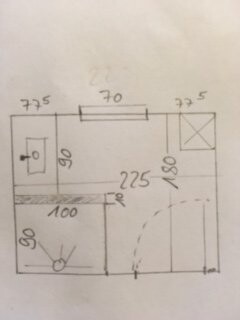
I could extend the bathroom to 190 cm (75 inches) or even 195 cm (77 inches), but I would prefer not to. The extra centimeters would reduce the already limited storage space in the utility room.

Bertram100 schrieb:
If I use a shower wall, it has joints just like a glass block wall, right? I would imagine a tiled stud wall with the usual 3 mm (1/8 inch) grout joints. I know glass blocks like bricks, with 1 cm (3/8 inch) mortar joints. I wouldn’t want those where it’s constantly wet.
https://www.instagram.com/11antgmxde/
https://www.linkedin.com/company/bauen-jetzt/
B
Bertram10026 Aug 2017 21:31Okay, I didn’t know glass blocks have such wide joints. I’m not an expert at plastering and I’m happy to scrub and polish as little as possible. Glass blocks are off the table.
B
Bertram10026 Aug 2017 21:46How would you separate the shower from the washbasin area? Simply with glass?
Similar topics