
ᐅ 10x10 m urban villa (approximately 1,670 sq ft, 6 rooms), fine-tuning welcome
Created on: 20 Aug 2017 14:34
C
Changeling
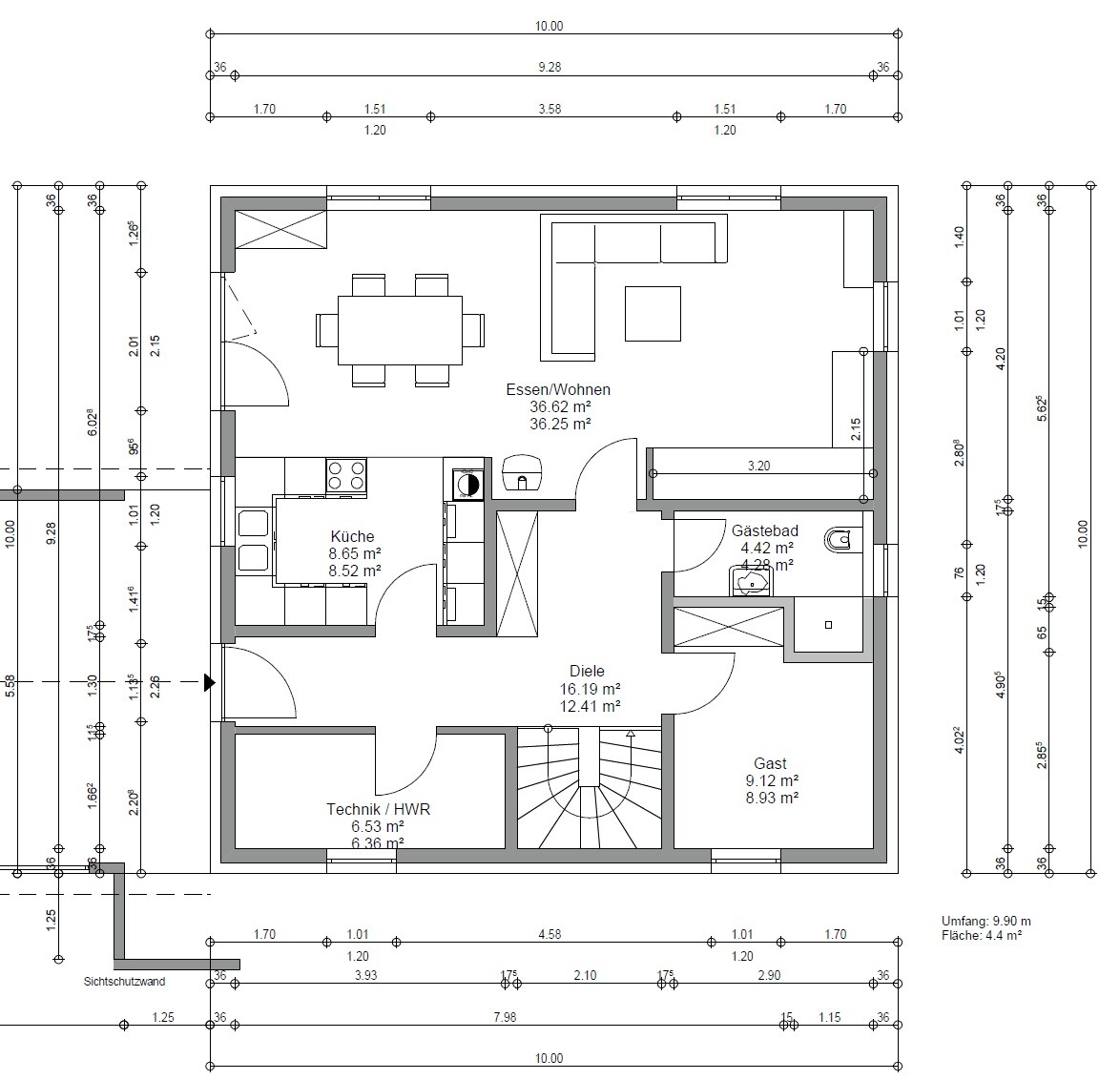
Ground Floor:
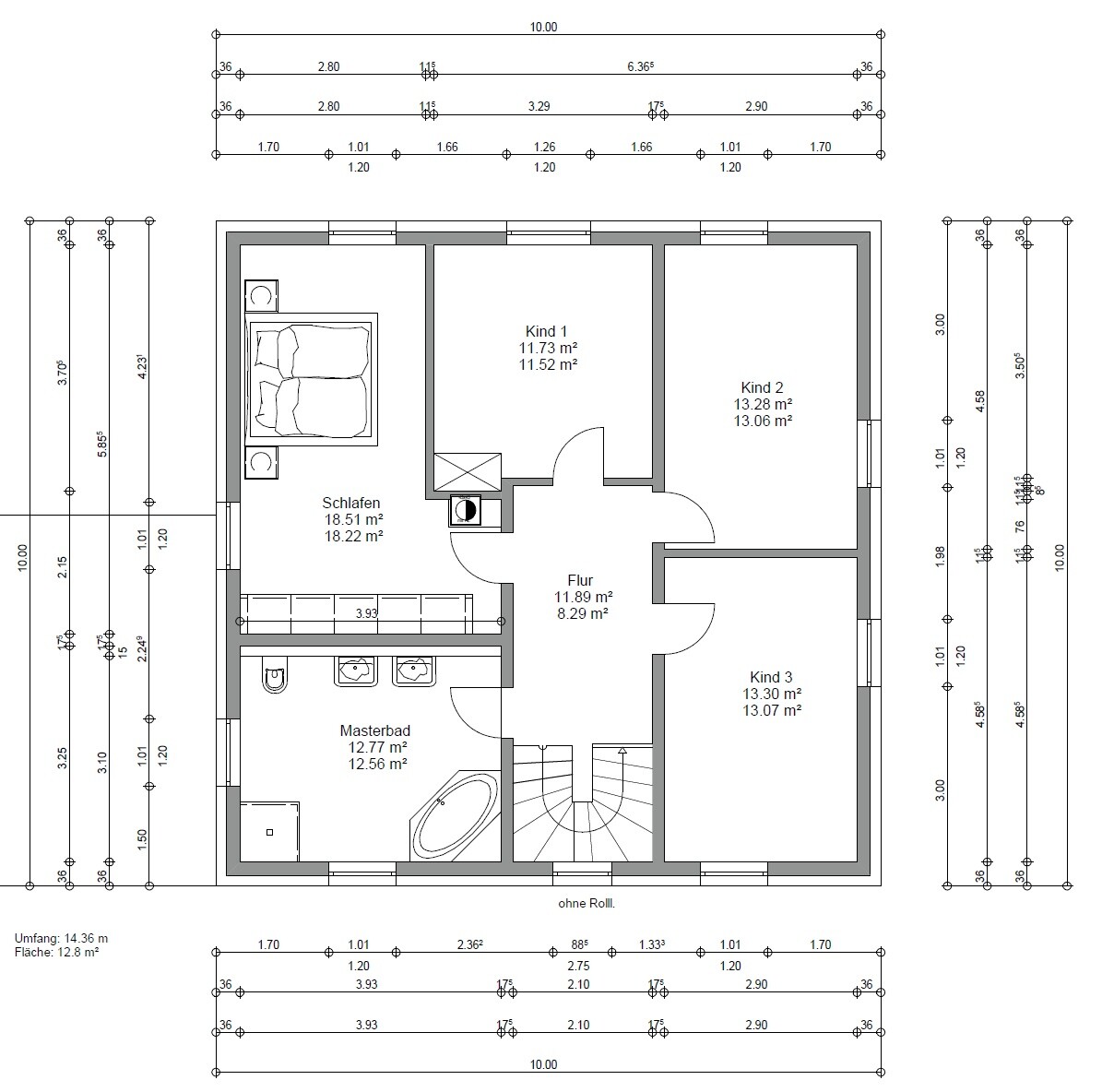
Upper Floor:
Outdoor Areas:

Positioned on the Plot:

Development Plan / Restrictions:
The plot may only be built on the southern half; otherwise, there are no particular restrictions.
Plot size: 900 square meters (approx. 30 x 30 meters / 98 x 98 feet)
Slope: No, only on the west side does the land slope down 3 meters (10 feet) toward the street at the end of the plot. On the north side, there is a retaining wall because the plot is about 2 meters (7 feet) above street level there. Therefore, access by vehicle is only possible from the south.
Clients’ Requirements
Style, Roof Shape, Building Type: A two-story urban villa with a pyramid hip roof (square hipped roof), since the upper floor has no sloped ceilings.
Basement: No basement, as it is too expensive, impractical, and involves additional construction risks.
Number of Occupants, Age: 2 adults (30 years old), 1 child (3 years old), with 1-2 more children planned.
Living Room: A large, open living area was important to us as this is where life happens. A computer corner is planned in the lower right corner since we spend more time at the computer than watching TV. We also work a lot from home and do not want to be confined to a separate room.
Fireplace: Yes.
Guest Room: Also used as storage space, which is especially useful since there is no basement.
Kitchen: The stove and sink are not in their final positions yet – a cooking island is undesirable because of the extractor hood and impractical due to splashing.
Technical / Utility Room: Also serves as a pantry and should be filled with shelves up to the ceiling.
Children’s Rooms: Size should be adequate.
Bedroom: Almost too large, but necessary due to the large wardrobe and double bed.
Bathroom: The design is still at an early stage; for example, the shower is planned as a built-in enclosure without a cabin.
Terrace: Important to us, along with a covered area so we can leave items outside occasionally.
Garage, Carport: As large as possible! It should be a wooden carport, fully closed at the front with sectional doors, and open or closed at the rear as needed. We currently use our garage as a "second living room" and for storing garden tools and similar items. Due to the long car, space will be tight; likely the terrace will be slightly smaller and the carport deeper (or the roof overhang on the left extended). The additions on the far left are planned later as a garden shed or similar and are therefore not a fixed part of the house. The covered connection to the house is a must, so we can enter without getting wet. The lower part facing the street is purely for privacy and is not a solid wall.
Garden: We will build our greenhouse ourselves as we have it now.
House Design:
Planning by: Planner from a construction company; outdoor areas added by us.
What do you particularly like? Why?: The numerous outbuildings and large carport for space, the large living room with open kitchen (also for space). Also, the level access to the terrace (which we don’t have currently).
What do you dislike? Why?: The basement level feels a bit cramped (utility room/kitchen small), while the upper floor is very spacious, but so far this is the best solution.
Cost Estimate by Architect/Planner: $290,000 USD with a maximum of +10% overrun.
Insulation / Construction: Unfortunately, it is built only to the 2016 Energy Saving Ordinance (EnEV) standards; I would have preferred better insulation, but it is likely too expensive. The masonry consists of calcium silicate blocks (20 cm / 8 inches outside + 16 cm / 6 inches EPS (polystyrene) insulation boards).
Heating System: Ground-source heat pump (brine-water) with earth probe; gas connection would be too expensive and we do not want oil heating.
If you had to give up features / expansions
- Could you do without: At most one fewer children’s room; the rest should stay as is...
- Could you not do without: Everything? That would be difficult.
Why did the design turn out the way it is?
We reviewed suggestions from the planner, spent a weekend designing alternatives ourselves, and ultimately found the current compromise. It includes essentially all our wishes.
The design could have been better if the house orientation had been different; otherwise, the kitchen/terrace/dining area wouldn’t all have to be squeezed next to the carport. However, since the street is on the south side and the northern half of the plot cannot be built on, the house must be positioned as it is and the terrace on the south side to catch the sun. We do not want the carport on the east side, as that would place the house further toward the center of the plot and make the terrace fully visible from the neighboring house to the south.
A similar-sized building plot on the east side will be developed with another single-family urban villa.
What is the most important / fundamental question regarding the floor plan in 130 characters?
What do you think? What could be improved or is missing? Any concerns?
Upper Floor:
Outdoor Areas:
Positioned on the Plot:
Development Plan / Restrictions:
The plot may only be built on the southern half; otherwise, there are no particular restrictions.
Plot size: 900 square meters (approx. 30 x 30 meters / 98 x 98 feet)
Slope: No, only on the west side does the land slope down 3 meters (10 feet) toward the street at the end of the plot. On the north side, there is a retaining wall because the plot is about 2 meters (7 feet) above street level there. Therefore, access by vehicle is only possible from the south.
Clients’ Requirements
Style, Roof Shape, Building Type: A two-story urban villa with a pyramid hip roof (square hipped roof), since the upper floor has no sloped ceilings.
Basement: No basement, as it is too expensive, impractical, and involves additional construction risks.
Number of Occupants, Age: 2 adults (30 years old), 1 child (3 years old), with 1-2 more children planned.
Living Room: A large, open living area was important to us as this is where life happens. A computer corner is planned in the lower right corner since we spend more time at the computer than watching TV. We also work a lot from home and do not want to be confined to a separate room.
Fireplace: Yes.
Guest Room: Also used as storage space, which is especially useful since there is no basement.
Kitchen: The stove and sink are not in their final positions yet – a cooking island is undesirable because of the extractor hood and impractical due to splashing.
Technical / Utility Room: Also serves as a pantry and should be filled with shelves up to the ceiling.
Children’s Rooms: Size should be adequate.
Bedroom: Almost too large, but necessary due to the large wardrobe and double bed.
Bathroom: The design is still at an early stage; for example, the shower is planned as a built-in enclosure without a cabin.
Terrace: Important to us, along with a covered area so we can leave items outside occasionally.
Garage, Carport: As large as possible! It should be a wooden carport, fully closed at the front with sectional doors, and open or closed at the rear as needed. We currently use our garage as a "second living room" and for storing garden tools and similar items. Due to the long car, space will be tight; likely the terrace will be slightly smaller and the carport deeper (or the roof overhang on the left extended). The additions on the far left are planned later as a garden shed or similar and are therefore not a fixed part of the house. The covered connection to the house is a must, so we can enter without getting wet. The lower part facing the street is purely for privacy and is not a solid wall.
Garden: We will build our greenhouse ourselves as we have it now.
House Design:
Planning by: Planner from a construction company; outdoor areas added by us.
What do you particularly like? Why?: The numerous outbuildings and large carport for space, the large living room with open kitchen (also for space). Also, the level access to the terrace (which we don’t have currently).
What do you dislike? Why?: The basement level feels a bit cramped (utility room/kitchen small), while the upper floor is very spacious, but so far this is the best solution.
Cost Estimate by Architect/Planner: $290,000 USD with a maximum of +10% overrun.
Insulation / Construction: Unfortunately, it is built only to the 2016 Energy Saving Ordinance (EnEV) standards; I would have preferred better insulation, but it is likely too expensive. The masonry consists of calcium silicate blocks (20 cm / 8 inches outside + 16 cm / 6 inches EPS (polystyrene) insulation boards).
Heating System: Ground-source heat pump (brine-water) with earth probe; gas connection would be too expensive and we do not want oil heating.
If you had to give up features / expansions
- Could you do without: At most one fewer children’s room; the rest should stay as is...
- Could you not do without: Everything? That would be difficult.
Why did the design turn out the way it is?
We reviewed suggestions from the planner, spent a weekend designing alternatives ourselves, and ultimately found the current compromise. It includes essentially all our wishes.
The design could have been better if the house orientation had been different; otherwise, the kitchen/terrace/dining area wouldn’t all have to be squeezed next to the carport. However, since the street is on the south side and the northern half of the plot cannot be built on, the house must be positioned as it is and the terrace on the south side to catch the sun. We do not want the carport on the east side, as that would place the house further toward the center of the plot and make the terrace fully visible from the neighboring house to the south.
A similar-sized building plot on the east side will be developed with another single-family urban villa.
What is the most important / fundamental question regarding the floor plan in 130 characters?
What do you think? What could be improved or is missing? Any concerns?
My sketches are just rough drafts and the measurements are not very precise, but everything should more or less fit, for example the staircase that is indicated... you just have to shift things accordingly.
The second sketch would also be 10 x 10 meters (33 x 33 feet), but with the flat-roof extension.
My comment about the 50,000 for the footing, foundation, and concrete for the less important parts is serious: you build in order not to have to use such "makeshift solutions" outside the living space anymore. This current situation might be ideal for you because you don’t have the option inside, but it might be a disadvantage when selling or if the secondary structure falls through quickly because the money had to be spent elsewhere.
I’d say: just because someone never cooks and always uses a Thermomix doesn’t mean they’ll give up the stove and oven.
Therefore, I would plan enough storage space inside for everyday items... later you can always fill up your carport [emoji12][emoji6]; for a workshop and garden tools, such a space is ideal.
However, compromises have to be made in a new build—if it has to be shorter, then so be it.
At least the money is invested in a house, which holds value better than a carport.
Regards, Yvonne
The second sketch would also be 10 x 10 meters (33 x 33 feet), but with the flat-roof extension.
My comment about the 50,000 for the footing, foundation, and concrete for the less important parts is serious: you build in order not to have to use such "makeshift solutions" outside the living space anymore. This current situation might be ideal for you because you don’t have the option inside, but it might be a disadvantage when selling or if the secondary structure falls through quickly because the money had to be spent elsewhere.
I’d say: just because someone never cooks and always uses a Thermomix doesn’t mean they’ll give up the stove and oven.
Therefore, I would plan enough storage space inside for everyday items... later you can always fill up your carport [emoji12][emoji6]; for a workshop and garden tools, such a space is ideal.
However, compromises have to be made in a new build—if it has to be shorter, then so be it.
At least the money is invested in a house, which holds value better than a carport.
Regards, Yvonne
Regarding the location and the trees.
I thought a carport usually requires about 5 meters (16 feet) clearance at the front, but you’d have to check how far the house itself needs to be set back.
I like front gardens because they create a nice entrance area and provide enough parking space for guests. With a 900 m² (9,688 ft²) plot, you can afford some distance from the street.
The trees won’t block your light if they are deciduous. They lose their leaves in winter, allowing sunlight to pass through, and in summer the sun shines over the tree canopy.
Is that house there even a residential building?
Would you mind sending me the address via private message?
I thought a carport usually requires about 5 meters (16 feet) clearance at the front, but you’d have to check how far the house itself needs to be set back.
I like front gardens because they create a nice entrance area and provide enough parking space for guests. With a 900 m² (9,688 ft²) plot, you can afford some distance from the street.
The trees won’t block your light if they are deciduous. They lose their leaves in winter, allowing sunlight to pass through, and in summer the sun shines over the tree canopy.
Is that house there even a residential building?
Would you mind sending me the address via private message?

ypg schrieb:
Is that building even a residential house? Probably not. I would say it’s more likely a district court or a county administrative office.
https://www.instagram.com/11antgmxde/
https://www.linkedin.com/company/bauen-jetzt/

Changeling schrieb:
Wow, thank you very much for the design and your effort!! May I ask which software you used and if it is freely available? I am currently struggling with an outdated version of MS Visio...The software is called "Sweet Home 3D" and is available online for free. I highly recommend it to anyone without professional experience to identify weak points in their own plans and fix them early on.
C
Changeling22 Aug 2017 06:57ypg schrieb:
Regarding the location and the trees.
I thought a carport usually requires 5 meters (16 feet) clearance at the front, the house placement depends on how far.
[...]
Is that building even a residential house? Why does the carport “require” the 5 meters (16 feet)? Is it for turning space?
Due to the limited building window, the house can probably be set back only about 1 to at most 2 meters (3 to 6 feet), if I remember correctly.
The building was converted into a residential property; it used to be something else. But there are definitely apartments in it now.
We didn’t budget much cash for the exterior landscaping, since we plan to do a lot of it ourselves.
@Invi85 : Thanks! I’ll give that a try.

Changeling schrieb:
Why does the carport “need” the 5 meters?Because most municipalities now require a 5-meter (16 feet) setback for carports and garages.Similar topics