
ᐅ Difference in Soundproofing Between a Solid (Masonry) House and a Prefabricated (Modular) House?
Created on: 18 Aug 2017 16:05
O
OliverK
Hello dear forum,
We are a family of four planning to build a single-family house in Ingolstadt by the end of 2017 or beginning of 2018. We are still at the very beginning and are currently looking for the best building partner for us (if anyone has a recommendation in this region, we would be very happy to hear it!). The first major decision is whether to choose a general contractor or an architect, and whether to build a prefabricated house using timber construction or a solid masonry house built with bricks.
We have done a lot of research and have realized that the most important difference for us between a solid masonry house with bricks and a prefabricated timber house is sound insulation. This is supposed to be better in a masonry house and is an important point for us since we have two small children.
The question is how big this difference really is. Bien-Zenker (our current favorite for prefabricated timber houses) also offers a hybrid wall called “EFFIZIENZHAUS 40 KLIMA-MASSIVWAND,” which combines timber and brick elements. Does this mean there is practically no difference compared to a traditional solid masonry house? Or is this just marketing hype?
Regarding indoor climate, our current understanding is that there is not much difference between brick construction and timber construction since modern new builds are airtight anyway, and it mainly depends on a good ventilation system. Therefore, sound insulation seems to be the last major difference, especially since both types of construction are supposed to be similar in price.
Could you please shed some light on this for us?
Thank you and best regards,
Oliver
We are a family of four planning to build a single-family house in Ingolstadt by the end of 2017 or beginning of 2018. We are still at the very beginning and are currently looking for the best building partner for us (if anyone has a recommendation in this region, we would be very happy to hear it!). The first major decision is whether to choose a general contractor or an architect, and whether to build a prefabricated house using timber construction or a solid masonry house built with bricks.
We have done a lot of research and have realized that the most important difference for us between a solid masonry house with bricks and a prefabricated timber house is sound insulation. This is supposed to be better in a masonry house and is an important point for us since we have two small children.
The question is how big this difference really is. Bien-Zenker (our current favorite for prefabricated timber houses) also offers a hybrid wall called “EFFIZIENZHAUS 40 KLIMA-MASSIVWAND,” which combines timber and brick elements. Does this mean there is practically no difference compared to a traditional solid masonry house? Or is this just marketing hype?
Regarding indoor climate, our current understanding is that there is not much difference between brick construction and timber construction since modern new builds are airtight anyway, and it mainly depends on a good ventilation system. Therefore, sound insulation seems to be the last major difference, especially since both types of construction are supposed to be similar in price.
Could you please shed some light on this for us?
Thank you and best regards,
Oliver

OliverK schrieb:
whether a prefabricated house using timber construction or a solid house built with brickwork. Solid does not necessarily mean brick, as there are more than just a handful of alternatives.
OliverK schrieb:
We have already done a lot of research and have recognized that for us the most important difference between a solid brick house and a prefabricated timber house is sound insulation. This is supposed to be better in the solid house and is an important point for us since we have two small children. What exactly? You can only “recognize” facts, but “is supposed to be better” sounds more like hearsay.
Sound insulation should first be divided into two categories: airborne sound and impact sound. Airborne sound comes from environmental noise, speech, singing, etc., transmitted through the air. Impact sound primarily results from the force of footsteps or vibrations of the floor and is transmitted through building components. Without extraordinary environmental noise (such as a highway in the prevailing wind direction, etc.), airborne sound usually does not require special attention, except if the children are practicing the trumpet. This applies to both construction methods with regard to the walls.
Where the prefabricated house is conceptually at a slight disadvantage is impact sound—simply due to the stronger mechanical connection between ceiling and wall components. If the children are skipping rope or playing tag in their rooms, it will be more disturbing to the living room below in a prefabricated house. However, I would not rule out the prefabricated house for this reason alone. First, the difference is not that dramatic, and second, the kids are not constantly rowdy.
https://www.instagram.com/11antgmxde/
https://www.linkedin.com/company/bauen-jetzt/
T
Traumfaenger20 Aug 2017 12:3811ant schrieb:
That’s why I wouldn’t turn my back on prefabricated houses right away. First, the difference isn’t that significant, and second, the kids aren’t constantly rowdy. I can only agree with @11ant. If enhanced sound insulation is important to you, there are various options such as special floor infills and decoupling of structural components. Try searching for “sound insulation eco” or “sound insulation in prefabricated houses.”
R
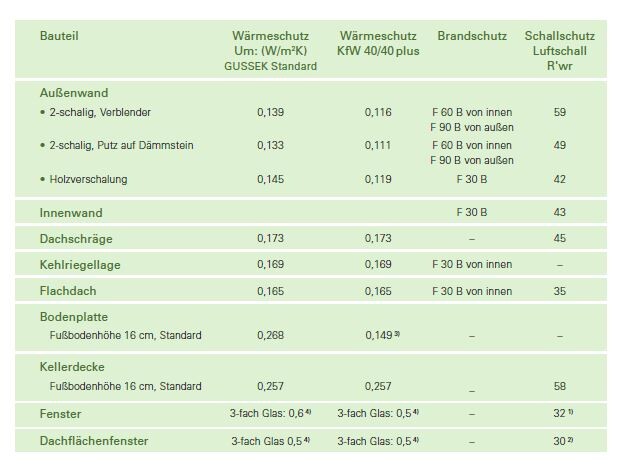
R.Hotzenplotz20 Aug 2017 13:48When you knock on the interior partition walls in a prefabricated house, it doesn’t give the impression of effective sound insulation. The providers generally do not offer quantitative decibel (dB) ratings for soundproofing, except for the company Gussek Haus.
We have now visited the prefab house park in Frechen twice but will most likely stick to a solid (or conventional) build. Somehow, we don’t really feel comfortable with the prefabrication method.
Maybe we are mistaken, but our impression was also that the houses seem to emit some kind of odor and create an unpleasant indoor atmosphere...
We have now visited the prefab house park in Frechen twice but will most likely stick to a solid (or conventional) build. Somehow, we don’t really feel comfortable with the prefabrication method.
Maybe we are mistaken, but our impression was also that the houses seem to emit some kind of odor and create an unpleasant indoor atmosphere...
R
R.Hotzenplotz20 Aug 2017 14:02Attached is an excerpt from the construction description of Gussek Haus, which has just been sent to me.
T
Traumfaenger20 Aug 2017 14:27R.Hotzenplotz schrieb:
Maybe we are wrong, but our impression was also that the houses tend to emit some substances and create an unpleasant indoor climate.....That definitely depends on the manufacturer. Perhaps there were also too many new furniture items containing formaldehyde?
In the prefabricated house sector, there are different manufacturers committed to "healthy living" construction methods using biologically tested materials (timber frame and solid wood construction). On the other hand, why wouldn’t solid constructions also have floors, paints, plastics, etc., that emit substances?
Regarding sound insulation: I have seen similar decibel values in other building performance specifications as well.
Similar topics