
Hello everyone,
we are planning to build a single-family house in a new residential area. According to the development plan, only one full storey is allowed, and since we do not want a bungalow or a gable roof, we will build with a recessed upper floor. The design will be in Bauhaus style with a flat roof/parapet.
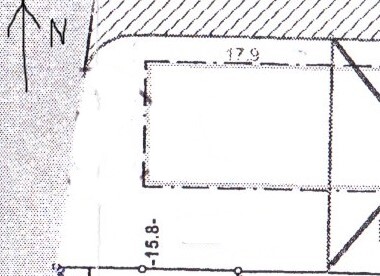
The plot measures 550 m² (5,920 sq ft), with a building envelope 17.9 m (59 ft) wide and 12 m (39 ft) deep.
The house should have a living area of about 140-150 m² (1,510-1,615 sq ft). In addition, a double garage with a rear storage room is planned (6 x 9 m / 20 x 30 ft). The house will be fully clad in brick; a basement is not desired. Currently, there are three of us living there, but at least one more child is planned.
I have an architect who is preparing the plans based on my specifications.
Additional information about the plot/development plan:
- Not a sloped site
- Site coverage ratio 0.4
- Floor area ratio 0.6
- Corner plot
- Building envelope is set 2.5 m (8 ft) behind the street
- Orientation to the south
- No other restrictions; the storage room behind the garage may extend beyond the building envelope
Ground floor wishes:
Rooms: kitchen, dining and living room, utility room, home office, guest toilet, pantry, possibly a separate technical room
- Open floor plan, i.e., kitchen and living area not separated. However, the living space should be visually distinct from the kitchen and dining area
- Spacious entrance area with a wardrobe niche, preferably hidden to the side
- Hallway should not feel like a narrow corridor
- Kitchen with two rows of cabinets and a door to the terrace
- All living room walls should be long enough for a media wall, possibly rearranged later
- Possibly a connection from the utility room to the garage
- Small home office
- Utility room/pantry should be connected to the kitchen to allow laundry to be carried directly to the garden
- Staircase preferably with a landing
- Covered area to the garage, or at least a covered entrance door
Upper floor wishes:
- 2 children’s bedrooms
- Bedroom only large enough for bed and wardrobe with enough space to walk comfortably
- Spacious bathroom with bathtub, shower, one sink, and toilet
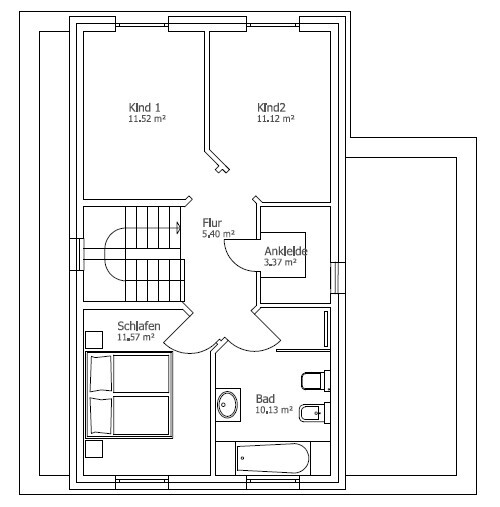
- Since the recessed upper floor is planned with a maximum of 50-60 m² (540-645 sq ft), there will be no large hallway, just the essentials
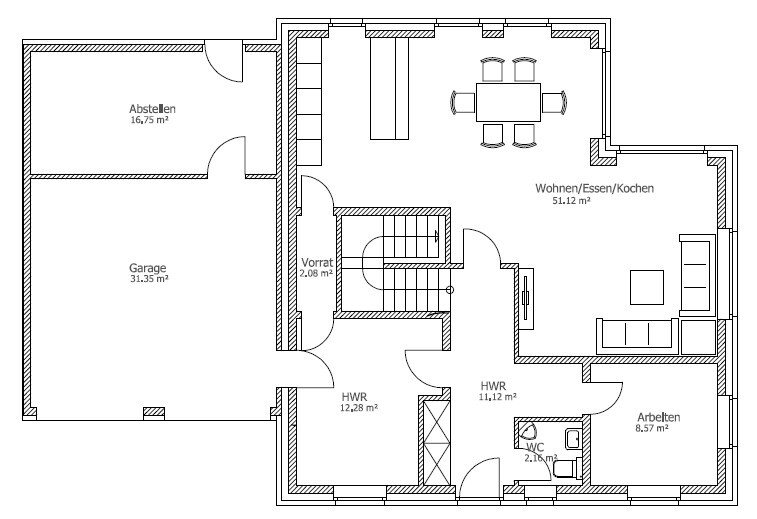
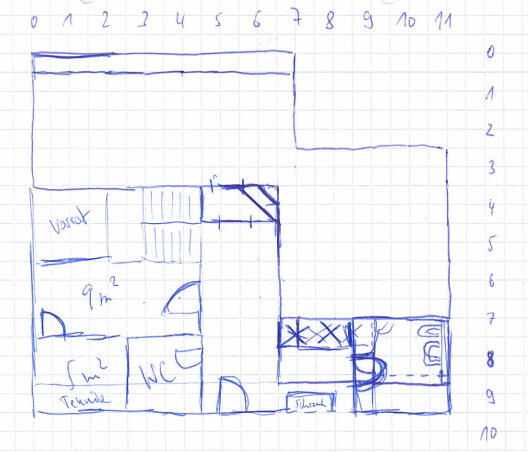
I have already drawn the concept for the dining and living area with terrace, but I am still missing ideas for the entrance area and room layout. The floor plan attached was the first idea, but I have since enlarged the living room (see sketch). Please do not evaluate the doors in the floor plan, as they were inserted provisionally.
As mentioned, the upper part of the ground floor (kitchen, dining room, living room) is almost fixed for me. Only the entrance area with hallway, wardrobe, utility room, home office, and staircase do not yet satisfy me. It would also be nice to highlight the staircase a bit.
I want to plan the upper floor towards the end once I know how many square meters I will have available. The ground floor should have 90-100 m² (970-1,080 sq ft). The shape of the ground floor can still vary depending on the design. Due to the long terrace front in the living room, the house will now be more rectangular. The house/garage should be built directly on the front left property boundary.
Thank you in advance for your help!
we are planning to build a single-family house in a new residential area. According to the development plan, only one full storey is allowed, and since we do not want a bungalow or a gable roof, we will build with a recessed upper floor. The design will be in Bauhaus style with a flat roof/parapet.
The plot measures 550 m² (5,920 sq ft), with a building envelope 17.9 m (59 ft) wide and 12 m (39 ft) deep.
The house should have a living area of about 140-150 m² (1,510-1,615 sq ft). In addition, a double garage with a rear storage room is planned (6 x 9 m / 20 x 30 ft). The house will be fully clad in brick; a basement is not desired. Currently, there are three of us living there, but at least one more child is planned.
I have an architect who is preparing the plans based on my specifications.
Additional information about the plot/development plan:
- Not a sloped site
- Site coverage ratio 0.4
- Floor area ratio 0.6
- Corner plot
- Building envelope is set 2.5 m (8 ft) behind the street
- Orientation to the south
- No other restrictions; the storage room behind the garage may extend beyond the building envelope
Ground floor wishes:
Rooms: kitchen, dining and living room, utility room, home office, guest toilet, pantry, possibly a separate technical room
- Open floor plan, i.e., kitchen and living area not separated. However, the living space should be visually distinct from the kitchen and dining area
- Spacious entrance area with a wardrobe niche, preferably hidden to the side
- Hallway should not feel like a narrow corridor
- Kitchen with two rows of cabinets and a door to the terrace
- All living room walls should be long enough for a media wall, possibly rearranged later
- Possibly a connection from the utility room to the garage
- Small home office
- Utility room/pantry should be connected to the kitchen to allow laundry to be carried directly to the garden
- Staircase preferably with a landing
- Covered area to the garage, or at least a covered entrance door
Upper floor wishes:
- 2 children’s bedrooms
- Bedroom only large enough for bed and wardrobe with enough space to walk comfortably
- Spacious bathroom with bathtub, shower, one sink, and toilet
- Since the recessed upper floor is planned with a maximum of 50-60 m² (540-645 sq ft), there will be no large hallway, just the essentials
I have already drawn the concept for the dining and living area with terrace, but I am still missing ideas for the entrance area and room layout. The floor plan attached was the first idea, but I have since enlarged the living room (see sketch). Please do not evaluate the doors in the floor plan, as they were inserted provisionally.
As mentioned, the upper part of the ground floor (kitchen, dining room, living room) is almost fixed for me. Only the entrance area with hallway, wardrobe, utility room, home office, and staircase do not yet satisfy me. It would also be nice to highlight the staircase a bit.
I want to plan the upper floor towards the end once I know how many square meters I will have available. The ground floor should have 90-100 m² (970-1,080 sq ft). The shape of the ground floor can still vary depending on the design. Due to the long terrace front in the living room, the house will now be more rectangular. The house/garage should be built directly on the front left property boundary.
Thank you in advance for your help!
T
Traumfaenger8 Jul 2017 21:48Regarding your ground floor:
Does the utility room at the bottom left really need to have three doors? Each door takes up wall space, and without a basement, you don’t have much storage area in my opinion. The space under the stairs should definitely be used; this has already been mentioned somewhere here.
The entrance hall seems quite awkwardly shaped and wastes space in my view. Also, for a Bauhaus-style house, I would expect a more open and generous area, meaning no door between the living space and the hall/staircase. The staircase is often a design feature in Bauhaus architecture and can be integrated into the living area, allowing you to omit the door to the stairs and hallway. Overall, I would shorten the hall; you have a narrow corridor going north and another to the right, which just takes up unnecessary space.
The home office looks a bit small for my taste, but if you integrate the staircase into the living/dining area, you might be able to move the wall between the office and living room slightly northward. You gain space by removing the narrow section of the hallway.
I would completely redesign the upper floor, as it looks quite complicated and does not reflect the straightforwardness typical of the Bauhaus style. But I assume the upper floor will be finalized once the ground floor is more clearly planned?
Does the utility room at the bottom left really need to have three doors? Each door takes up wall space, and without a basement, you don’t have much storage area in my opinion. The space under the stairs should definitely be used; this has already been mentioned somewhere here.
The entrance hall seems quite awkwardly shaped and wastes space in my view. Also, for a Bauhaus-style house, I would expect a more open and generous area, meaning no door between the living space and the hall/staircase. The staircase is often a design feature in Bauhaus architecture and can be integrated into the living area, allowing you to omit the door to the stairs and hallway. Overall, I would shorten the hall; you have a narrow corridor going north and another to the right, which just takes up unnecessary space.
The home office looks a bit small for my taste, but if you integrate the staircase into the living/dining area, you might be able to move the wall between the office and living room slightly northward. You gain space by removing the narrow section of the hallway.
I would completely redesign the upper floor, as it looks quite complicated and does not reflect the straightforwardness typical of the Bauhaus style. But I assume the upper floor will be finalized once the ground floor is more clearly planned?

Alex85 schrieb:
Admittedly, I don’t know any architect in the world by name, nor what they stood for. That somewhat excuses your following statement
Alex85 schrieb:
Maybe the gentleman was so well-known because he dared to do what nobody else did. and raises the very interesting question of who actually shaped your sense of what "Bauhaus" really is:
Alex85 schrieb:
But the buildings you mentioned only reinforce my impression that brickwork and Bauhaus don’t really go together. Now hold on tight, here come two highlights:
Rocket stage number one)
Ludwig Mies van der Rohe was not a rebel who did something different from what everyone else apparently thinks "Bauhaus" should be. He was Bauhaus, meaning he taught there and even led it from 1930 onwards. He also continued to influence it in exile.
Rocket stage number two)
The Bauhaus members were not all architects. Just Google Kandinsky, Feininger, Moholy-Nagy, Itten, Schlemmer, and so on. Painters, stage designers, typographers, textile designers, furniture designers. And they even had women, who could do it even better.
The only thing that stuck with the RTL consumer is "flat roof, matte white." Fack ju, Göhte
.
Traumfaenger schrieb:
The staircase is usually a highlight in Bauhaus, In the previous sense: also at Hornbach
.
Traumfaenger schrieb:
A top floor set back from the outer walls of the building (penthouse or setback floor) is only considered a full storey if it reaches this height over more than two-thirds of the floor area below. That’s also how I understand it: the key characteristic is that it is "significantly smaller than the floor below," and setbacks don’t have to be on all sides.
https://www.instagram.com/11antgmxde/
https://www.linkedin.com/company/bauen-jetzt/
T
Traumfaenger8 Jul 2017 22:1811ant schrieb:
In the previous sense: also available at Hornbach To add to the list, Le Corbusier and of course especially Walter Gropius should be mentioned here, all of whom also used clinker brick to some extent.
@Alex85
You can also clearly distinguish a "genuine" Bauhaus building from a "shoebox with a flat roof" if you take some time to explore the ideas behind this architectural style. And if you haven’t done so yet—which is definitely worthwhile and interesting—you will still be able to sense a different effect:
When you enter a genuine Bauhaus building, it looks incredibly minimalist and simple, but somehow everything is perfectly harmonious and coherent. You might not be able to explain why at first, but that impression should definitely become clear to you.
A square building with a flat roof, however, is far from this—even if it has anthracite-colored windows.
mihaco schrieb:
Regarding the topic of a full storey, Traumfaenger has already covered everything; the same rules apply to us as well. The upper floor then has 2/3 of the area of the ground floorOkay, so the upper floor is nicely set back compared to the ground floor. I understand.
T
toxicmolotof9 Jul 2017 00:3311ant schrieb:
That’s also how I understand it: the key characteristic is that the top floor is significantly smaller than the floor below, and setbacks do not have to be on all sides.But in North Rhine-Westphalia (NRW) they do. It’s different in other federal states, as far as I know.
“A top floor (setback storey) recessed relative to the building’s exterior walls”
In a detached house, all exterior walls are indeed exterior walls. I have already discussed this with the building authority during our house construction. The only exception was the stairwell, where having no setback was acceptable. This is also stated in the state building regulations.
Hello everyone,
I met with our architect again. We are now planning a slightly more open design for the living area (keyword: staircase). We have also revised the entrance area. The staircase is moving more towards the center, which means the upper floor will be completely redesigned as well.
As soon as I receive the new plans, I will upload them.
Best regards, mihaco
I met with our architect again. We are now planning a slightly more open design for the living area (keyword: staircase). We have also revised the entrance area. The staircase is moving more towards the center, which means the upper floor will be completely redesigned as well.
As soon as I receive the new plans, I will upload them.
Best regards, mihaco
Similar topics