
Hello everyone,
we are planning to build a single-family house in a new residential area. According to the development plan, only one full storey is allowed, and since we do not want a bungalow or a gable roof, we will build with a recessed upper floor. The design will be in Bauhaus style with a flat roof/parapet.
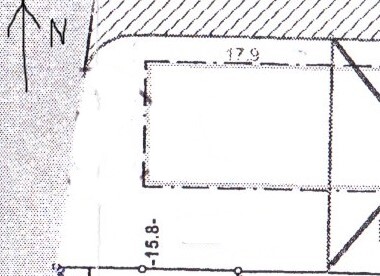
The plot measures 550 m² (5,920 sq ft), with a building envelope 17.9 m (59 ft) wide and 12 m (39 ft) deep.
The house should have a living area of about 140-150 m² (1,510-1,615 sq ft). In addition, a double garage with a rear storage room is planned (6 x 9 m / 20 x 30 ft). The house will be fully clad in brick; a basement is not desired. Currently, there are three of us living there, but at least one more child is planned.
I have an architect who is preparing the plans based on my specifications.
Additional information about the plot/development plan:
- Not a sloped site
- Site coverage ratio 0.4
- Floor area ratio 0.6
- Corner plot
- Building envelope is set 2.5 m (8 ft) behind the street
- Orientation to the south
- No other restrictions; the storage room behind the garage may extend beyond the building envelope
Ground floor wishes:
Rooms: kitchen, dining and living room, utility room, home office, guest toilet, pantry, possibly a separate technical room
- Open floor plan, i.e., kitchen and living area not separated. However, the living space should be visually distinct from the kitchen and dining area
- Spacious entrance area with a wardrobe niche, preferably hidden to the side
- Hallway should not feel like a narrow corridor
- Kitchen with two rows of cabinets and a door to the terrace
- All living room walls should be long enough for a media wall, possibly rearranged later
- Possibly a connection from the utility room to the garage
- Small home office
- Utility room/pantry should be connected to the kitchen to allow laundry to be carried directly to the garden
- Staircase preferably with a landing
- Covered area to the garage, or at least a covered entrance door
Upper floor wishes:
- 2 children’s bedrooms
- Bedroom only large enough for bed and wardrobe with enough space to walk comfortably
- Spacious bathroom with bathtub, shower, one sink, and toilet
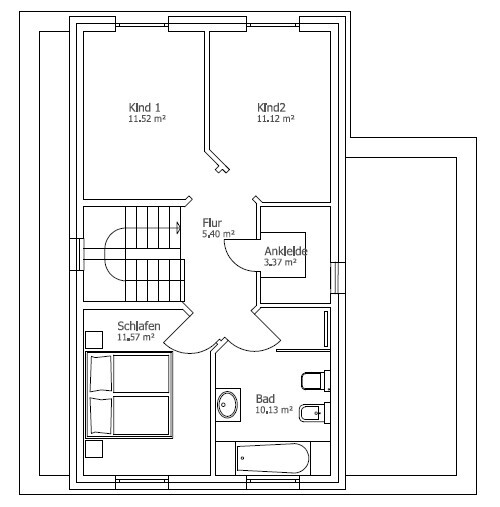
- Since the recessed upper floor is planned with a maximum of 50-60 m² (540-645 sq ft), there will be no large hallway, just the essentials
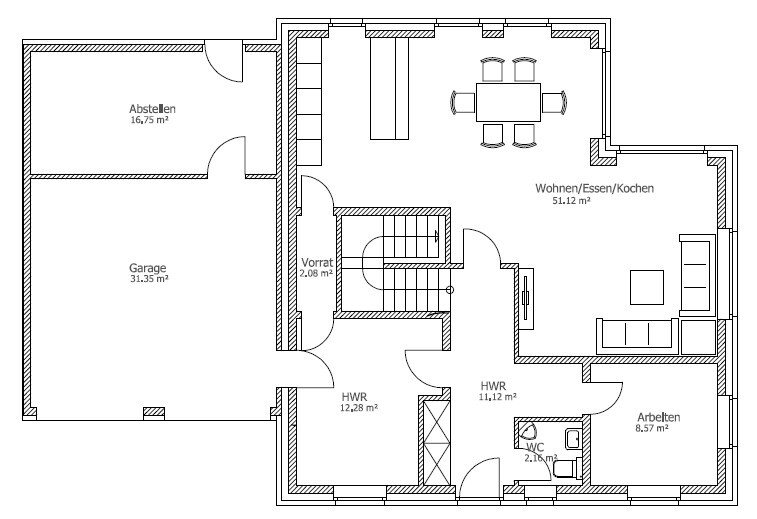
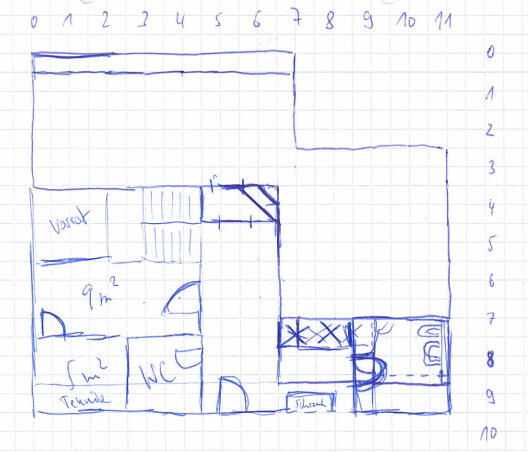
I have already drawn the concept for the dining and living area with terrace, but I am still missing ideas for the entrance area and room layout. The floor plan attached was the first idea, but I have since enlarged the living room (see sketch). Please do not evaluate the doors in the floor plan, as they were inserted provisionally.
As mentioned, the upper part of the ground floor (kitchen, dining room, living room) is almost fixed for me. Only the entrance area with hallway, wardrobe, utility room, home office, and staircase do not yet satisfy me. It would also be nice to highlight the staircase a bit.
I want to plan the upper floor towards the end once I know how many square meters I will have available. The ground floor should have 90-100 m² (970-1,080 sq ft). The shape of the ground floor can still vary depending on the design. Due to the long terrace front in the living room, the house will now be more rectangular. The house/garage should be built directly on the front left property boundary.
Thank you in advance for your help!
we are planning to build a single-family house in a new residential area. According to the development plan, only one full storey is allowed, and since we do not want a bungalow or a gable roof, we will build with a recessed upper floor. The design will be in Bauhaus style with a flat roof/parapet.
The plot measures 550 m² (5,920 sq ft), with a building envelope 17.9 m (59 ft) wide and 12 m (39 ft) deep.
The house should have a living area of about 140-150 m² (1,510-1,615 sq ft). In addition, a double garage with a rear storage room is planned (6 x 9 m / 20 x 30 ft). The house will be fully clad in brick; a basement is not desired. Currently, there are three of us living there, but at least one more child is planned.
I have an architect who is preparing the plans based on my specifications.
Additional information about the plot/development plan:
- Not a sloped site
- Site coverage ratio 0.4
- Floor area ratio 0.6
- Corner plot
- Building envelope is set 2.5 m (8 ft) behind the street
- Orientation to the south
- No other restrictions; the storage room behind the garage may extend beyond the building envelope
Ground floor wishes:
Rooms: kitchen, dining and living room, utility room, home office, guest toilet, pantry, possibly a separate technical room
- Open floor plan, i.e., kitchen and living area not separated. However, the living space should be visually distinct from the kitchen and dining area
- Spacious entrance area with a wardrobe niche, preferably hidden to the side
- Hallway should not feel like a narrow corridor
- Kitchen with two rows of cabinets and a door to the terrace
- All living room walls should be long enough for a media wall, possibly rearranged later
- Possibly a connection from the utility room to the garage
- Small home office
- Utility room/pantry should be connected to the kitchen to allow laundry to be carried directly to the garden
- Staircase preferably with a landing
- Covered area to the garage, or at least a covered entrance door
Upper floor wishes:
- 2 children’s bedrooms
- Bedroom only large enough for bed and wardrobe with enough space to walk comfortably
- Spacious bathroom with bathtub, shower, one sink, and toilet
- Since the recessed upper floor is planned with a maximum of 50-60 m² (540-645 sq ft), there will be no large hallway, just the essentials
I have already drawn the concept for the dining and living area with terrace, but I am still missing ideas for the entrance area and room layout. The floor plan attached was the first idea, but I have since enlarged the living room (see sketch). Please do not evaluate the doors in the floor plan, as they were inserted provisionally.
As mentioned, the upper part of the ground floor (kitchen, dining room, living room) is almost fixed for me. Only the entrance area with hallway, wardrobe, utility room, home office, and staircase do not yet satisfy me. It would also be nice to highlight the staircase a bit.
I want to plan the upper floor towards the end once I know how many square meters I will have available. The ground floor should have 90-100 m² (970-1,080 sq ft). The shape of the ground floor can still vary depending on the design. Due to the long terrace front in the living room, the house will now be more rectangular. The house/garage should be built directly on the front left property boundary.
Thank you in advance for your help!
Admittedly, I don’t know any architect by name or what they stood for. However, the examples you mentioned only reinforce my belief that brick cladding and Bauhaus style don’t really go well together. Perhaps the gentleman was well-known because he dared to do what no one else did.
T
Traumfaenger8 Jul 2017 20:54But other Bauhaus architects also used clinker bricks back then. Of course, this is always a matter of personal taste. However, I’ve noticed that Bauhaus-style houses, which for over 10 years were typically built with white exteriors and windows in anthracite gray, are now increasingly being finished with clinker brick. Usually not red anymore, but in lighter shades and with a "geschlemmt" technique. Just search for "modern Bauhaus clinker geschlemmt." It actually looks quite good when you see these buildings in person, but of course, that’s just my personal preference.
T
Traumfaenger8 Jul 2017 21:00Regarding the topic of setback upper floors (also known as recessed top floors) in North Rhine-Westphalia (NRW), the state building code (§2 (5)) defines full storeys as floors whose ceiling top edge is on average more than 1.60 m (5 ft 3 in) above the ground surface and which have a height of at least 2.30 m (7 ft 7 in). A top floor that is set back relative to the exterior walls of the building (setback upper floor) is only considered a full storey if it meets this height over more than two-thirds of the floor area of the storey below it. A floor with sloped roof surfaces is considered a full storey if it meets this height over more than three-quarters of its floor area.
The new state building code planned for 2018 was intended to simplify and relax these rules. Although it had already been approved, it is now likely to be revoked by the new state government.
In addition, individual building authorities may naturally have their own interpretations regarding setback upper floors…
The new state building code planned for 2018 was intended to simplify and relax these rules. Although it had already been approved, it is now likely to be revoked by the new state government.
In addition, individual building authorities may naturally have their own interpretations regarding setback upper floors…
mihaco schrieb:
@ypg The pantry in the floor plan is too narrow to walk through with laundry, so I have already widened it in my sketch.In your sketch with the enlarged pantry, the staircase shifts further to the right side of the ground floor, moving towards the center... As a result, you won't be able to plan a suitable room in that area on the upper floor. This won’t work.
Even if the upper floor is not very important to you right now, your sketch example clearly shows that you always have to plan the upper floor as well. It’s no use designing a fancy ground floor and then struggling with the space on the upper floor.
Since I still don’t know your local rules regarding building regulations (VGs), it’s not possible to give advice or start planning yet.
Regards, Yvonne
Thanks again to everyone. I didn’t expect my topic to spark a fundamental discussion about Bauhaus style and brickwork, nor the discussion about the recessed upper floor.
I’m not really looking to debate those here, as tastes are obviously subjective. For those interested, the building will use a nearly mortarless brick in a standard size. A flat roof is permitted, and according to the architect, the setback is sufficient.
The position of the upper floor is not finalized yet; it will be determined only after we plan the ground floor. The staircase should ideally be in the left-central area. Where exactly the upper floor setback will be, remains to be seen.
My main concern was the ground floor layout and how to best arrange the hallway, home office, technical room, and utility room without wasting much space, as well as the points I mentioned at the beginning. The new sketch is coming, but unfortunately, I haven’t made much progress with the planning yet.
Best regards,
mihaco
I’m not really looking to debate those here, as tastes are obviously subjective. For those interested, the building will use a nearly mortarless brick in a standard size. A flat roof is permitted, and according to the architect, the setback is sufficient.
The position of the upper floor is not finalized yet; it will be determined only after we plan the ground floor. The staircase should ideally be in the left-central area. Where exactly the upper floor setback will be, remains to be seen.
My main concern was the ground floor layout and how to best arrange the hallway, home office, technical room, and utility room without wasting much space, as well as the points I mentioned at the beginning. The new sketch is coming, but unfortunately, I haven’t made much progress with the planning yet.
Best regards,
mihaco
On the topic of full stories, mihaco has already covered everything; the same rules apply to us as well. The upper floor then has two-thirds of the area of the ground floor.
Traumfaenger schrieb:
On the subject of setback floors, the building code of North Rhine-Westphalia states in §2 (5): "Full stories are floors whose ceiling top edge extends on average more than 1.60 m (5.25 ft) above the ground surface and have a height of at least 2.30 m (7.55 ft). A top floor that is set back from the exterior walls of the building (setback floor) only counts as a full story if it reaches this height across more than two-thirds of the floor area of the story below. A story with sloped roof surfaces is considered a full story if it reaches this height over more than three-quarters of its floor area."
This was intended to be simplified and relaxed with the new building code of 2018, which had already been approved but is now likely to be repealed by the new state government.
In addition, individual building authorities may naturally have their own opinions regarding setback floors…
Similar topics