
Thank you for all suggestions!
------------------
Development Plan/Restrictions
Building gap in an older residential area, no detailed development plan, but subject to §34
Plot is surrounded by roads on three sides
Plot size = 610 m² (6566 sq ft)
Slope = approx. 0.50 m (1.6 ft) south-facing slope
Site coverage ratio = not explicitly defined
Floor area ratio = not explicitly defined
Building envelope, building line, and limits = not explicitly defined (state building code requires 2.50 m (8.2 ft) distance)
Edge development = a neighbor’s shed at the northeast boundary
Number of parking spaces = 4 (state building code requires: 2 per dwelling unit)
Number of floors = 1 ½ (presumably required due to §34)
Roof type = gable roof (presumably required due to §34)
Architectural style = similar to surrounding buildings (§34)
Orientation = unclear, existing buildings are varied
Maximum height/limits = unclear, existing buildings mostly around 7.50 m (24.6 ft) ridge height
Other requirements = none known
Immediate surroundings have no trees
Owners’ Requirements
Architectural style, roof type, building type = no preference, just what’s allowed
Basement, floors = no basement (budget reasons), desired number of floors is 2, but only 1 ½ permitted
Number of residents, age = initially Dwelling Unit 1 (ground floor): 2 adults (tenants or holiday renters) + Dwelling Unit 2 (attic): 2 adults, 1 child (2 years old)
In about 10 years, after conversion to a single-family house: 2 adults
Space requirement on ground and upper floor = small, current space needs not permanent, DU2 (attic) needs about 10 m² (108 sq ft) of storage space in basement/attic
Office: family use or home office? = no dedicated office but a utility/cleaning/common room
Overnight guests per year = none
Open or closed architecture = open
Conservative or modern construction style = no preference, just what is permitted
Open kitchen, cooking island = open kitchen yes, cooking island only if space allows (therefore no)
Number of dining seats = initially DU1 (ground floor): 4 + DU2 (attic): 4
Fireplace = no
Music/sound system wall = no
Balcony, roof terrace = no (budget reasons)
Garage, carport = no (budget reasons)
Utility garden, greenhouse = no
Additional wishes/special requirements/daily routine, also reasons why certain things should or should not be included
= Single-family house divided into two small rental units for a few years, one rented to relatives,
- to avoid a separate utility room on the ground floor, building services/heating/ventilation systems will be distributed between the common room and the attic,
- the seemingly “normal” dormer on the south side is omitted mainly due to budget,
- the roof pitch is steep (45°) to maximize usable space,
- the house orientation should allow wide unobstructed views and solar panels should be feasible,
- the site is very sunny, so excessive south-facing windows are not desired
House Design
Planning source = do-it-yourself
What do you particularly like? Why? = House can be easily converted into a single-family home
What do you dislike? Why? = Ground floor space utilization is not optimal, no practical option to add a balcony later on the attic floor
Cost estimate according to architect/planner = unknown (“can be done very nicely for 400000”)
Personal budget limit for house including equipment = 200000 (two hundred thousand), excluding kitchen and furniture
Preferred heating system = district heating (required by the municipality, but acceptable)
If you have to give up something, which details/extensions
- can you give up = everything “common today but not 20 years ago,” kitchens, glass panels in front doors, separate dressing rooms, roller shutters on north/west/east, roof windows
- reluctant to give up = underfloor heating (because it is hard to retrofit)
- cannot give up = utility/cleaning/common room, some storage space somewhere, division into two rentable units
Why did the design turn out as it is now? = A mix of many examples from various magazines/internet, simplified/reduced to fit the very limited budget
-------
By the way, the light blue shaded rectangles on the site plan are intended to represent parking spaces for cars
kaho674 schrieb:
No, you could go on forever listing the no-gos. Some prefab house suppliers also offer homes designed for two families. These are marketed under names like multigenerational houses or family homes, etc. You can definitely find something better with those, just to get a sense of the concept. Yes, the multigenerational houses from prefab providers would fit perfectly. Or even two small semi-detached houses. However, they generally have much more living space overall and are clearly above my budget based on the catalogue price.
bindig schrieb:
Yes, a standard prefabricated house would actually be the remaining option if a shared prefabricated house and a shared custom-designed house are not feasible within this budget.Why do you insist on sharing?
That’s not clear to me.
It doesn’t make the whole thing cheaper.
200,000 with or without additional construction costs.
We built our large bungalow for 260k. Of course, without additional building costs.
Are you sure it really needs to be that tall? Building authorities also issue exceptions. You could ask if they generally see any chance for that.
However, 200k is quite a tight budget. You will really need to keep the size small.
Are you sure it really needs to be that tall? Building authorities also issue exceptions. You could ask if they generally see any chance for that.
However, 200k is quite a tight budget. You will really need to keep the size small.
ypg schrieb:
I have a problem understanding the reasons—because maybe you don’t explain why it has to be so complicated?!It becomes complicated due to the combination of constraints:- Section 34 (local building laws) with existing buildings that are all one and a half stories high and much more expensive than my budget
- my budget of only 200,000 (only for the house, excluding kitchen and furniture)
- we want to start building now even though we won’t “need” the house for another 10 years, because in 10 years it might be completely unaffordable. I am currently saving nearly 2,000 Euros per month and with that I am maybe just managing to keep up with the ongoing price inflation in the real estate market
- the plan is to rent to relatives, and if it gets too tight with school children or teenagers, the timing also fits for us moving in ourselves
- renting the entire house would be quite expensive for my cousin despite a family discount; I would like the subsidy from an additional small holiday/secondary apartment, so that is why the split
- for the maintenance and technical equipment of the holiday/secondary apartment and part of the home technology/heating/ventilation, the ground floor utility room is intended, plus some space in the attic
- because part of the technical equipment is planned for the attic (and storage space too), the staircase must be in the middle due to the low building height of the house
- because the staircase has to be in the middle, it ends up being sideways on the ground floor
These points are meant to help with understanding; I do not want to shut down alternative ideas, quite the opposite.
I also have a problem understanding—assuming it is a good and reasonably sensible plan—why the parking spaces are distributed so oddly on the property.A parking space right next to the house would be nice if a garage or carport are not in the budget. The other three spaces are on the busier street running along the bottom of the plan. I could probably part with that part of the garden on the south side the most. Where would the parking spaces be better located?Why is the house being built at all? Are you looking for an investment? Do you want a holiday apartment and be landlords, or do you want a home for yourselves (whoever that is)? You build the house according to that. First, we want to rent it to my cousin, and as soon as it gets too cramped for him (or a little later), my partner and I want to move in ourselves. Currently, both of us are frequently away for work. We want to start building because prices keep rising and we don’t want to wait any longer.An example from the web, quickly found at Scanhaus Marlow, where I can tell at a glance that it is possible to separate the ground floor and upper floor into two units with minimal effort, if you accept compromises in living quality and size.
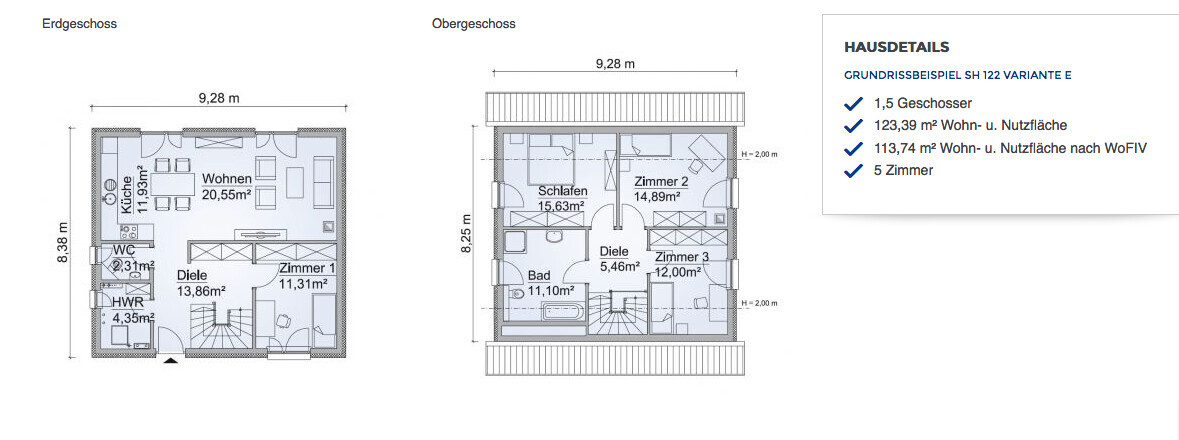
But first there is the question: what do you basically want?Thanks for the example. It can actually be separated. I’ve redrawn it so that each floor is one living unit.
It is very good here that the ground floor child/office room is large enough to fit a double bed if you are willing to compromise. In this example, the ground floor child’s room unfortunately has no direct access to the rest of the ground floor apartment but only through the “public” staircase. However, if you move its door to the wall facing the living room as I drew, it fits. A prefabricated house provider once rejected that because the walls running longitudinally under the ridge are load-bearing walls.
A shower needs to be accommodated on the ground floor (if you want/need to keep the utility room because otherwise there is no space for the home technology). The kitchen could be reduced in size to create room for a small bathroom with a window; I have also marked that.
The question remains where to locate the second set of technical equipment. The utility room is sufficient for one set of heating and ventilation systems. If you don’t use special duplicated devices, the second set of heating/hot water/ventilation must go somewhere else. The attic is difficult to impossible because in prefab houses it is usually too low and because the fold-down ladder is too narrow and steep to get the equipment up there. With enough money, a solution could certainly be found.
If you want to include a kitchen combined with living and dining space in the upper floor and halve the bathroom but keep the bathroom window, the upper floor only has one window serving kitchen + dining + living areas. With money, adding a roof window is of course possible.
This is the crux of the matter. I once got a prefab house provider to calculate what it would cost to split a one and a half story house into two levels, and the price went way beyond my budget. (It is cheaper with bungalows.)
I do not want to criticize the proposal in principle.
It just seems very expensive in this specific case to separate the two floors into individual units. Like many other prefab houses, this house seems optimized for exactly one purpose. My partner and I have looked at several model houses and many floor plans. So far, every attempt to split a small one and a half story prefab house has run into something that made it very expensive for the respective provider, no matter how flexible we were. But one should never give up hope; this example already looks much more promising than most other designs I have tried to split. Thanks again.
haydee schrieb:
Why do you really want to split it?
That’s not clear to me.
It doesn’t make the overall cost cheaper.
200,000 with or without additional building costs I explained the reason for splitting in more detail earlier. In short: my partner and I won’t be able to move into the house for about ten years because we are both frequently traveling for work right now. However, we don’t want to wait to start building due to rising costs. My cousin and his small family would like to rent somewhere, and I would prefer to have him as a tenant. The rent for the entire house would be too expensive, so we’re planning to include a holiday or granny flat.
The 200,000 is without land and without additional building costs. Just for the house.
Evolith schrieb:
We built our large bungalow for 260k, of course excluding additional construction-related costs.
Are you sure it really has to be that tall? Building authorities also issue special permits in some cases. Maybe you could ask if there is generally a chance for that.
200k is already a tight budget. You’ll have to keep the size small.
I have already spoken several times with the local building authority and the municipality. They kindly did not rule anything out. However, both made it clear that they actually expect something in this building gap similar to what the neighbors all have. And what the neighbors have, according to several independent rough estimates based on a site visit or photos, will cost at least twice my budget. More likely significantly more. Even the locals I asked do not believe it is possible below 400,000.
At least we have to somehow fit into the picture in terms of the external dimensions.
Similar topics