
ᐅ Waterproof concrete + flush-mounted electrical boxes in the basement – how can this be addressed?
Created on: 13 Jun 2017 02:22
D
DReffects
Good evening,
We have commissioned a single-family house with a basement from a developer. Three of the four basement rooms will be used as living space or offices.
The basement exterior walls are made of 24cm (9.5 inches) thick waterproof concrete. From the beginning, it was clear to me that in a new build, electrical and network outlets should naturally be installed flush-mounted. Surface-mounted trunking is absolutely unacceptable to me, especially in living areas.
We have discussed this several times with the developer and were always told, “No problem, there have never been any issues with this.” Now, however, the electrician has raised concerns, and the developer is now siding with him.
So, my question to the community: What is the actual risk here? I thought that either the concrete is waterproof or it isn’t.
Are there any guidelines on how deep a flush-mounted box should be installed or other practical experience you can share?
Surface-mounted installation is, unfortunately, a huge no-go for me — which is exactly why we chose a new build, so that my office rooms don’t have to show something like that.
There are also decentralized ventilation units in the basement rooms that require electrical connections embedded in the concrete.
What options are available for this?
Thank you very much!
DR
We have commissioned a single-family house with a basement from a developer. Three of the four basement rooms will be used as living space or offices.
The basement exterior walls are made of 24cm (9.5 inches) thick waterproof concrete. From the beginning, it was clear to me that in a new build, electrical and network outlets should naturally be installed flush-mounted. Surface-mounted trunking is absolutely unacceptable to me, especially in living areas.
We have discussed this several times with the developer and were always told, “No problem, there have never been any issues with this.” Now, however, the electrician has raised concerns, and the developer is now siding with him.
So, my question to the community: What is the actual risk here? I thought that either the concrete is waterproof or it isn’t.
Are there any guidelines on how deep a flush-mounted box should be installed or other practical experience you can share?
Surface-mounted installation is, unfortunately, a huge no-go for me — which is exactly why we chose a new build, so that my office rooms don’t have to show something like that.
There are also decentralized ventilation units in the basement rooms that require electrical connections embedded in the concrete.
What options are available for this?
Thank you very much!
DR

77.willo schrieb:
Why can’t ducts be connected to the fans? Because the fan’s power connection is about 10cm (5 inches) inside the wall and has to be connected from the side.
C
Caspar202018 Jun 2017 20:41DReffects schrieb:
Because the power connection for the fan is located about 10cm (4 inches) inside the wall and must be connected from the side.Well then; until now we have only dealt with shallow flush-mounted boxes. Now we're already halfway into the wall.
Until now, fans were not really on my radar before the conversation with the Building Owners’ Protection Association, as I had assumed that the fan units, including the power supply, had been embedded in the structure… but that is not the case. Only the fan housings were embedded. During a site inspection today, the following became apparent:
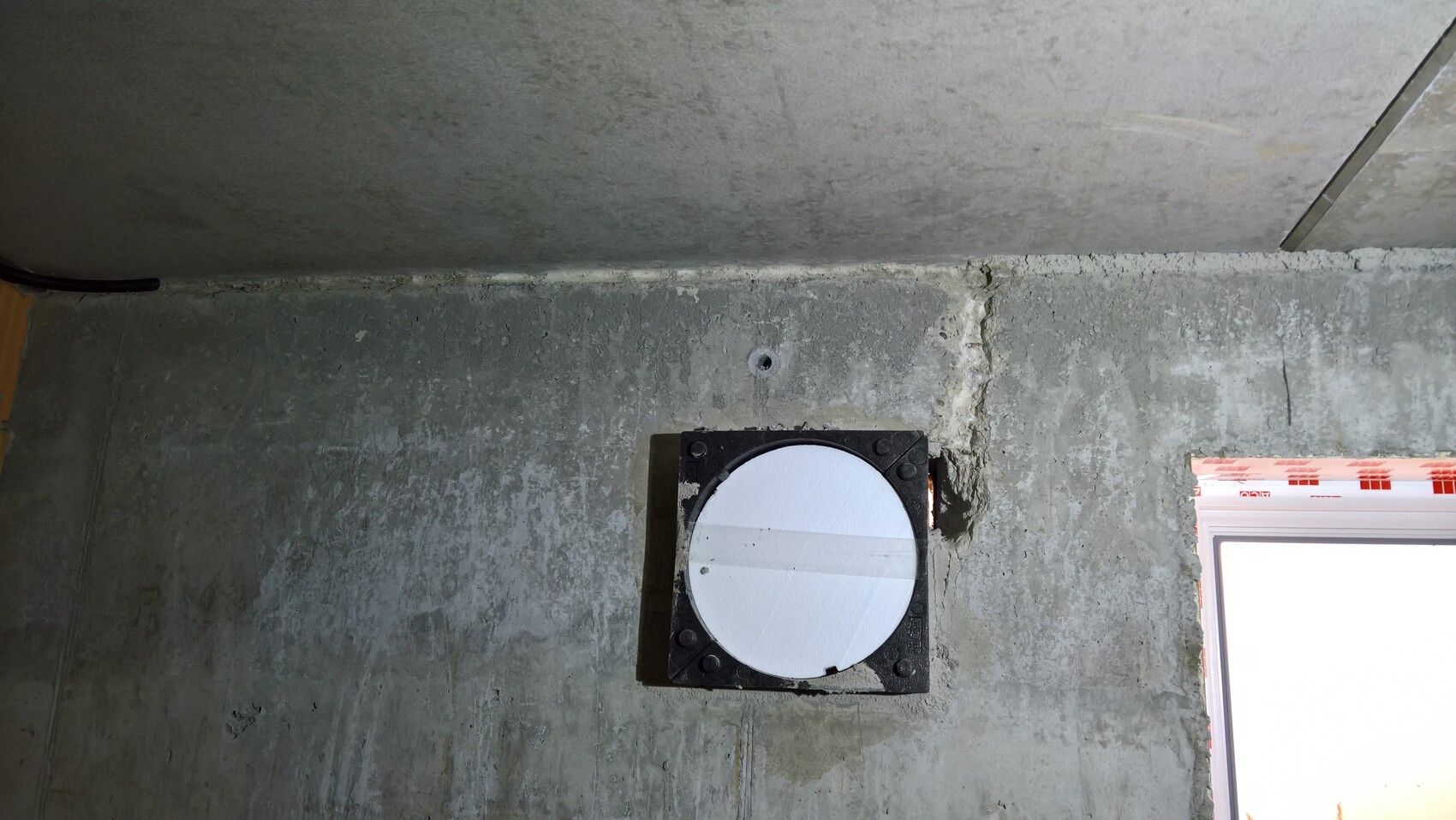
So, news from the experts. I have now spoken with two more structural engineers. The written basic statement from the Bauherren-Schutzbund was strictly correct according to the standard. However, the expert from the Bauherren-Schutzbund and another engineer added in a detailed conversation that this standard only needs to be followed in extreme cases:
The crucial point is the professional execution using a proper box chaser and not with an angle grinder and hammer.
Further findings:
This is reassuring, since the groundwater at our site, according to the local water authority, is very far below.
Today, ONE DAY before the electrical work is scheduled to start, we received an additional offer from the electrician. However, it now states:
"Chiseling boxes / grooves into concrete – the warranty for the waterproof concrete (WU concrete) will be voided."
How would you handle this situation? Thanks for the help!
- If there is no standing, pressurized groundwater, professionally installing flush-mounted junction boxes is not an issue, provided that an entire cluster of boxes is not installed in the wall. Three per wall would be the approximate limit.
- In this case, a 45mm (1.8 inches) deep junction box should be used.
- Alternatively, it is possible to build out the exterior walls with 6cm (2.4 inches) wide aerated concrete blocks (e.g., Ytong) to create an installation layer. A separate ventilation system is not necessary for this.
The crucial point is the professional execution using a proper box chaser and not with an angle grinder and hammer.
Further findings:
- In a current new build, if the basement rooms are finished as living spaces according to the construction description (which applies to us), flush-mounted installation is the expected type of installation and not unusual.
- Usually, the boxes and conduits would already be cast into the concrete.
- Here, the mistake clearly lies with the site manager, who repeatedly emphasized (pun intended) that this would only happen "once the entire shell structure is completed."
This is reassuring, since the groundwater at our site, according to the local water authority, is very far below.
Today, ONE DAY before the electrical work is scheduled to start, we received an additional offer from the electrician. However, it now states:
"Chiseling boxes / grooves into concrete – the warranty for the waterproof concrete (WU concrete) will be voided."
How would you handle this situation? Thanks for the help!
B
Bieber081521 Jun 2017 14:34DReffects schrieb:
"Chiseling holes / slits in concrete – the warranty for waterproof concrete is voided" I would definitely decline that, I would not accept it under any circumstances.
How much living space, in percentage, do you lose due to the 6cm (2.4 inches) outer wall cladding?
Similar topics