
B
Bauherr751 Jun 2017 09:01Hello,
We have now lived for six years in our newly built single-family house, and the exterior is still almost a shell.
I want to start with the paving work and the landscaping around the house.
Let’s begin with the entrance platform. We have chosen paving stones from the KANN Germanika Antique range. This system also includes palisades.
I would very much like to use the palisades as "block steps." What is the usual height for such a step or entrance platform? The palisades measure 62/42/28 x 21 x 14 cm (24/17/11 x 8 x 6 inches). I would like to use the 14 cm (6 inches) dimension for the height and the 21 cm (8 inches) for the depth. Will that work well? Are the palisades normally laid on a foundation or directly into lean concrete? Is crushed stone then compacted by hand inside, followed by a layer of grit? Are the paving stones compacted with a plate compactor or is tapping them in with a hammer sufficient? Are the joints then filled with mortar?
Maybe someone has a website where I can see and read about this?
There is another difficulty:
I need to pave right up to the door. The door is set in the middle of a 24 cm (9.5 inch) thick wall, with about 12 cm (5 inches) of insulation in front of it, and in front of the perimeter insulation there is a wall made of drainage bricks 11.5 cm (4.5 inches) thick. We have a basement. So I first need to waterproof the basement ceiling and the door threshold. Can I then create a mortar bed on top of that and lay the stones, maybe also the palisades, on it? Or would it be better to use grit?
I would appreciate any advice and tips.
Thank you very much.
Best regards,
Thomas
We have now lived for six years in our newly built single-family house, and the exterior is still almost a shell.
I want to start with the paving work and the landscaping around the house.
Let’s begin with the entrance platform. We have chosen paving stones from the KANN Germanika Antique range. This system also includes palisades.
I would very much like to use the palisades as "block steps." What is the usual height for such a step or entrance platform? The palisades measure 62/42/28 x 21 x 14 cm (24/17/11 x 8 x 6 inches). I would like to use the 14 cm (6 inches) dimension for the height and the 21 cm (8 inches) for the depth. Will that work well? Are the palisades normally laid on a foundation or directly into lean concrete? Is crushed stone then compacted by hand inside, followed by a layer of grit? Are the paving stones compacted with a plate compactor or is tapping them in with a hammer sufficient? Are the joints then filled with mortar?
Maybe someone has a website where I can see and read about this?
There is another difficulty:
I need to pave right up to the door. The door is set in the middle of a 24 cm (9.5 inch) thick wall, with about 12 cm (5 inches) of insulation in front of it, and in front of the perimeter insulation there is a wall made of drainage bricks 11.5 cm (4.5 inches) thick. We have a basement. So I first need to waterproof the basement ceiling and the door threshold. Can I then create a mortar bed on top of that and lay the stones, maybe also the palisades, on it? Or would it be better to use grit?
I would appreciate any advice and tips.
Thank you very much.
Best regards,
Thomas
So, with basement waterproofing, and considering this is a hazardous area where loose retaining walls, uneven stones and joints, and incorrect slopes or measurements can lead to someone (whether you, visitors, or the mail carrier) getting seriously injured, I would say: have it done. It won’t be that expensive.
I only know that there are minimum dimensions for exterior steps in terms of height. Also, a 21cm (8 inches) step is not even wide enough for my shoe... and off the top of my head, I would place the second step directly on the first one, but I am not an expert!
Why has it taken so long for you? Did you run out of money? That would obviously explain why you haven’t had it done. But judging by your questions, it seems you are a complete novice here, so I recommend consulting a professional.
Regards, Yvonne
I only know that there are minimum dimensions for exterior steps in terms of height. Also, a 21cm (8 inches) step is not even wide enough for my shoe... and off the top of my head, I would place the second step directly on the first one, but I am not an expert!
Why has it taken so long for you? Did you run out of money? That would obviously explain why you haven’t had it done. But judging by your questions, it seems you are a complete novice here, so I recommend consulting a professional.
Regards, Yvonne
B
Bauherr751 Jun 2017 18:17Hello Yvonne,
First of all, thank you very much for your reply and the tip.
However – I have done all the work on my construction myself except for the trades (plastering, roof, windows, doors, and heating/water). Everything. Of course, with help from family. Unfortunately, we don’t have anyone skilled in landscaping among them.
The reason it took so long is partly because I worked as a software developer for industrial control systems and traveled a lot across Europe. Also, after the “main” construction was finished, my motivation declined a bit. We never ran out of money.
So today at lunchtime on my way home, I paid attention to other entrance platforms. First, I want to build a “border” with retaining wall palisades and lay paving stones inside it. So everything will be on one level. Because of the stone grid size, the platform should be about 1.70 m by 1.00 to 1.20 m (5 ft 7 in by 3 ft 3 in to 3 ft 11 in). When I see other platforms made with palisades—certainly not all by professionals—and others done differently, I saw heights from about 8 cm up to, I believe, 20 cm (3 in up to 8 in). Even natural stone slabs with risers (certainly made by a stonemason), which were only about max. 10 cm (4 in) high.
I can’t quite understand that. Uneven stones and joints, incorrect slope—I don’t see why that should happen.
Still, thank you very much and I hope to receive more tips and comments.
Best regards,
Thomas
First of all, thank you very much for your reply and the tip.
However – I have done all the work on my construction myself except for the trades (plastering, roof, windows, doors, and heating/water). Everything. Of course, with help from family. Unfortunately, we don’t have anyone skilled in landscaping among them.
The reason it took so long is partly because I worked as a software developer for industrial control systems and traveled a lot across Europe. Also, after the “main” construction was finished, my motivation declined a bit. We never ran out of money.
So today at lunchtime on my way home, I paid attention to other entrance platforms. First, I want to build a “border” with retaining wall palisades and lay paving stones inside it. So everything will be on one level. Because of the stone grid size, the platform should be about 1.70 m by 1.00 to 1.20 m (5 ft 7 in by 3 ft 3 in to 3 ft 11 in). When I see other platforms made with palisades—certainly not all by professionals—and others done differently, I saw heights from about 8 cm up to, I believe, 20 cm (3 in up to 8 in). Even natural stone slabs with risers (certainly made by a stonemason), which were only about max. 10 cm (4 in) high.
ypg schrieb:
.... and considering that this is a hazard area where loose palisades, uneven stones and joints, and incorrect slope or dimensions can cause someone (whether you, guests, or the postman) to break a bone, I would say: have it done. It won’t be that expensive.
I can’t quite understand that. Uneven stones and joints, incorrect slope—I don’t see why that should happen.
Still, thank you very much and I hope to receive more tips and comments.
Best regards,
Thomas
B
Bauherr7517 Jun 2017 10:52Hello,
regarding the last part of my opening post in this thread, I’m already writing about the waterproofing.
I have now started to close or seal the door threshold.
As I mentioned above, I am not sure what I need to lay over the waterproofing (bituminous thick coating) to protect it from damage by the gravel or crushed stone? Or is concrete usually poured over it?
Also, I still have the perimeter insulation and the drainage stone wall—how should these be covered?
Thank you very much for your answers, tips, and help.
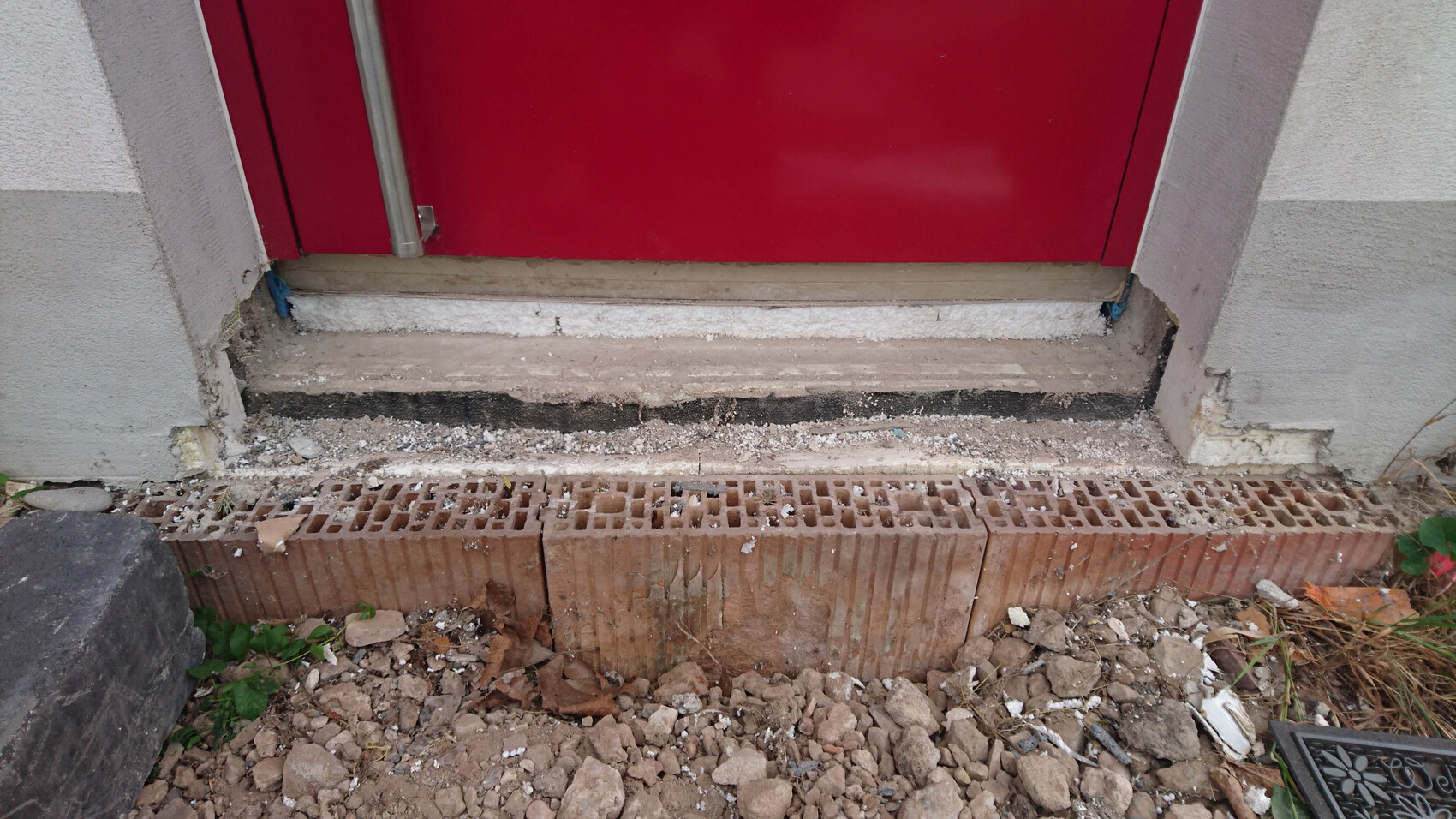
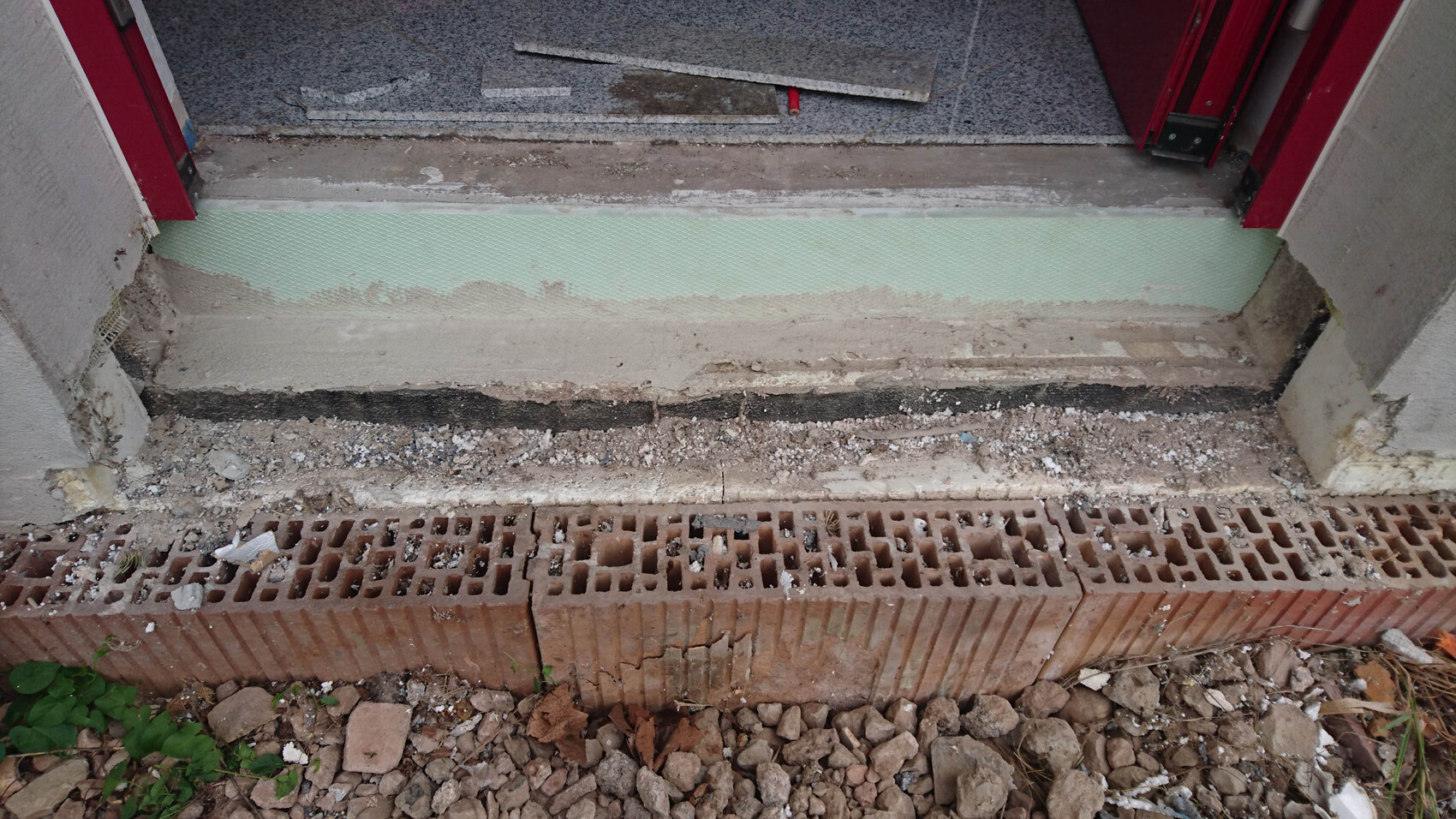
regarding the last part of my opening post in this thread, I’m already writing about the waterproofing.
I have now started to close or seal the door threshold.
As I mentioned above, I am not sure what I need to lay over the waterproofing (bituminous thick coating) to protect it from damage by the gravel or crushed stone? Or is concrete usually poured over it?
Also, I still have the perimeter insulation and the drainage stone wall—how should these be covered?
Thank you very much for your answers, tips, and help.
K
Knallkörper17 Jun 2017 11:18Hello.
Under our door threshold, there is a profile about 20cm (8 inches) high, to which a sealing membrane (some kind of polymer with a self-adhesive backing) is attached. This extends forward and connects on the side to the brickwork (in your case, this would be the insulation layer). First, the border of the platform was made from granite pillars. The interior was then lightly filled with gravel and dry mortar, and the granite paving stones were laid on top. The joints were filled with a water-permeable resin mortar; for your situation, a waterproof one might be better.
Under our door threshold, there is a profile about 20cm (8 inches) high, to which a sealing membrane (some kind of polymer with a self-adhesive backing) is attached. This extends forward and connects on the side to the brickwork (in your case, this would be the insulation layer). First, the border of the platform was made from granite pillars. The interior was then lightly filled with gravel and dry mortar, and the granite paving stones were laid on top. The joints were filled with a water-permeable resin mortar; for your situation, a waterproof one might be better.
B
Bauherr7517 Jun 2017 11:26Hello Knallkörper,
Thank you very much.
I applied a triple layer of thick coating with fabric reinforcement on our basement walls (you can see a narrow black strip).
I would now connect a thick coating to this.
Then maybe place a bitumen mat on the door threshold to protect it from damage caused by the gravel.
Now, the only remaining issue is the perimeter insulation.
I am a bit worried that over time, the gravel might settle slightly and press into the insulation.
Best regards
Thank you very much.
I applied a triple layer of thick coating with fabric reinforcement on our basement walls (you can see a narrow black strip).
I would now connect a thick coating to this.
Then maybe place a bitumen mat on the door threshold to protect it from damage caused by the gravel.
Now, the only remaining issue is the perimeter insulation.
I am a bit worried that over time, the gravel might settle slightly and press into the insulation.
Best regards
Similar topics