
ᐅ First Draft Floor Plan Single-Family Home (approx. 200 sqm) – Request for Feedback
Created on: 24 Feb 2017 22:45
S
SupaCriz
Hello,
we are about to sign the contract for the purchase of a hillside plot in a Franconian university town (existing building will be demolished) and have now created a first draft of the floor plans. We would appreciate your feedback! Many thanks in advance.
Please excuse the poor quality of the drawings and the almost complete lack of area specifications – we would like to receive initial feedback before our next meeting with the planners. Afterwards, we will upload higher-quality floor plans. For orientation: The draft is based on a footprint of 10x10m (33x33 feet).
Development plan/restrictions: Development plan
Plot size: 500 sqm (5400 sq ft)
Slope: yes, approx. 6 m (20 feet) drop over 28 m (92 feet) plot length (south-facing slope)
Site coverage ratio (Grundflächenzahl): 0.2
Floor area ratio (Geschossflächenzahl): 0.2 (according to the city, some upward deviation is possible here)
Building envelope, building line, and boundary: standard setback distances
Edge development: Garage will be built on the boundary. This is permitted.
Number of parking spaces: 2, likely a double garage
Number of floors: I + basement (that means 1 full storey + basement floor → cellar built into the slope)
Roof type: no specification
Style: no specification
Orientation: Roof ridge must run east-west
Maximum heights/limits: Eaves max. 3 m (10 feet) above street level
Other requirements
Homeowners’ requirements
Style, roof shape, building type: Gable roof with 48° pitch
Basement, floors: Basement – to be used as high-quality living space on the south slope with direct access to the terrace
Number of persons, ages: Parents just over 30, children aged 0 and 2 years
Space requirements on ground and upper floor: Ground floor: main living area and kitchen; upper floor: 3 bedrooms + bathroom
Office, family use or home office?: Possibly an office as a studio under the roof (not a decisive criterion)
Overnight guests per year: extended visits expected
Open or closed design: open
Conservative or modern construction: classic form but large windows with high ceiling height; possibly corner glazing towards southwest in the living room
Open kitchen, kitchen island: closed kitchen with dining table
Number of dining seats: 6
Fireplace: likely yes, but external fireplace
Music/sound wall: no
Balcony, roof terrace: no
Garage, carport: double garage
Vegetable garden, greenhouse: no
Further wishes/special features/daily routine, also reasons why certain choices were made or rejected:
Ground-level terrace access from the basement (not yet drawn)
Photovoltaics
House design
Planner: Planner from a construction company (civil engineer) with many changes from our side
What do you like most? Why? Large basement room with terrace access. Comfortable overnight option for guests.
What do you dislike? Why? Limited space upstairs. Small main bathroom. The limited space is unfortunately due to the definition of full storey according to the Bavarian building code of 1969.
Price estimate according to architect/planner: €300,000 plus additional costs
Personal price limit for house including fittings: 380,000
Preferred heating system: geothermal heat pump
If you had to make compromises, which details/features
- could you live without: photovoltaics
- could you not live without: basement with living space quality
Why is the design like it is now? For example:
The planner’s initial draft was heavily customized by us. We are still in a very early phase and therefore open to suggestions and ideas.
Creativity may still be somewhat lacking at the moment.

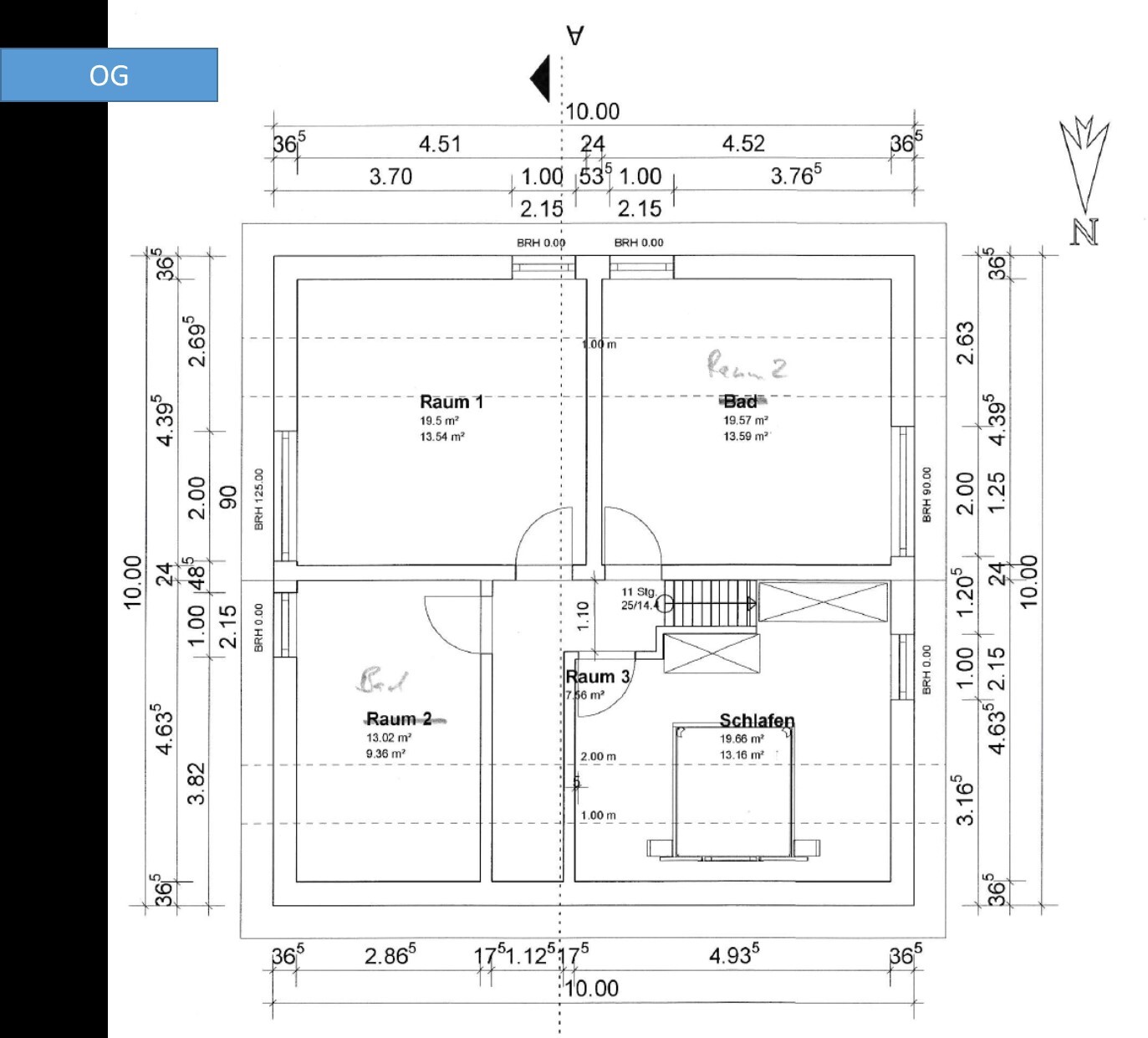
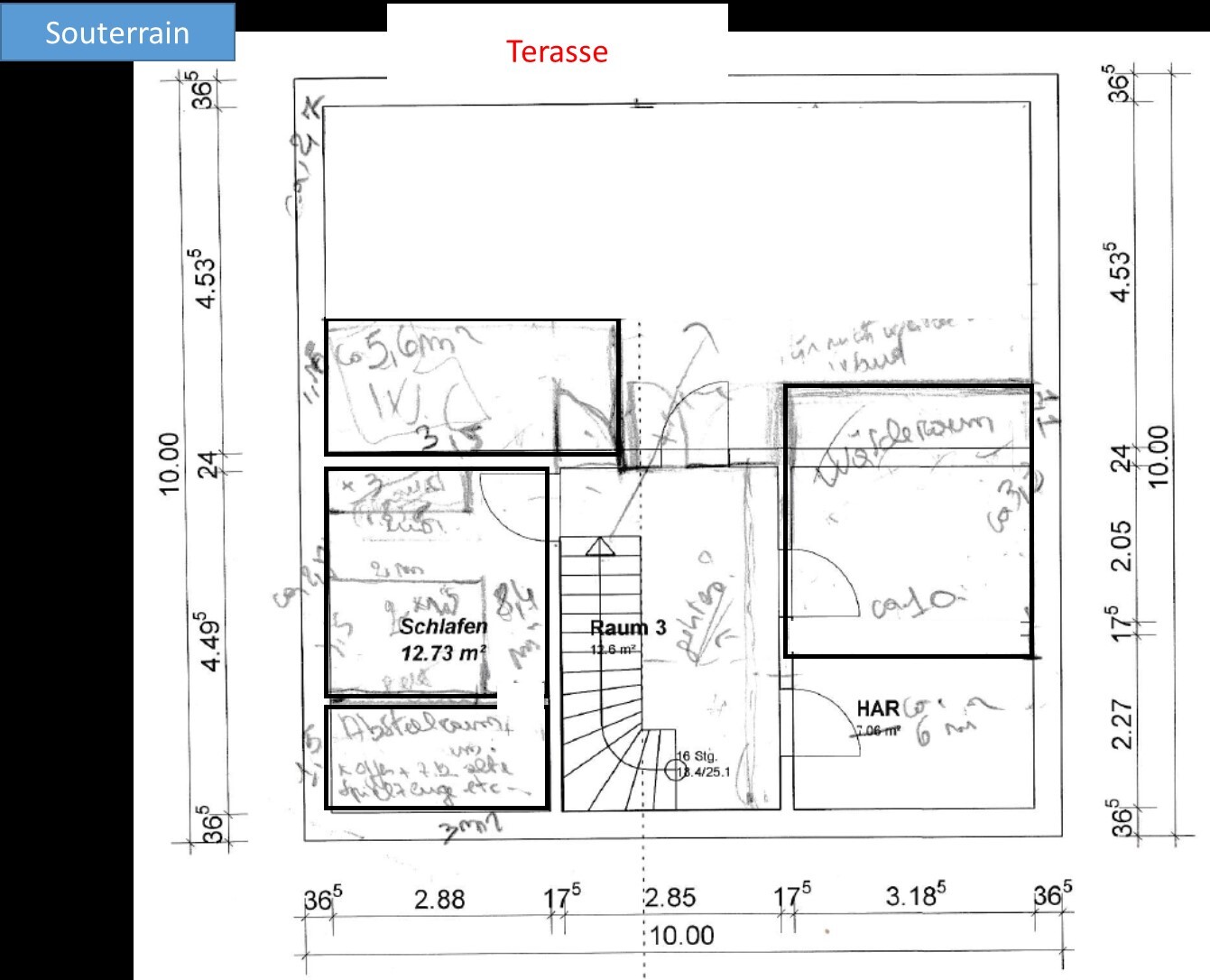
we are about to sign the contract for the purchase of a hillside plot in a Franconian university town (existing building will be demolished) and have now created a first draft of the floor plans. We would appreciate your feedback! Many thanks in advance.
Please excuse the poor quality of the drawings and the almost complete lack of area specifications – we would like to receive initial feedback before our next meeting with the planners. Afterwards, we will upload higher-quality floor plans. For orientation: The draft is based on a footprint of 10x10m (33x33 feet).
Development plan/restrictions: Development plan
Plot size: 500 sqm (5400 sq ft)
Slope: yes, approx. 6 m (20 feet) drop over 28 m (92 feet) plot length (south-facing slope)
Site coverage ratio (Grundflächenzahl): 0.2
Floor area ratio (Geschossflächenzahl): 0.2 (according to the city, some upward deviation is possible here)
Building envelope, building line, and boundary: standard setback distances
Edge development: Garage will be built on the boundary. This is permitted.
Number of parking spaces: 2, likely a double garage
Number of floors: I + basement (that means 1 full storey + basement floor → cellar built into the slope)
Roof type: no specification
Style: no specification
Orientation: Roof ridge must run east-west
Maximum heights/limits: Eaves max. 3 m (10 feet) above street level
Other requirements
Homeowners’ requirements
Style, roof shape, building type: Gable roof with 48° pitch
Basement, floors: Basement – to be used as high-quality living space on the south slope with direct access to the terrace
Number of persons, ages: Parents just over 30, children aged 0 and 2 years
Space requirements on ground and upper floor: Ground floor: main living area and kitchen; upper floor: 3 bedrooms + bathroom
Office, family use or home office?: Possibly an office as a studio under the roof (not a decisive criterion)
Overnight guests per year: extended visits expected
Open or closed design: open
Conservative or modern construction: classic form but large windows with high ceiling height; possibly corner glazing towards southwest in the living room
Open kitchen, kitchen island: closed kitchen with dining table
Number of dining seats: 6
Fireplace: likely yes, but external fireplace
Music/sound wall: no
Balcony, roof terrace: no
Garage, carport: double garage
Vegetable garden, greenhouse: no
Further wishes/special features/daily routine, also reasons why certain choices were made or rejected:
Ground-level terrace access from the basement (not yet drawn)
Photovoltaics
House design
Planner: Planner from a construction company (civil engineer) with many changes from our side
What do you like most? Why? Large basement room with terrace access. Comfortable overnight option for guests.
What do you dislike? Why? Limited space upstairs. Small main bathroom. The limited space is unfortunately due to the definition of full storey according to the Bavarian building code of 1969.
Price estimate according to architect/planner: €300,000 plus additional costs
Personal price limit for house including fittings: 380,000
Preferred heating system: geothermal heat pump
If you had to make compromises, which details/features
- could you live without: photovoltaics
- could you not live without: basement with living space quality
Why is the design like it is now? For example:
The planner’s initial draft was heavily customized by us. We are still in a very early phase and therefore open to suggestions and ideas.
Creativity may still be somewhat lacking at the moment.

ypg schrieb:
It certainly wasn’t meant to be that detailed, because such an approach would only make the design worse.
The main point is the principle of installing a space-saving staircase.Your suggestion to place this staircase over the other one wouldn’t work because of the differing steepness, and continuing it identically upwards wouldn’t work either (because you would have to enter it by crawling at the start). That’s why I quickly sketched how it could be structurally possible at all. It would still look like the work of a haunted house designer, which I fully agree with.
ypg schrieb:
I’m not making detailed proposals here because I don’t consider the design reasonable [...] For me, the oversized storage room (and other rooms as well) only appears because of the staircase positioning; somehow everything looks just roughly drawn in here.For this design, all hope is lost. The planner seems to be a draftsman: technically it’s all feasible, but architecturally bordering on a crime. Aside from the well-executed dormer, most details look like nitpicking by a technical draftsman who can’t even stack three bricks properly.
SupaCriz schrieb:
The window of course shouldn’t overlap with the cupboard. We have already told the planners this and it will be corrected soon. [...] Larger and more windows will be added throughout the rest of the house, and upstairs there will be several double casement windows. [...] Access to the terrace is via the lower additional living, guest, and play area, which is incorrectly labeled as a recreation room. [...] The only reason for the large pantry/storage room for things like the vacuum cleaner is that this room is the least attractive one in the entire house.What exactly do your planners do for a living? After so many design versions, everything still looks like the floor plans are just placeholders for whatever will ultimately be awkwardly squeezed between the exterior walls?
This house is a unique—and likely Europe’s most comprehensive—collection of the least appealing rooms!
SupaCriz schrieb:
For the living room, for example, we want to install one of those large external windows where the windowsill serves as a seat.But please, under no circumstances go with that contractor who has a 1950s mindset and turns it into a flower window. Then the house will no longer just look like the Devil’s grandmother but with severe facelifts as well.
SupaCriz schrieb:
Our builder constructs— as some have rightly pointed out—very traditional houses. Because of that, we have to plan every window ourselves [...] Has anyone had experience with narrow windows between base cabinets and wall cabinets in the kitchen? [...] We wanted to see if there would be room for a sink, toilet, bidet, washing machine, and shower if needed.They don’t build “traditional” houses; rather, they are at least sixty years behind in even remotely developing a sense for architecture. I would never trust them with ribbon windows, and the word “bidet” is probably a foreign concept to them. After the war, people were glad to move from a Nissen hut into a brick house. Today, a builder should be able to offer a bit more.
SupaCriz schrieb:
We would like to have a fixed staircase because the attic might be used as an office, a retreat for teenagers, etc. We want to keep these options open and therefore do not want to access it only via a retractable ladder.Give the teenagers a loft retreat above their rooms, with access from there. Everything else is less worthwhile than the effort a staircase to the attic requires.
SupaCriz schrieb:
Thanks for your feedback!The only thanks that would be welcome is if our feedback were to have some positive use.
I will give you one more chance, then I’m out of this gingerbread house thread.
https://www.instagram.com/11antgmxde/
https://www.linkedin.com/company/bauen-jetzt/
@11ant
Regarding the stairs: we are aware that the staircase should be planned first, of course considering the room layout on the ground floor as well as the upper floor and attic if needed.
Then the design will work if you have some experience.
_As_ it is here, all hope is lost, all advice wasted.
Goodbye and happy Easter [emoji214]
Regards, Yvonne
Regarding the stairs: we are aware that the staircase should be planned first, of course considering the room layout on the ground floor as well as the upper floor and attic if needed.
Then the design will work if you have some experience.
_As_ it is here, all hope is lost, all advice wasted.
Goodbye and happy Easter [emoji214]
Regards, Yvonne
SupaCriz schrieb:
However, there are some points where our habits probably differ from those of many others (including in our family). We currently have a very nice west-facing terrace and hardly use it. On the other hand, we lived on the first floor for a long time and had to go outside and across the yard to get to the garden. We used the garden a lot then. --> For us, a direct access from the living room to the terrace and garden is not important. On the contrary, we really like the idea of having a kind of rustic second living room, possibly with a fireplace, from which we then step out onto the terrace and garden. And of course, we understand that many people think and live differently. This works better for us.I get the impression that you are somewhat convincing yourselves that everything is fine as it is. You say you’re satisfied with this and that, so why change anything or try something new in the new house?
Normally, it should get better, more beautiful, more comfortable if you are spending a lot of money on a house. If you want to have the same or even just something close to what you had before, you don’t have to go through all the work and financial effort.
You’ve already had to take a lot of criticism for your designs, so I’m holding back for that reason. But what I would be curious about is, for example, where do you hang your laundry? Is there going to be a cute little hardware store drying rack in the living room?
marv45 schrieb:
I get the impression you’re sugarcoating the whole situation a bit. Claiming to be satisfied with this or that as it is now. [...] You’ve already taken quite a bit of criticism for your designs, which is why I’m holding back.The criticism here is less about the perfectly valid “different” taste of this building family compared to others in this forum. Rather, the issue is that this is not really “their” design, or more precisely, that the underlying base model is completely unsuitable as a foundation to turn it into the SupaCriz family’s house:
We’re dealing with the contractor’s “08/15 Ten by Ten” model here. Proven since 1948, then upgraded from 24 to 30 and in 1980 from 30 to 36.5 cm (14 inches) exterior wall thickness, built hundreds of times now with various roof pitches and ridge orientations. For slopes in the opposite direction, it has even been built with an individual garage in the basement. With oil tank, wine cellar, in white or light coffee-gray. And in the current version, for once the basement plan does not say “hobby cellar” in the rear half of the basement area.
In an architecture lecture hall, even the most unobservant student in the back row would immediately recognize this. However, a single building family wishes like brave Gauls to believe that this could somehow still become “their” house.
That, however, cannot succeed. Never, to be precise. This is simply due to an unsuitable approach:
A “conversion” is always the right choice when the suboptimal house is already standing. But here, it’s not the adaptable house that is on the plot, it’s a stubborn building contractor who’s stuck.
You renovate houses that don’t fit well. But you don’t renovate off-the-shelf plans that don’t fit—you throw them away.
This realization, however, is not quite sinking in with the SupaCriz family—they move walls and windows as if the house already existed. The devotion here to the Hippocratic Oath would be exemplary if this were about a human life. But it’s only about the life of an off-the-shelf building plan—which in this case lies undoubtedly stillborn on the drawing board.
https://www.instagram.com/11antgmxde/
https://www.linkedin.com/company/bauen-jetzt/
Hello everyone,
we have reconsidered a few points. Here is a new draft.
The windows are still not included in this version. Currently, we are leaning towards large window areas in the southwest corner of the living room (not corner glazing, but 50cm (20 inches) of masonry in the corner). Additionally, we are considering a patio door with four steps leading down from the living room on the ground floor on the west side into the garden. The height above the ground there would need to be about 1m (3 feet 3 inches).
On the upper floor, the bathroom and master bedroom will each get a double casement window, and possibly the eastern children’s room as well (potentially as a replacement for the window facing northeast).
In the basement, we want to almost entirely avoid light wells and instead install windows with a high sill height in the utility rooms that sit above ground level.
We have one more question regarding the positioning of the house on the site. It would be possible to add about 1m (3 feet 3 inches) of fill so that the entrance is at street level. The alternative would be to have the entrance and finished floor level approximately 70cm-1m (28-39 inches) below street level, following the natural slope of the site. Both options are common in the immediate neighborhood. Are there any fundamental advantages or disadvantages to consider here (other than the garden becoming accordingly steeper if the house is built “higher up”)?
Thanks for your opinions!
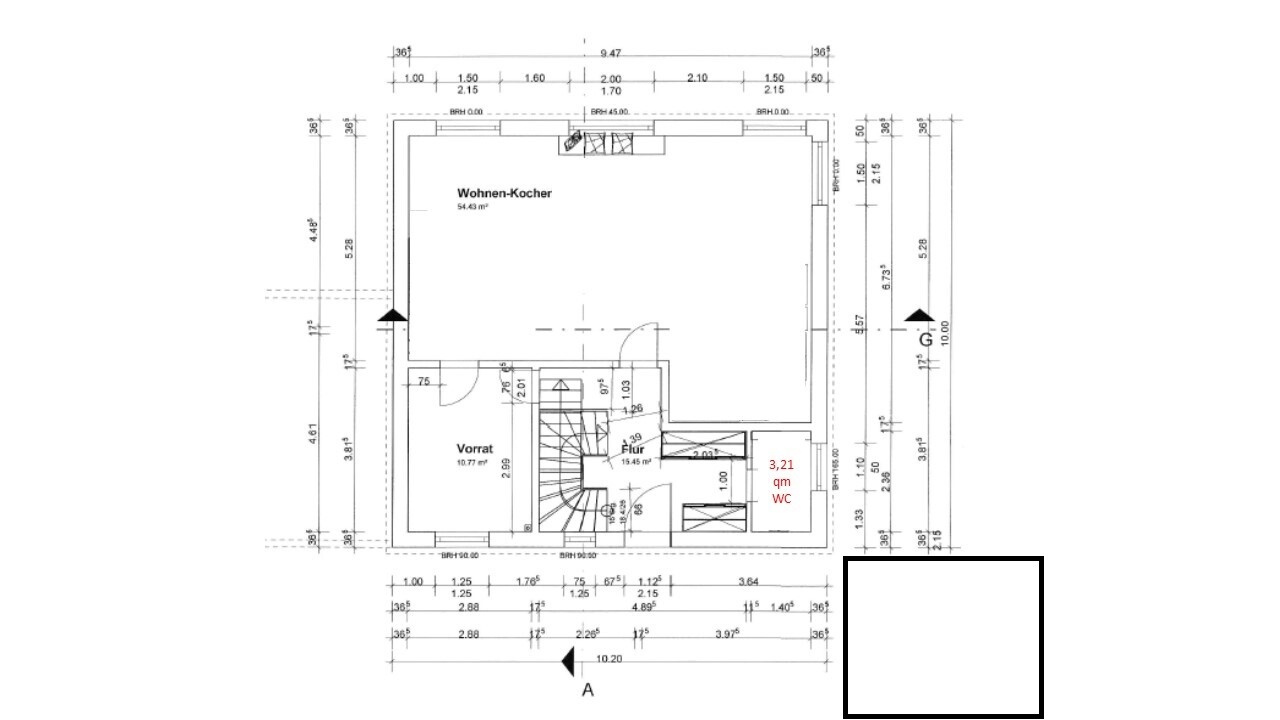
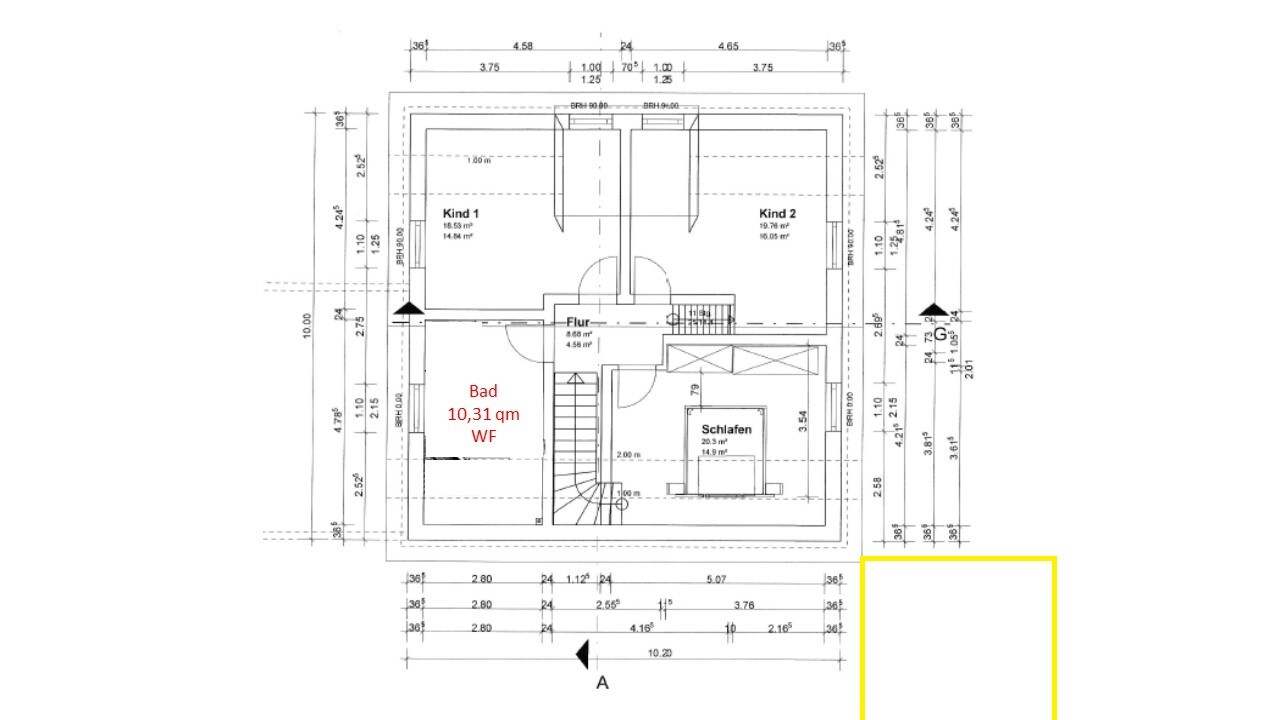

we have reconsidered a few points. Here is a new draft.
The windows are still not included in this version. Currently, we are leaning towards large window areas in the southwest corner of the living room (not corner glazing, but 50cm (20 inches) of masonry in the corner). Additionally, we are considering a patio door with four steps leading down from the living room on the ground floor on the west side into the garden. The height above the ground there would need to be about 1m (3 feet 3 inches).
On the upper floor, the bathroom and master bedroom will each get a double casement window, and possibly the eastern children’s room as well (potentially as a replacement for the window facing northeast).
In the basement, we want to almost entirely avoid light wells and instead install windows with a high sill height in the utility rooms that sit above ground level.
We have one more question regarding the positioning of the house on the site. It would be possible to add about 1m (3 feet 3 inches) of fill so that the entrance is at street level. The alternative would be to have the entrance and finished floor level approximately 70cm-1m (28-39 inches) below street level, following the natural slope of the site. Both options are common in the immediate neighborhood. Are there any fundamental advantages or disadvantages to consider here (other than the garden becoming accordingly steeper if the house is built “higher up”)?
Thanks for your opinions!
SupaCriz schrieb:
We still have one question regarding the house’s positioning on the site. It might be possible to raise the ground by about 1 meter (3 feet) so that the entrance aligns with street level. Alternatively, the entrance and the finished floor level could follow the natural terrain, sitting approximately 70 centimeters (28 inches) to 1 meter (3 feet) below street level. Both options are present in the immediate neighborhood. Are there any fundamental advantages or disadvantages to consider here (apart from the fact that the garden will become steeper if the house is positioned “higher up”)?That would be convenient in terms of
SupaCriz schrieb:
In the basement level, we want to almost completely avoid light wells and instead have windows with a high sill height in the ancillary rooms that sit above ground level. because of the positive impact on that sill height relative to the terrain, but apart from
SupaCriz schrieb:
a patio door with a drop of 4 steps from the living room on the ground floor at the west side leading to the garden, where the height above ground would have to be about 1 meter (3 feet). which would be just as disadvantageous in the other case, it affects things overall, doesn’t it?
Eaves height and ridge height are often measured at the top edge of the finished ground floor (indirectly anchored to the street by limiting how far above it the floor may be), or sometimes directly related to the street level itself.
Aside from “underpinning” the basement (which, if I recall correctly, matches the garden level at the rear) or the cellar, or the slope stabilization under the garage, such a house elevation could also pose challenges at the top.
The lower floor plans have already been slightly trimmed down (except for the confusion caused by the two stair configurations), but the roof still ends at - well.
That’s why I stand by this: Reengineering instead of tinkering with a fundamentally flawed floor plan.
https://www.instagram.com/11antgmxde/
https://www.linkedin.com/company/bauen-jetzt/
Similar topics