
ᐅ Single-story house with a hip roof – is converting the attic worthwhile?
Created on: 22 Apr 2017 00:05
J
jawknee
Hello everyone,
I am currently looking for a plot of land and plan to build a small single-family house of about 120 sqm (1,292 sq ft), without a basement. I am thinking of a classic house with a pitched roof, including a utility room, kitchen, guest toilet, and living/dining area on the ground floor, and bedrooms, bathroom, and guest room/office upstairs.
Since I want to discuss specific details with builders or architects only once I have a plot as a basis, I cannot provide more detailed information at this stage. I hope this is sufficient for now.
I have now found a suitable plot (about 700 sqm (7,535 sq ft)), which will be developed next year, and according to the zoning plan, everything seemed fine. However, after asking the real estate agent for more information, it turned out there was a change to the development plan.
Previously, the following was allowed:
Ground floor + upper floor, pitched roof, 35–45 degrees, knee wall 80 cm (31 inches)
Now, only the following is permitted:
Ground floor + upper floor, hipped roof, 20–35 degrees, knee wall 80 cm (31 inches)
The floor area ratio (0.8) and site coverage ratio (0.4) have not changed.
According to the description and the agent’s statement, this would be a classic bungalow. Although I don’t completely rule it out, I am not a 100% fan of bungalows because, based on my preferences, I would like to have the bedroom and bathroom upstairs, and a bungalow also tends to use more of the plot area.
However, it seems that there are bungalows with usable attic space. My question is whether it is practical to manage about 120 sqm (1,292 sq ft) with a knee wall of 80 cm (31 inches) to fit a bathroom and bedroom in the roof space... and you would also need to accommodate a staircase. From a gut feeling, I find it hard to imagine, but maybe one of the experts here can share their assessment. It would also be interesting to know if it makes economic sense at all.
Thank you very much in advance.
I am currently looking for a plot of land and plan to build a small single-family house of about 120 sqm (1,292 sq ft), without a basement. I am thinking of a classic house with a pitched roof, including a utility room, kitchen, guest toilet, and living/dining area on the ground floor, and bedrooms, bathroom, and guest room/office upstairs.
Since I want to discuss specific details with builders or architects only once I have a plot as a basis, I cannot provide more detailed information at this stage. I hope this is sufficient for now.
I have now found a suitable plot (about 700 sqm (7,535 sq ft)), which will be developed next year, and according to the zoning plan, everything seemed fine. However, after asking the real estate agent for more information, it turned out there was a change to the development plan.
Previously, the following was allowed:
Ground floor + upper floor, pitched roof, 35–45 degrees, knee wall 80 cm (31 inches)
Now, only the following is permitted:
Ground floor + upper floor, hipped roof, 20–35 degrees, knee wall 80 cm (31 inches)
The floor area ratio (0.8) and site coverage ratio (0.4) have not changed.
According to the description and the agent’s statement, this would be a classic bungalow. Although I don’t completely rule it out, I am not a 100% fan of bungalows because, based on my preferences, I would like to have the bedroom and bathroom upstairs, and a bungalow also tends to use more of the plot area.
However, it seems that there are bungalows with usable attic space. My question is whether it is practical to manage about 120 sqm (1,292 sq ft) with a knee wall of 80 cm (31 inches) to fit a bathroom and bedroom in the roof space... and you would also need to accommodate a staircase. From a gut feeling, I find it hard to imagine, but maybe one of the experts here can share their assessment. It would also be interesting to know if it makes economic sense at all.
Thank you very much in advance.

We have an older development plan from 1970 that designated multiple multi-family houses with three floors each. However, the seller only sells if buyers build single-family homes. This statement is well known, so all buyers rely on it, and so far, this has been the case.
The development plan itself is not changed for this. It allows three full stories, a knee wall of 20cm (8 inches), and a maximum roof pitch of 30°.
We applied for and received approval from the local authority for a deviation from the development plan. Instead of three stories, we are building just 1.5 stories, but we are increasing the knee wall to 100cm (39 inches) and the roof pitch to 45°.
Most neighbors are building two full stories with a hipped roof at 30° pitch, typical of an urban villa.
To determine if you can convert and use your attic space effectively, try sketching it out with a protractor and pencil. Draw the cross-section, including the ceiling area, knee wall height, and roof pitch. Then, with dashed lines, mark the points where the height between the top of the floor and the underside of the roof structure reaches 2m (6 ft 7 in) (ignoring additional floor buildup like screed, underfloor heating, or laminate). The area between those dashed lines can be used standing upright. Is that space sufficient for a living area?
The development plan itself is not changed for this. It allows three full stories, a knee wall of 20cm (8 inches), and a maximum roof pitch of 30°.
We applied for and received approval from the local authority for a deviation from the development plan. Instead of three stories, we are building just 1.5 stories, but we are increasing the knee wall to 100cm (39 inches) and the roof pitch to 45°.
Most neighbors are building two full stories with a hipped roof at 30° pitch, typical of an urban villa.
To determine if you can convert and use your attic space effectively, try sketching it out with a protractor and pencil. Draw the cross-section, including the ceiling area, knee wall height, and roof pitch. Then, with dashed lines, mark the points where the height between the top of the floor and the underside of the roof structure reaches 2m (6 ft 7 in) (ignoring additional floor buildup like screed, underfloor heating, or laminate). The area between those dashed lines can be used standing upright. Is that space sufficient for a living area?
Wonderful examples of how this can look in practice are also provided by the house catalog from Scanhaus Marlow. They offer such types in their selection. Bungalows with potential for future expansion. They were the ones who inspired us to think this way back then. Karsten
@Nordlys
That sounds pretty good. What knee wall height do you have? (I can't quite tell through the blue vapor barrier ^^)
@Kaspatoo
Thanks for the tip! I tried sketching it out with a rough floor plan of 9 x 12m (29.5 x 39.4 ft) for about 90 square meters (970 sq ft) of living space on the ground floor. Using a 35-degree roof pitch, at a height of 2m (6.6 ft), I get around 28–30 square meters (300–320 sq ft) of usable space upstairs (ignoring floor buildup and the partition between bedroom and bathroom). So it sounds feasible.
What I'm still wondering:
How do you usually calculate construction costs here? Normally, I estimate roughly for the house as 120 square meters (1,290 sq ft) times €1800 (excluding additional costs for now). Is it realistic then to calculate the bungalow version as 90 square meters (970 sq ft) downstairs plus 30 square meters (320 sq ft) upstairs? Or do I need to count the full 90 square meters (970 sq ft) upstairs as well—or at least more than the 30 square meters—even if it can't be fully used? For the living area calculation, it's usually the first option, but does the same apply when calculating costs?
That sounds pretty good. What knee wall height do you have? (I can't quite tell through the blue vapor barrier ^^)
@Kaspatoo
Thanks for the tip! I tried sketching it out with a rough floor plan of 9 x 12m (29.5 x 39.4 ft) for about 90 square meters (970 sq ft) of living space on the ground floor. Using a 35-degree roof pitch, at a height of 2m (6.6 ft), I get around 28–30 square meters (300–320 sq ft) of usable space upstairs (ignoring floor buildup and the partition between bedroom and bathroom). So it sounds feasible.
What I'm still wondering:
How do you usually calculate construction costs here? Normally, I estimate roughly for the house as 120 square meters (1,290 sq ft) times €1800 (excluding additional costs for now). Is it realistic then to calculate the bungalow version as 90 square meters (970 sq ft) downstairs plus 30 square meters (320 sq ft) upstairs? Or do I need to count the full 90 square meters (970 sq ft) upstairs as well—or at least more than the 30 square meters—even if it can't be fully used? For the living area calculation, it's usually the first option, but does the same apply when calculating costs?
Knee wall height: none. We Norwegians don’t really like that. It always makes the houses look awkward. To me, a bungalow should have a somewhat flowing, natural appearance. That’s why I find roof pitches steeper than 35 degrees borderline in terms of aesthetics. The most attractive is below 30 degrees, but then you can forget about any attic conversions.
Have a general contractor who can do custom work calculate the costs for you. It won’t be more expensive than another house. The foundation slab will be larger, yes, but not the wall surfaces. The roof will cost a bit more. On the other hand, there won’t be a reinforced concrete ceiling. I won’t mention our price again here, as it’s apparently very reasonable compared to what people pay elsewhere. Use the price list from Scanhaus Marlow as a reference—it’s a good starting point if you realistically expect that won’t be the final price.
I’m attaching a photo taken this morning.
Karsten
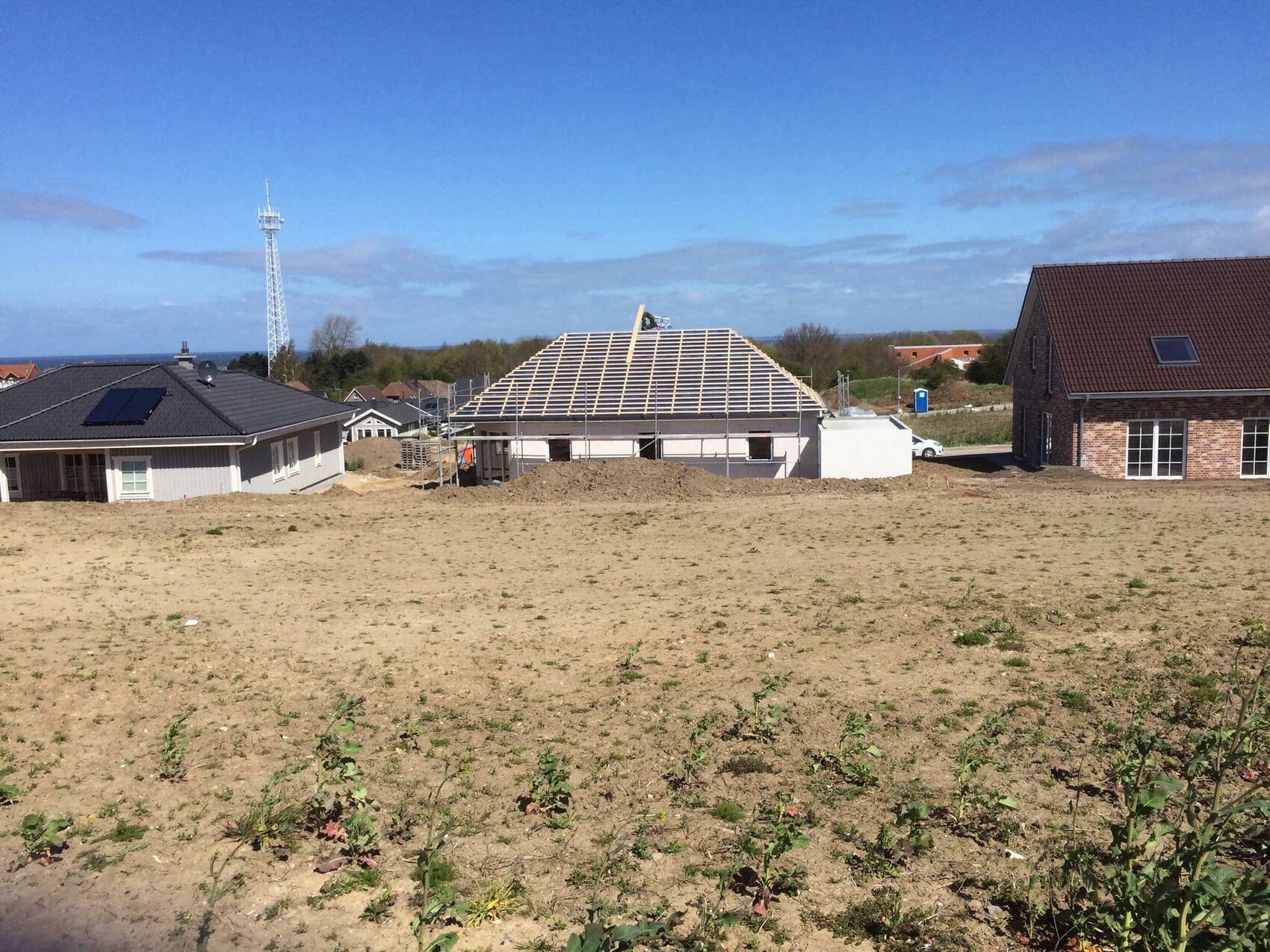
Have a general contractor who can do custom work calculate the costs for you. It won’t be more expensive than another house. The foundation slab will be larger, yes, but not the wall surfaces. The roof will cost a bit more. On the other hand, there won’t be a reinforced concrete ceiling. I won’t mention our price again here, as it’s apparently very reasonable compared to what people pay elsewhere. Use the price list from Scanhaus Marlow as a reference—it’s a good starting point if you realistically expect that won’t be the final price.
I’m attaching a photo taken this morning.
Karsten

jawknee schrieb:
The development plan is for a complete new residential area, which will be partially developed this year, and the rest (including the plot I want) will be developed next year. Different sections were grouped according to Tuscan-style houses, bungalows, and pitched roofs.Drug tests should probably be conducted before some local council meetings.
https://www.instagram.com/11antgmxde/
https://www.linkedin.com/company/bauen-jetzt/
This is how things are in the council. Nicely divided by factions. One area for the Black faction, one for the Red, one for the Green, and possibly another for the Yellow. Life is supposed to be like that as well. Citizens are expected to sort themselves accordingly. Karsten
Similar topics