
ᐅ Creating a Submission Plan for a 140m² Single-Family Home – Feedback and Tips?
Created on: 18 Apr 2017 17:31
Z
zuluindia
Hello dear community,
We are planning to build a single-family house next year and believe we are ready to have a permit plan created.
The plot is 21m (69 feet) wide and 31m (102 feet) long.
The groundwater level is very high, so no basement.
The zoning regulations require both the house and the garage to have a gable roof.
The garden is located to the north behind the house; we deliberately placed the terrace on the north(west) side because we both prefer not to be exposed to the sun for long periods.
25 cm (10 inches) bricks + 20 cm (8 inches) insulation.
The house will be heated with geothermal energy (KNV Topline 1145) using a trench collector system.
The garage will be built without a door, essentially as a carport, allowing side access to the main entrance.
The roof above the mechanical room (in the attic) will simply be extended.
The guest toilet/bathroom on the ground floor will partially fit under the staircase.
Zoning restrictions/requirements: gable roof, eave height 5m (16 feet)
Plot size: 650 m² (7,000 sq ft)
Slope: no
Floor area ratio: 0.3
Building envelope, building line and boundary: 3m (10 feet), garage recessed 5m (16 feet)
Edge development: my "garage" adjacent to existing neighbor’s garage
Number of stories: 2
Roof style: gable roof
Architectural style: rather modern
Orientation: south-facing if possible
Maximum heights/limits: 5m (16 feet) eave height/roof edge
Homeowner requirements
No basement (due to high groundwater)
2 people (planning for 4)
Office: only intended as a storage room/guest room, for future needs
House design
Who designed it:
I designed it myself
We planned the kitchen in the “niche” so it is not the center of the room when entering and because it faces the street, letting us follow what is happening outside a bit.
The living room is on the darker north side since light from the south or west can be distracting when watching TV on the couch (as it is currently).
Thanks in advance,
Christian
We are planning to build a single-family house next year and believe we are ready to have a permit plan created.
The plot is 21m (69 feet) wide and 31m (102 feet) long.
The groundwater level is very high, so no basement.
The zoning regulations require both the house and the garage to have a gable roof.
The garden is located to the north behind the house; we deliberately placed the terrace on the north(west) side because we both prefer not to be exposed to the sun for long periods.
25 cm (10 inches) bricks + 20 cm (8 inches) insulation.
The house will be heated with geothermal energy (KNV Topline 1145) using a trench collector system.
The garage will be built without a door, essentially as a carport, allowing side access to the main entrance.
The roof above the mechanical room (in the attic) will simply be extended.
The guest toilet/bathroom on the ground floor will partially fit under the staircase.
Zoning restrictions/requirements: gable roof, eave height 5m (16 feet)
Plot size: 650 m² (7,000 sq ft)
Slope: no
Floor area ratio: 0.3
Building envelope, building line and boundary: 3m (10 feet), garage recessed 5m (16 feet)
Edge development: my "garage" adjacent to existing neighbor’s garage
Number of stories: 2
Roof style: gable roof
Architectural style: rather modern
Orientation: south-facing if possible
Maximum heights/limits: 5m (16 feet) eave height/roof edge
Homeowner requirements
No basement (due to high groundwater)
2 people (planning for 4)
Office: only intended as a storage room/guest room, for future needs
House design
Who designed it:
I designed it myself
We planned the kitchen in the “niche” so it is not the center of the room when entering and because it faces the street, letting us follow what is happening outside a bit.
The living room is on the darker north side since light from the south or west can be distracting when watching TV on the couch (as it is currently).
Thanks in advance,
Christian
The living area on the ground floor contains a lot of "empty space." This is not cost-efficient but does contribute positively to the feeling of spaciousness, so that’s good. Therefore, I assume cost is not the reason why you keep all the other rooms so small and sometimes cramped. Upstairs, I find it somewhat acceptable—apart from the bedroom, which you apparently want quite tight, although I can’t understand that. The upstairs hallway is actually quite generous, but on the ground floor, all the other rooms are far too small, especially considering their future use.
The entrance hallway on the ground floor will feel like a long, narrow corridor. Especially because the corner next to the door to the office surely won’t remain empty but will be filled with a coat rack or similar furniture. This means even this "wider" part of the hallway will feel cramped. This looks uninviting visually and is also impractical if all four of you arrive home at the same time. You’ll be constantly stepping on each other’s feet. In my opinion, people often underestimate the importance of a home’s entrance area.
The office will initially be used as a cloakroom. That’s okay for now, although not an aesthetically pleasing solution in my opinion. Since you seem to have thought about the use in case of illness, injury, or old age, this layout is not only less than ideal but simply unusable. I wouldn’t even assume the worst case—that both of you are elderly and bedridden—because then you probably wouldn’t want to or be able to live in the house anyway. But it’s enough if one of you is affected and the other takes on the caregiver role, which is the usual case. Then you need help getting up, walking, washing, etc., possibly a wheelchair or walking aid. All of that is far too tight. It won’t work.
I don’t even want to talk about the bathroom on the ground floor. It’s not comfortable or inviting even for young, healthy people to use (assuming the shower under the stairs even works). But in the case mentioned above, when one person is helping or caring for the other, it simply won’t work. Please keep this in mind. Even if the shower and toilet are swapped, the space won’t increase, and assistance by a second person will be nearly impossible. And then there’s the question: do you really want a bathroom without natural light in a house? Sure, you can do it, no question. With a mechanical ventilation system, there’s no major ventilation issue. But is a windowless and daylight-free (and much too small) bathroom really the goal in a house you design yourself, presumably investing your entire savings in, and where you hope to live well into old age?
The kitchen is too small for us, but that is very much a personal preference. I only wonder where, for example, you plan to put a freezer. Currently, as a couple, a fridge-freezer combination is sufficient. With children, this will become tight. The pantry in the corner, however, does not objectively make sense. I like having a pantry directly adjacent to the kitchen, but in this case, you actually gain more storage space by simply fitting the corner with kitchen cabinets. It’s slightly more expensive, but will bring you more long-term satisfaction.
What I don’t like is the staircase on the garden side. This sacrifices a large part of the garden frontage, which would be better used by the living, dining, or kitchen areas. An exception would be if you have a nice view on the street side (hillside location?).
I can’t quite follow the argument that you want to experience some street life from the kitchen. What kind of area is this? A busy residential neighborhood? Are there many young families around? Will your children play on the street with other kids or rather in the garden? Independently of the directions, I would place the staircase (and all adjacent rooms) facing the street and the entire living area facing the garden, since life will mostly take place there—unless your street is a traffic-calmed residential street with many children.
In this respect, I can also understand the double French doors (?) near the sofa. Why do you want to walk out to the street side from the dining area? Aside from the fact that, according to the plan, the doors will be blocked by dining furniture anyway. In my opinion, a window at the same height as those in the kitchen and office would make more sense here.
Regarding the upstairs, have you considered skylights, especially for the walk-in closet (which has no natural light) and the children’s rooms, which are somewhat deep spaces? The windows you’ve planned might be sufficient but are probably not optimal for the amount of natural light.
As for the walk-in closet: I would prefer it to be a through-room.
Furthermore, I would suggest positioning the doors so you can place cabinets behind them—that means leaving a rough dimension of at least 70cm (27.5 inches), better 75–80cm (30–31.5 inches) of space. Also, consider window openings in the rooms so that you can place furniture against the full-height walls and still open the windows. You’ll definitely need the cabinets for storage.
I don’t find the outbuilding too large, as criticized elsewhere, considering there is no basement. But please keep in mind that many things you don’t want to store in an outbuilding. The same applies to the attic. Sure, it’s possible, but it’s impractical and annoying to climb up through the hatch, even if only a few times a year. I know what I’m talking about. As you get older, it will definitely become even more inconvenient and impractical.
Finally, a few general thoughts:
Regarding living in old age, the planning is unusable. Either from the start, you create a proper bedroom with walk-in closet and bathroom on the ground floor, or you skip that and use the ground floor space more generously, planning the staircase so that the installation of a stairlift is possible.
Overall, except for the living room, the space feels very tight. Not so tight that it won’t work (except for the age planning on the ground floor), but it won’t feel comfortable. Usually, you only build once in your life. This is normally the largest investment you make. The tight entrance hallway on the ground floor is a good example: you’re right, it works. But it won’t look or feel nice. If you’re spending so much money, it should also be nice.
I feel you just don’t yet have a good sense of how certain measurements feel in reality. Arm yourselves with a tape measure and visit several model home neighborhoods! Measure rooms, door widths, and furniture! This will help you, and then—if financially and legally possible—you will probably want to increase the house dimensions by one meter (approximately 3 feet) on each side. This will incur additional costs, but they are relatively low, and you will be glad afterward.
If you’re not under time pressure, really reconsider all the criticism you have received and think about drawing up a new plan from scratch, taking your plot’s conditions and all the feedback into account. Almost everything makes sense.
A self-designed house is a very personal, almost intimate matter, and people often resist criticism that doesn’t fit their own ideas.
Regarding the planner: a good planner will certainly tell you a lot you don’t want to hear, and I imagine many points raised here would come up. But don’t forget that not all planners are good, and also, especially if the planner is also the builder, there might be a commercial interest involved. In that case, he probably won’t tear your entire plan apart, since he knows that might risk the job. Aside from the price, it’s also about personal chemistry. People prefer someone who flatters them rather than the one who critiques the entire plan.
Good luck!
The entrance hallway on the ground floor will feel like a long, narrow corridor. Especially because the corner next to the door to the office surely won’t remain empty but will be filled with a coat rack or similar furniture. This means even this "wider" part of the hallway will feel cramped. This looks uninviting visually and is also impractical if all four of you arrive home at the same time. You’ll be constantly stepping on each other’s feet. In my opinion, people often underestimate the importance of a home’s entrance area.
The office will initially be used as a cloakroom. That’s okay for now, although not an aesthetically pleasing solution in my opinion. Since you seem to have thought about the use in case of illness, injury, or old age, this layout is not only less than ideal but simply unusable. I wouldn’t even assume the worst case—that both of you are elderly and bedridden—because then you probably wouldn’t want to or be able to live in the house anyway. But it’s enough if one of you is affected and the other takes on the caregiver role, which is the usual case. Then you need help getting up, walking, washing, etc., possibly a wheelchair or walking aid. All of that is far too tight. It won’t work.
I don’t even want to talk about the bathroom on the ground floor. It’s not comfortable or inviting even for young, healthy people to use (assuming the shower under the stairs even works). But in the case mentioned above, when one person is helping or caring for the other, it simply won’t work. Please keep this in mind. Even if the shower and toilet are swapped, the space won’t increase, and assistance by a second person will be nearly impossible. And then there’s the question: do you really want a bathroom without natural light in a house? Sure, you can do it, no question. With a mechanical ventilation system, there’s no major ventilation issue. But is a windowless and daylight-free (and much too small) bathroom really the goal in a house you design yourself, presumably investing your entire savings in, and where you hope to live well into old age?
The kitchen is too small for us, but that is very much a personal preference. I only wonder where, for example, you plan to put a freezer. Currently, as a couple, a fridge-freezer combination is sufficient. With children, this will become tight. The pantry in the corner, however, does not objectively make sense. I like having a pantry directly adjacent to the kitchen, but in this case, you actually gain more storage space by simply fitting the corner with kitchen cabinets. It’s slightly more expensive, but will bring you more long-term satisfaction.
What I don’t like is the staircase on the garden side. This sacrifices a large part of the garden frontage, which would be better used by the living, dining, or kitchen areas. An exception would be if you have a nice view on the street side (hillside location?).
I can’t quite follow the argument that you want to experience some street life from the kitchen. What kind of area is this? A busy residential neighborhood? Are there many young families around? Will your children play on the street with other kids or rather in the garden? Independently of the directions, I would place the staircase (and all adjacent rooms) facing the street and the entire living area facing the garden, since life will mostly take place there—unless your street is a traffic-calmed residential street with many children.
In this respect, I can also understand the double French doors (?) near the sofa. Why do you want to walk out to the street side from the dining area? Aside from the fact that, according to the plan, the doors will be blocked by dining furniture anyway. In my opinion, a window at the same height as those in the kitchen and office would make more sense here.
Regarding the upstairs, have you considered skylights, especially for the walk-in closet (which has no natural light) and the children’s rooms, which are somewhat deep spaces? The windows you’ve planned might be sufficient but are probably not optimal for the amount of natural light.
As for the walk-in closet: I would prefer it to be a through-room.
Furthermore, I would suggest positioning the doors so you can place cabinets behind them—that means leaving a rough dimension of at least 70cm (27.5 inches), better 75–80cm (30–31.5 inches) of space. Also, consider window openings in the rooms so that you can place furniture against the full-height walls and still open the windows. You’ll definitely need the cabinets for storage.
I don’t find the outbuilding too large, as criticized elsewhere, considering there is no basement. But please keep in mind that many things you don’t want to store in an outbuilding. The same applies to the attic. Sure, it’s possible, but it’s impractical and annoying to climb up through the hatch, even if only a few times a year. I know what I’m talking about. As you get older, it will definitely become even more inconvenient and impractical.
Finally, a few general thoughts:
Regarding living in old age, the planning is unusable. Either from the start, you create a proper bedroom with walk-in closet and bathroom on the ground floor, or you skip that and use the ground floor space more generously, planning the staircase so that the installation of a stairlift is possible.
Overall, except for the living room, the space feels very tight. Not so tight that it won’t work (except for the age planning on the ground floor), but it won’t feel comfortable. Usually, you only build once in your life. This is normally the largest investment you make. The tight entrance hallway on the ground floor is a good example: you’re right, it works. But it won’t look or feel nice. If you’re spending so much money, it should also be nice.
I feel you just don’t yet have a good sense of how certain measurements feel in reality. Arm yourselves with a tape measure and visit several model home neighborhoods! Measure rooms, door widths, and furniture! This will help you, and then—if financially and legally possible—you will probably want to increase the house dimensions by one meter (approximately 3 feet) on each side. This will incur additional costs, but they are relatively low, and you will be glad afterward.
If you’re not under time pressure, really reconsider all the criticism you have received and think about drawing up a new plan from scratch, taking your plot’s conditions and all the feedback into account. Almost everything makes sense.
A self-designed house is a very personal, almost intimate matter, and people often resist criticism that doesn’t fit their own ideas.
Regarding the planner: a good planner will certainly tell you a lot you don’t want to hear, and I imagine many points raised here would come up. But don’t forget that not all planners are good, and also, especially if the planner is also the builder, there might be a commercial interest involved. In that case, he probably won’t tear your entire plan apart, since he knows that might risk the job. Aside from the price, it’s also about personal chemistry. People prefer someone who flatters them rather than the one who critiques the entire plan.
Good luck!

richardm schrieb:
The kitchen would be too small for us, but of course, that is a very personal matter. I’m just wondering where, for example, you plan to put a freezer unit. Right now, since there are two of you, a fridge-freezer combo is easily enough. With children, it all gets tight. The pantry in the corner, however, objectively doesn’t make much sense. I also like having a pantry directly adjacent to the kitchen, but in this specific case, you get more storage space if you simply furnish the corner with kitchen cabinets. That’s a bit more expensive but will bring you more long-term satisfaction. As I read the drawing, the pantry here forms the transition between the continuous run of cabinets and the freestanding tall refrigerator.
richardm schrieb:
What I don’t like is the staircase on the garden side. This causes you to lose a lot of garden frontage, which could be better used for the living area, dining area, or kitchen. Exception: you might have a nice view on the street side (like on a sloped site). Some aspects of the room layout probably stem, if I recall correctly, from the desire to have a moderate amount of sunshine on the terrace (which could also be managed through shading).
richardm schrieb:
You must not forget, on the one hand, that not all planners are equally skilled. On the other hand, I could imagine that especially if the planner is also the contractor, there is a commercial interest at play, and then he will hardly tear your entire design apart beyond recognition, because he knows exactly that this would endanger potential business. Such cases can be found (also here) “in abundance.” Just a few weeks ago, we had a planner here who paid attention to nothing significant except window symmetry. The design was perfectly compliant and approvable, but you couldn’t open a closet door properly in the walk-in wardrobe, and similar “minor details.”
A very good first post, @richardm!
https://www.instagram.com/11antgmxde/
https://www.linkedin.com/company/bauen-jetzt/
Z
zuluindia21 Apr 2017 18:11@richardm: Thank you very much for your great contribution and the time you invested.
I find it very helpful.
I will get back to you tomorrow, as I’m currently a bit stressed and think a brief reply wouldn’t be appropriate.
I find it very helpful.
I will get back to you tomorrow, as I’m currently a bit stressed and think a brief reply wouldn’t be appropriate.
Z
zuluindia22 Apr 2017 08:10Good morning.
First of all, thank you again for your detailed post.
I’ll try to address all the points raised. Unfortunately, I phrased some things awkwardly.
My approach to the size of the house was to try to design it as small as I believe is reasonably possible and then increase size or width at “critical” points.
I think it’s easier to enlarge some rooms here and there than to figure out which room you need to reduce by a few centimeters.
In my specific case, I am limited to a width of 18.16 m (60 feet), but I could go up to 5 m (16 feet) in depth.
As a first step, I increased the width by the additional 15 cm (6 inches) available and will probably also take another 10 cm (4 inches) from the garage.
In depth, I initially added 30 cm (12 inches), but that will probably increase a little more. I invested the full 30 cm in the hallway—thanks for your tips on that. Maybe I underestimated how narrow the hallway feels because in the 3D model it looks good. Also, for example, in my apartment building (a large residential tower), a roughly 20 m (65 feet) long and 150 cm (60 inches) wide corridor leads to the apartment, and I haven’t really noticed it negatively so far. [/QUOTE]
I agree with you about a bathroom without a window; that would really be a last resort and shouldn’t be planned in a new build.
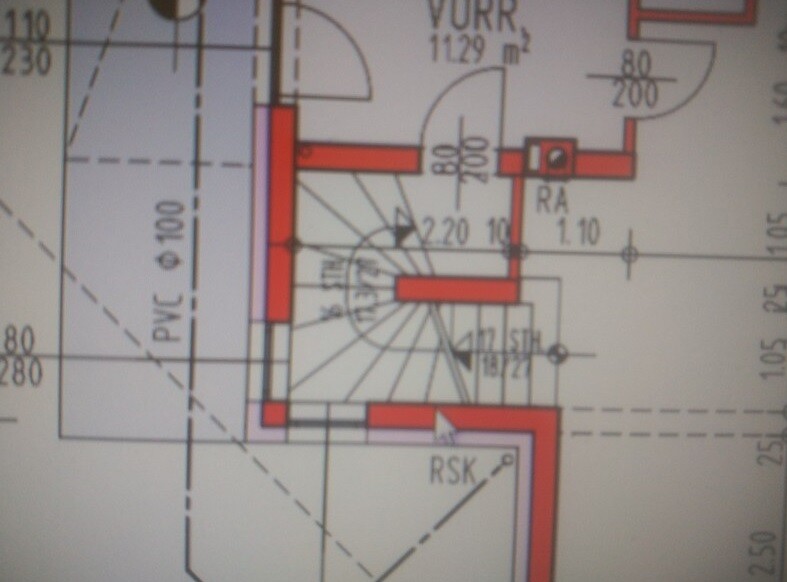
I have received a lot of negative feedback on this but have done further research and saw a stair design at a colleague’s place that allows this without issue (he has been living with it for a year now; photo to follow).
I also appreciate the note that the ground floor bathroom is somewhat too small, which is due to my planning approach (starting from a small floor plan) and my “planning naivety.”
We have looked at several kitchens in our circle of friends and family and are very satisfied with the kitchen size.
We wanted a U-shaped layout again (which we have now) with a maximum of 150 cm (60 inches) width between the rows. Our current kitchen is a bit smaller and without a pantry, meaning a few larger appliances are out in the open, but it’s still perfectly sufficient since we both cook regularly and my wife bakes a lot (luckily, she exercises enough).
We will build near the end of a small quiet cul-de-sac, with two houses on each side before and after us, so there is almost no traffic.
The immediate surroundings are quite flat, so no hillside or similar.
We’ve been debating the door in the dining area for a long time; I’m the only one who really wants it. It will most likely be replaced with a window…
Me too; that has already been changed.
That’s very helpful and something I partly didn’t consider.
It’s also part of what I meant by having a “good planner,” e.g., optimizing windows, doors, and interior walls.
You are right about the rest—the planner will always look after the business side and may not necessarily argue against it (I’ll keep that in mind).
Again, you’re right. It was misunderstood—the attic is meant for things used twice a year or seasonally (winter jackets, Christmas decorations, possibly skis).
That is unfortunately very true; I can only do my best to stay objective.
Thank you very much
First of all, thank you again for your detailed post.
I’ll try to address all the points raised. Unfortunately, I phrased some things awkwardly.
richardm schrieb:
The living area on the ground floor contains a lot of “empty space.” This is not cost-efficient, but it enhances the feeling of space, so that’s good. I assume this is not the reason why all your other rooms are kept so small and sometimes cramped. On the upper floor, apart from the bedroom (which you apparently want quite small, although I don’t understand that), it’s still somewhat acceptable; the hallway on the upper floor is even quite “generous.” However, on the ground floor, all the other rooms are much too tight, especially considering their future use.
My approach to the size of the house was to try to design it as small as I believe is reasonably possible and then increase size or width at “critical” points.
I think it’s easier to enlarge some rooms here and there than to figure out which room you need to reduce by a few centimeters.
In my specific case, I am limited to a width of 18.16 m (60 feet), but I could go up to 5 m (16 feet) in depth.
richardm schrieb:
The hallway on the ground floor will feel like a long, narrow corridor. Especially because the corner next to the door to the office likely won’t be empty but filled with something like a coat rack. So even this “wider” part of the hallway will feel cramped. That doesn’t look very inviting and it’s impractical when four people come home at the same time—everyone will be in each other’s way. In my opinion, the entrance area of a house is often underrated in its importance.
As a first step, I increased the width by the additional 15 cm (6 inches) available and will probably also take another 10 cm (4 inches) from the garage.
In depth, I initially added 30 cm (12 inches), but that will probably increase a little more. I invested the full 30 cm in the hallway—thanks for your tips on that. Maybe I underestimated how narrow the hallway feels because in the 3D model it looks good. Also, for example, in my apartment building (a large residential tower), a roughly 20 m (65 feet) long and 150 cm (60 inches) wide corridor leads to the apartment, and I haven’t really noticed it negatively so far. [/QUOTE]
richardm schrieb:
I don’t even want to talk about the bathroom on the ground floor. It’s already not nice or inviting to use for young, healthy people (if the shower under the stairs even works), but in the case when one person needs help or care, it won’t work. Please consider this carefully. Even if the shower and toilet were swapped, the space wouldn’t increase, and assistance would be almost impossible. And then there’s the question: do you really want a bathroom without natural light in your house? Of course, it is doable, and with a controlled ventilation system, ventilation isn’t a big issue. But is a windowless (and far too small) bathroom really the goal in a house you design yourself, put in (presumably) all your money, and hope to live in for many years?
I agree with you about a bathroom without a window; that would really be a last resort and shouldn’t be planned in a new build.
I have received a lot of negative feedback on this but have done further research and saw a stair design at a colleague’s place that allows this without issue (he has been living with it for a year now; photo to follow).
I also appreciate the note that the ground floor bathroom is somewhat too small, which is due to my planning approach (starting from a small floor plan) and my “planning naivety.”
richardm schrieb:
The kitchen would be too small for us, but that is a very individual matter. I wonder where you want to put a freezer, for example. Now that you are two, a fridge-freezer combo is fine. With kids, it all gets tight. The pantry in the corner objectively doesn’t make sense. I like a pantry next to the kitchen too, but in your case you’ll have more storage if you simply furnish the corner with kitchen cabinets. That’s a bit more expensive but will give you more long-term satisfaction.
We have looked at several kitchens in our circle of friends and family and are very satisfied with the kitchen size.
We wanted a U-shaped layout again (which we have now) with a maximum of 150 cm (60 inches) width between the rows. Our current kitchen is a bit smaller and without a pantry, meaning a few larger appliances are out in the open, but it’s still perfectly sufficient since we both cook regularly and my wife bakes a lot (luckily, she exercises enough).
richardm schrieb:
What I don’t like is the staircase on the garden side. This takes up a lot of garden frontage that would be better used by the living area, dining area, or kitchen. Exception: if you have a nice view toward the street side (hillside?).
In this respect, I can understand the double door to the terrace (?) by the sofa. Why do you want to step outside from the dining area onto the street side? Apart from the fact that, according to the plan, the door will be blocked by the furniture in the dining area anyway. I think a window at the same height as the kitchen and office windows would make more sense here.
We will build near the end of a small quiet cul-de-sac, with two houses on each side before and after us, so there is almost no traffic.
The immediate surroundings are quite flat, so no hillside or similar.
We’ve been debating the door in the dining area for a long time; I’m the only one who really wants it. It will most likely be replaced with a window…
richardm schrieb:
Regarding the wardrobe room: I would prefer it as a walk-through room.
Me too; that has already been changed.
richardm schrieb:
Additionally, I would consider positioning the doors so that you can put cabinets behind them—that means leaving a structural opening width of at least 70 cm (28 inches), preferably 75–80 cm (30–32 inches). The same applies to window openings in the rooms so that you can place wardrobes against the full-height walls but still open the windows. You will need the wardrobes for storage.
That’s very helpful and something I partly didn’t consider.
It’s also part of what I meant by having a “good planner,” e.g., optimizing windows, doors, and interior walls.
You are right about the rest—the planner will always look after the business side and may not necessarily argue against it (I’ll keep that in mind).
richardm schrieb:
I don’t think the outbuilding is too large considering there is no basement, as criticized elsewhere, but please keep in mind that many things are not ideal to store in an outbuilding. The same goes for the attic. Sure, it’s possible, but climbing up the hatch is inconvenient and annoying, even if only a few times a year. Unfortunately, I know what I’m talking about. And when you get older, it will definitely be more annoying and impractical.
Again, you’re right. It was misunderstood—the attic is meant for things used twice a year or seasonally (winter jackets, Christmas decorations, possibly skis).
richardm schrieb:
A self-designed house is a very personal, almost intimate matter, and people tend to block out criticism when it doesn’t fit what they imagine.
That is unfortunately very true; I can only do my best to stay objective.
richardm schrieb:
Good luck!
Thank you very much
What do you want to convey with the attached floor plan?
Just because a 200cm (79 inches) outward-opening door fits under a staircase doesn’t mean you can shower there... A shower head should have some distance from the ceiling above; otherwise, the entire ceiling will get wet.
Also, just as a rough reference, the stair length here measures about 270cm (106 inches), but your plans show about 220cm (87 inches).
Just because a 200cm (79 inches) outward-opening door fits under a staircase doesn’t mean you can shower there... A shower head should have some distance from the ceiling above; otherwise, the entire ceiling will get wet.
Also, just as a rough reference, the stair length here measures about 270cm (106 inches), but your plans show about 220cm (87 inches).
Similar topics