
Hello everyone,
According to the district office, there is an issue with the building permit: the proposed location of the heat pump is not being accepted. The district office refers to a "guideline for improving protection against noise from stationary equipment."
Question: Has this guideline been legally established as binding in a law in Baden-Württemberg? In my opinion, the requirements are "can" rather than "must."
Specific details
Heat pump model: Weishaupt WWP L 12 AD
(According to my general contractor, Weishaupt does not offer a quieter heat pump.)
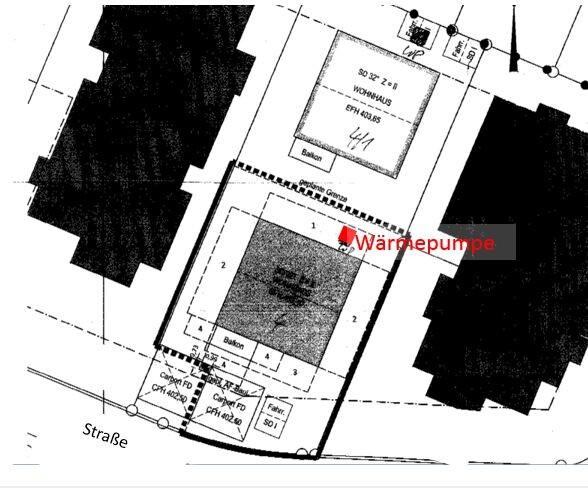
Heat pump location: See plan.
It should also be mentioned that this is a developed residential area, and the plot is a building gap. The buildings there were constructed in the 1980s/1990s. Accordingly, (oil) central heating systems are installed in the neighboring buildings, as there have been no new constructions. Therefore, there cannot be any heat pumps in the immediate vicinity.
Statement from the district office:
"If the heat pump were placed elsewhere, for example on the south side of the property, a greater distance to the neighbors would be possible. Due to the short distance to the house, reflections (within 3 m (10 feet) distance to a reflective surface) are to be expected. There may also be other noise sources in the vicinity."
"The planned location of the heat pump does not comply with the 'guideline for improving protection against noise from stationary equipment' in the following points:"
"According to the guideline, a maximum distance from and ideally a position facing away from the neighbors should be aimed for (see item 1 in the annex to the above-mentioned guideline).
"Given the tight building situation, internal or enclosed heat pumps, or heat pumps with significantly lower sound power levels, should be considered."
The unbelievable part:
The case officer at the district office even suggested to my general contractor that the whole house could basically be rotated so that the utility room (!) faces south, and then the heat pump location proposed by the district office on the south side would not result in long cables or pipes.
My reaction: "Seriously?"
Tomorrow I want to speak with the case officer myself.
Do you have any tips for how to proceed? Do you see good arguments I could raise?
Thank you for your input.
According to the district office, there is an issue with the building permit: the proposed location of the heat pump is not being accepted. The district office refers to a "guideline for improving protection against noise from stationary equipment."
Question: Has this guideline been legally established as binding in a law in Baden-Württemberg? In my opinion, the requirements are "can" rather than "must."
Specific details
Heat pump model: Weishaupt WWP L 12 AD
(According to my general contractor, Weishaupt does not offer a quieter heat pump.)
Heat pump location: See plan.
It should also be mentioned that this is a developed residential area, and the plot is a building gap. The buildings there were constructed in the 1980s/1990s. Accordingly, (oil) central heating systems are installed in the neighboring buildings, as there have been no new constructions. Therefore, there cannot be any heat pumps in the immediate vicinity.
Statement from the district office:
"If the heat pump were placed elsewhere, for example on the south side of the property, a greater distance to the neighbors would be possible. Due to the short distance to the house, reflections (within 3 m (10 feet) distance to a reflective surface) are to be expected. There may also be other noise sources in the vicinity."
"The planned location of the heat pump does not comply with the 'guideline for improving protection against noise from stationary equipment' in the following points:"
"According to the guideline, a maximum distance from and ideally a position facing away from the neighbors should be aimed for (see item 1 in the annex to the above-mentioned guideline).
- Heat pumps must be installed according to the state of noise reduction technology in a way that additional noise emissions, for example due to reflections on walls, are avoided.
"Given the tight building situation, internal or enclosed heat pumps, or heat pumps with significantly lower sound power levels, should be considered."
The unbelievable part:
The case officer at the district office even suggested to my general contractor that the whole house could basically be rotated so that the utility room (!) faces south, and then the heat pump location proposed by the district office on the south side would not result in long cables or pipes.
My reaction: "Seriously?"
Tomorrow I want to speak with the case officer myself.
Do you have any tips for how to proceed? Do you see good arguments I could raise?
Thank you for your input.
B
bierkuh8325 Mar 2017 01:09I agree with Alex on this. The topic of noise is far too complex and influenced by many possible sources to establish a formal planning and approval process for it. Anyone with some knowledge in this area would just shake their head... This would mean several thousand euros in costs and probably result in excessive structural measures, simply because the planner prefers to be on the safe side. This guideline makes sense.
Noise is a special issue that is also perceived subjectively in different ways.
If there were to be regulations, then a mandatory measurement of the neighbor’s snoring noise with the window open should also be introduced... or the barking of the neighbor’s dog.
Noise is a special issue that is also perceived subjectively in different ways.
If there were to be regulations, then a mandatory measurement of the neighbor’s snoring noise with the window open should also be introduced... or the barking of the neighbor’s dog.

Hello,
here:
I wouldn’t be so sure about that. Until the last tightening of the eco-regulations, a gas boiler was practically unbeatable economically when you really add up all the costs over the system’s lifespan. Now, because of the eco-restrictions, you will have to install around 15 m² (160 ft²) of solar thermal on your roof instead of just 5 m² (54 ft²). That will likely mean an additional cost of about 5,000–8,000 euros. As a result, the total cost of ownership (TCO) of an air-to-water heat pump is now roughly equal to that of a gas boiler with solar thermal.
If you install a controlled mechanical ventilation system anyway, you might still manage with the smaller solar thermal system, which would almost certainly make the gas condensing boiler cheaper.
By far, the most affordable heating system remains the gas condensing boiler without solar thermal.
Best regards,
Andreas
here:
FranzKa schrieb:
Gas with solar thermal is uneconomical!
I wouldn’t be so sure about that. Until the last tightening of the eco-regulations, a gas boiler was practically unbeatable economically when you really add up all the costs over the system’s lifespan. Now, because of the eco-restrictions, you will have to install around 15 m² (160 ft²) of solar thermal on your roof instead of just 5 m² (54 ft²). That will likely mean an additional cost of about 5,000–8,000 euros. As a result, the total cost of ownership (TCO) of an air-to-water heat pump is now roughly equal to that of a gas boiler with solar thermal.
If you install a controlled mechanical ventilation system anyway, you might still manage with the smaller solar thermal system, which would almost certainly make the gas condensing boiler cheaper.
By far, the most affordable heating system remains the gas condensing boiler without solar thermal.
Best regards,
Andreas
Hello everyone.
Legally, it is as follows:
If the development plan includes a requirement (not just a note) regarding sound emissions or immission levels (e.g., only a sound power level of xx dB or a limit of xx dB at the property boundary), you should follow the instructions of the local authority (LRA).
The LAI guideline has NO legal binding effect, unless there are specific requirements in the development plan.
Regarding regulations in building permits: IT DOES NOT MATTER.
Approve and build as you wish. If noise disputes arise later with neighbors and the local authority, only the limits set by the TA Lärm (Technical Instructions on Noise Protection) are relevant. Compliance with the TA Lärm noise limits (general residential area 40/55 dB) at the neighbor’s living room window (which must be open), kitchen (with dining table) or bedroom can be roughly calculated: Using a noise calculator based on the system’s sound power level, you calculate the immission at, for example, 4 meters (13 feet); the immission decreases by 6 dB for every doubling of the distance, or you can simply enter the correct distance.
If the TA Lärm limit values are met, the local authority has NO grounds to take action against the installation.
The neighbor will then likely be unhappy.
OF COURSE, this is not good...
Such an approach is therefore...
cheers
Legally, it is as follows:
If the development plan includes a requirement (not just a note) regarding sound emissions or immission levels (e.g., only a sound power level of xx dB or a limit of xx dB at the property boundary), you should follow the instructions of the local authority (LRA).
The LAI guideline has NO legal binding effect, unless there are specific requirements in the development plan.
Regarding regulations in building permits: IT DOES NOT MATTER.
Approve and build as you wish. If noise disputes arise later with neighbors and the local authority, only the limits set by the TA Lärm (Technical Instructions on Noise Protection) are relevant. Compliance with the TA Lärm noise limits (general residential area 40/55 dB) at the neighbor’s living room window (which must be open), kitchen (with dining table) or bedroom can be roughly calculated: Using a noise calculator based on the system’s sound power level, you calculate the immission at, for example, 4 meters (13 feet); the immission decreases by 6 dB for every doubling of the distance, or you can simply enter the correct distance.
If the TA Lärm limit values are met, the local authority has NO grounds to take action against the installation.
The neighbor will then likely be unhappy.
OF COURSE, this is not good...
Such an approach is therefore...
cheers
I forgot to mention something.
Keep the required setback distances, meaning you should definitely not build the structure closer than 3m (10 feet) to the property boundary, unless it is a permitted building (garage, storage room) within the building limits and not on the garage roof. Setback areas are allowed on public land (street, public park...).
In Bavaria, no heating systems are allowed in permitted buildings; this may also apply to heat pumps.
Keep the required setback distances, meaning you should definitely not build the structure closer than 3m (10 feet) to the property boundary, unless it is a permitted building (garage, storage room) within the building limits and not on the garage roof. Setback areas are allowed on public land (street, public park...).
In Bavaria, no heating systems are allowed in permitted buildings; this may also apply to heat pumps.
K
Knallkörper5 Apr 2017 13:27bierkuh83 schrieb:
I agree with Alex. Noise is a very complex issue with many possible sources of disturbance, making it unsuitable for initiating a planning and approval process here. Anyone with some knowledge of the subject would just shake their head...No. Noise is an everyday issue, and corresponding planning and approval procedures have existed for a long time—just not in residential construction. In my view, the manufacturer should be liable for any incorrect declaration of the sound power level. I assume this is not legally problematic. Then it’s up to the contractor to ensure correct installation. If a noise prediction has to be calculated for this—so what? In my opinion, the neighbors’ need for protection outweighs the additional effort in planning and execution.
Telis schrieb:
Legally, it looks like this:
If the zoning plan includes a regulation (not just a note) regarding sound emissions or immissions (e.g., only sound power levels of xx dB or limits of xxdB at the property boundary must be observed), you should follow the instructions of the local regulatory authority.
The LAI guideline has NO legal binding effectA guideline can also be recognized as a rule of technology, so your statement is not correct.
Somehow the discussion is drifting off. The starting point is that a single new building is being inserted into a gap within an old residential area. According to the attached drawing, it is quite large and significantly impacts the south-facing garden of the northern neighbor, which is now completely shaded. Since this is happening in Germany, not in Morocco, the shading is probably not very welcome. Additionally, they want to install the noisy unit there as well. Noise and shade — I would be absolutely thrilled. In this case, the location of the pump is really unacceptable. The authorities are completely right.
What to do now? Since the old residential area likely has natural gas available at the street, it would make sense to plan a condensing boiler and some solar thermal panels. Or, instead of the heat pump, place that bulky system on the south side.
What to do now? Since the old residential area likely has natural gas available at the street, it would make sense to plan a condensing boiler and some solar thermal panels. Or, instead of the heat pump, place that bulky system on the south side.
Similar topics