
ᐅ Tips/Insulation Concept for My Garage/Converting the Attic? Including Sketch
Created on: 29 Mar 2017 13:54
F
fizzzleHello everyone!
It’s great that this forum exists. I’ll just jump right in.
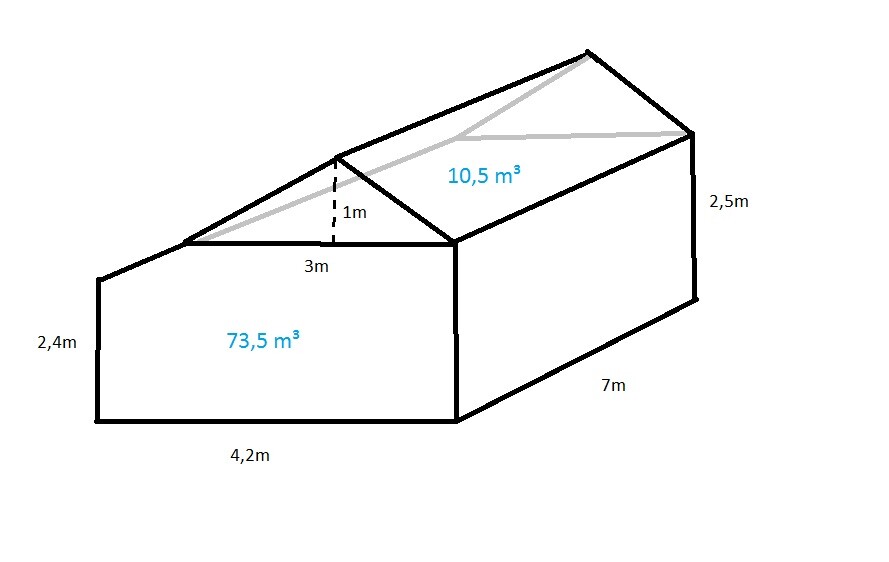
I have a detached wooden garage that is free on all sides. The garage is built as shown in the sketch. That means there is a small extension on the left side, which is directly connected to the garage space – basically enlarging the “original garage.” On top of that is a gable roof … see the sketch. The roof is directly connected to the garage room – so it’s basically one large space. There is no separate attic floor dividing the garage into two rooms!
The goal: I want to be able to work in my garage during winter/autumn without freezing. So the garage needs to be insulated. That’s no problem – I was thinking of using 100mm (4 inches) thick Neopor for insulation. The heat source would be a medium-sized stove with fireclay bricks.
Now the question:
Option 1: I leave the garage as it is and insulate it completely: exterior walls + roof. Then I have an 84m³ (2,965 ft³) space to heat – the warm air first goes up to the roof and only slowly comes back down.
Option 2: I build a conventional attic floor, meaning a ceiling that separates the roof from the garage space and insulate that normally – then I would only have 73.5m³ (2,595 ft³) of space to heat.
-> It’s clear that option 2 is better energy-wise! The warm air doesn’t just collect “uselessly” under the roof and it heats up faster. However, option 2 is much more expensive because you first have to build the attic floor. So, with option 1, could you say “Yes, you just have to wait 5 minutes longer for it to get warm,” or is the difference really significant? In other words, is installing the attic floor worth it?
I’d appreciate any advice and especially any experience!
Sketch:
Best regards!
It’s great that this forum exists. I’ll just jump right in.
I have a detached wooden garage that is free on all sides. The garage is built as shown in the sketch. That means there is a small extension on the left side, which is directly connected to the garage space – basically enlarging the “original garage.” On top of that is a gable roof … see the sketch. The roof is directly connected to the garage room – so it’s basically one large space. There is no separate attic floor dividing the garage into two rooms!
The goal: I want to be able to work in my garage during winter/autumn without freezing. So the garage needs to be insulated. That’s no problem – I was thinking of using 100mm (4 inches) thick Neopor for insulation. The heat source would be a medium-sized stove with fireclay bricks.
Now the question:
Option 1: I leave the garage as it is and insulate it completely: exterior walls + roof. Then I have an 84m³ (2,965 ft³) space to heat – the warm air first goes up to the roof and only slowly comes back down.
Option 2: I build a conventional attic floor, meaning a ceiling that separates the roof from the garage space and insulate that normally – then I would only have 73.5m³ (2,595 ft³) of space to heat.
-> It’s clear that option 2 is better energy-wise! The warm air doesn’t just collect “uselessly” under the roof and it heats up faster. However, option 2 is much more expensive because you first have to build the attic floor. So, with option 1, could you say “Yes, you just have to wait 5 minutes longer for it to get warm,” or is the difference really significant? In other words, is installing the attic floor worth it?
I’d appreciate any advice and especially any experience!
Sketch:
Best regards!
S
Steffen8029 Mar 2017 14:25We built an insulated and heated garage right away (connected to the house gas system, with a second high-flow supply). It is also important to insulate the floor slab. Overall, our approximately 35 m² (375 sq ft) garage cost around 40,000 EUR.
If I were to choose, I would go with option 2. You also get nice storage space upstairs.
If I were to choose, I would go with option 2. You also get nice storage space upstairs.
Steffen80 schrieb:
If I were to choose, I’d go with option 2. You also get nice storage space on top.Sure, that’s true! Maybe I should have phrased my question more precisely: I’m purely interested in the thermodynamics. How does option 2 improve the effect? Does anyone have a rule of thumb? Or can someone apply some physical concepts? For example, how much more energy would be needed to basically heat the roof first and then the garage space, or how long it would take for the heat to descend...
-> Unfortunately, the floor isn’t insulated—unfortunately! As mentioned, it’s an old wooden garage...
Thanks and best regards!
K
Knallkörper29 Mar 2017 21:08Compared to the walls and furnishings of your garage, the air volume has only a low heat capacity. This means the air heats up quickly. Especially when starting the heating, there is stronger convection due to the initial temperature differences, so the warm air mixes more with the cold air instead of staying at the top. On the other hand, including the roof space increases the exposed surface area, and the roof is often the least insulated part.
In general, I would advise against insulating garages for heat retention. If you can get firewood cheaply, it probably isn’t worth it. Insulation can also create risks elsewhere, such as condensation issues in summer.
In general, I would advise against insulating garages for heat retention. If you can get firewood cheaply, it probably isn’t worth it. Insulation can also create risks elsewhere, such as condensation issues in summer.
K
Knallkörper29 Mar 2017 21:11Steffen80 schrieb:
We built a garage that is both insulated and heated from the start (connected to the house gas system, with a second high-temperature supply line). It’s also important that the slab is insulated. In total, the approximately 35sqm (375 sq ft) garage cost us about 40,000 EUR.For you, costs are always 30 or 50% higher than expected. Although we paid about the same amount, our garage is significantly larger and was built with a cavity wall construction including core insulation and brick facing.
Similar topics