
Hello everyone,
According to the district office, there is an issue with the building permit: the proposed location of the heat pump is not being accepted. The district office refers to a "guideline for improving protection against noise from stationary equipment."
Question: Has this guideline been legally established as binding in a law in Baden-Württemberg? In my opinion, the requirements are "can" rather than "must."
Specific details
Heat pump model: Weishaupt WWP L 12 AD
(According to my general contractor, Weishaupt does not offer a quieter heat pump.)
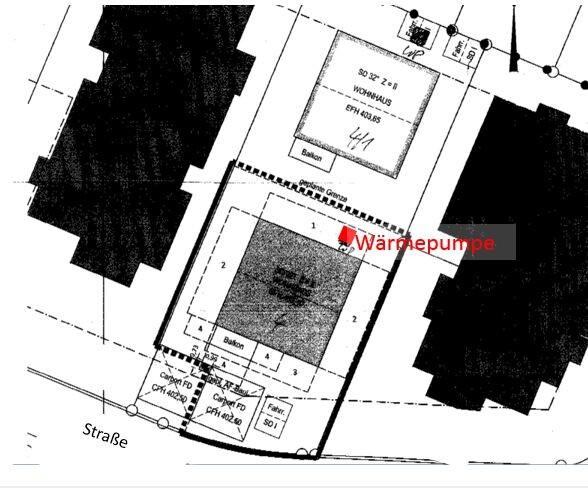
Heat pump location: See plan.
It should also be mentioned that this is a developed residential area, and the plot is a building gap. The buildings there were constructed in the 1980s/1990s. Accordingly, (oil) central heating systems are installed in the neighboring buildings, as there have been no new constructions. Therefore, there cannot be any heat pumps in the immediate vicinity.
Statement from the district office:
"If the heat pump were placed elsewhere, for example on the south side of the property, a greater distance to the neighbors would be possible. Due to the short distance to the house, reflections (within 3 m (10 feet) distance to a reflective surface) are to be expected. There may also be other noise sources in the vicinity."
"The planned location of the heat pump does not comply with the 'guideline for improving protection against noise from stationary equipment' in the following points:"
"According to the guideline, a maximum distance from and ideally a position facing away from the neighbors should be aimed for (see item 1 in the annex to the above-mentioned guideline).
"Given the tight building situation, internal or enclosed heat pumps, or heat pumps with significantly lower sound power levels, should be considered."
The unbelievable part:
The case officer at the district office even suggested to my general contractor that the whole house could basically be rotated so that the utility room (!) faces south, and then the heat pump location proposed by the district office on the south side would not result in long cables or pipes.
My reaction: "Seriously?"
Tomorrow I want to speak with the case officer myself.
Do you have any tips for how to proceed? Do you see good arguments I could raise?
Thank you for your input.
According to the district office, there is an issue with the building permit: the proposed location of the heat pump is not being accepted. The district office refers to a "guideline for improving protection against noise from stationary equipment."
Question: Has this guideline been legally established as binding in a law in Baden-Württemberg? In my opinion, the requirements are "can" rather than "must."
Specific details
Heat pump model: Weishaupt WWP L 12 AD
(According to my general contractor, Weishaupt does not offer a quieter heat pump.)
Heat pump location: See plan.
It should also be mentioned that this is a developed residential area, and the plot is a building gap. The buildings there were constructed in the 1980s/1990s. Accordingly, (oil) central heating systems are installed in the neighboring buildings, as there have been no new constructions. Therefore, there cannot be any heat pumps in the immediate vicinity.
Statement from the district office:
"If the heat pump were placed elsewhere, for example on the south side of the property, a greater distance to the neighbors would be possible. Due to the short distance to the house, reflections (within 3 m (10 feet) distance to a reflective surface) are to be expected. There may also be other noise sources in the vicinity."
"The planned location of the heat pump does not comply with the 'guideline for improving protection against noise from stationary equipment' in the following points:"
"According to the guideline, a maximum distance from and ideally a position facing away from the neighbors should be aimed for (see item 1 in the annex to the above-mentioned guideline).
- Heat pumps must be installed according to the state of noise reduction technology in a way that additional noise emissions, for example due to reflections on walls, are avoided.
"Given the tight building situation, internal or enclosed heat pumps, or heat pumps with significantly lower sound power levels, should be considered."
The unbelievable part:
The case officer at the district office even suggested to my general contractor that the whole house could basically be rotated so that the utility room (!) faces south, and then the heat pump location proposed by the district office on the south side would not result in long cables or pipes.
My reaction: "Seriously?"
Tomorrow I want to speak with the case officer myself.
Do you have any tips for how to proceed? Do you see good arguments I could raise?
Thank you for your input.
Understood. Build a house, buy an air-to-water heat pump, and whether it will be approved afterwards is then up to the planning permission lottery. Sorry, what you’re suggesting is an expensive bureaucratic nightmare full of major uncertainties. Absurd.
And then add the heat pump inspection afterwards to check something that doesn’t need checking.
And then add the heat pump inspection afterwards to check something that doesn’t need checking.
Alex85 schrieb:
expensive bureaucratic monster I don’t see how the implementation of the 1st Federal Immission Control Ordinance for small combustion plants is an expensive bureaucratic monster. Could you explain that to me?
Alex85 schrieb:
major uncertainties 1. How reliable is the sound power level specified by the manufacturer?
2. Does the equipment installation comply with current state-of-the-art standards?
At the moment, I would consider these as uncertainties. Once a comprehensive tool for planning and execution control is established, these uncertainties will approach zero (see again: small combustion plants).
I also don’t see major uncertainties here—what exactly are you referring to?
MayrCh schrieb:
I don't see how the implementation of the 1st Federal Immission Control Ordinance for small combustion units is an expensive bureaucratic monster. Could you explain that to me?This is not about small combustion units.
But since you can't let that go: The difference is that the inspection for small combustion units is ultimately just a formality. The products and installations are subject to certain standards, so it can be assumed that a proper installation will pose no problem during inspection.
Your suggestion regarding noise measurement on the actual object is entirely different. This is unpredictable because it heavily depends on local conditions. Imagine installing an air-to-water heat pump and then, at acceptance, discovering that the neighboring building, its shed or roof tiles, reflect sound in a very specific way, causing the measurement to fail. What would you do then? Tear down the heat pump? Dig up the ground and move it to the other side of the property? Nonsense. If there were such a rule, heat pumps would be dead in the water because there would be a big risk that the new installation would have to be removed again. That would effectively be an implicit ban.
MayrCh schrieb:
1. How reliable is the sound power level specified by the manufacturer?
2. Does the device installation conform to the state of the art?
I would currently regard these as uncertainties. Once a comprehensive tool for planning and execution control is established, these uncertainties will approach zero (see again: small combustion units).
I don't see major uncertainties here either—what are you referring to?The uncertainty arises from your approach of granting operating permits based on on-site measurements. Suddenly, in addition to device-specific factors and quality of installation, an incredible number of variables related to the location come into play. Therefore, before installing the system, it is completely unclear whether acceptance will be possible.
Likewise, regular checks, as required for gas boilers, are unnecessary here, since there is no (life) danger arising from lack of maintenance.
Moreover, not everything should be subjected to blanket control if it only poses a problem in a few cases. That is absolutely the wrong (uneconomical) approach. You might as well get a stamp from the authorities certifying that your shoes are tied properly.
Alex85 schrieb:
The products and installations are subject to certain standards, so it can be assumed that, if installed correctly, approval will not be a problem. You’ve got it, that’s exactly the point! That’s what my idea is about—focusing on this, as well as an optimized, well-thought-out location for the outdoor unit. By the way, the reason behind these “certain standards” was the legislator with the first Federal Immission Control Ordinance (1. BImSchV). The question is why air-to-water heat pumps aren’t also subject to a “certain standard.”
Alex85 schrieb:
So just place an air-to-water heat pump somewhere Hopefully, no one just installs an air-to-water heat pump without proper planning. It needs to be planned carefully, both from a heating technology and noise control perspective.
Alex85 schrieb:
…to then realize during the approval inspection… Noise measurement on the actual system afterward is then mostly a formality if a compatibility assessment has already been done during permitting. The same applies to gas, oil, and pellet heating systems, where only the emissions at the source are measured, not at the neighbors’ location; specifics of sound propagation and the source and receiver environment are already considered in the theoretical assessment. And no, this is not rocket science; it is done using situation-specific allowances—we’re still talking about a point-source noise here. The heat pump noise calculator from the Federal Heat Pump Association handles this quite well (based on the LAI guideline), with the almost exclusive weak point being the manufacturers’ somewhat random sound power levels for the units.
Alex85 schrieb:
Then what to do? Tear down the heat pump? Back to small-scale combustion units: What happens if your oil, gas, or pellet boiler does not meet the limit values of the 1. BImSchV during startup or a recurring inspection?
Alex85 schrieb:
An unbelievable number of variables No. These uncertainties are eliminated during the compatibility assessment in the permitting process—ideally already during the planning phase beforehand.
Alex85 schrieb:
So before installing the system, it is completely unclear whether approval is possible. See the assessment in the permitting process.
Alex85 schrieb:
Also, there is no need for regular checks like with gas boilers because there is no (life) hazard that could arise from lack of maintenance. Operating safety regulations have never been the topic here. The 1. BImSchV deals with air quality control and energy efficiency.
Alex85 schrieb:
Incidentally, you don’t have to subject something to a blanket control if it only poses a problem in a few cases. That’s a completely wrong (uneconomical) approach. You might as well get a stamp from the authorities confirming your shoes are tied correctly. If you follow that argument, periodic vehicle inspections (like MOT, TÜV, etc.) and any other recurring technical inspections would be obsolete. “Few cases” (and my professional experience suggests otherwise) are inevitably the result of recurring technical checks and are therefore an indication of their essential importance, not a reason to discard them.
T
toxicmolotof24 Mar 2017 23:38What kind of argument is "240sqm (2583 sq ft) house" when it comes to a ground source heat pump? By the same logic, an air-to-water heat pump would also be unsuitable.
Especially for a 240sqm (2583 sq ft) house, there should be enough space for a pellet boiler. Whether, for example, a deep geothermal borehole is worthwhile must be evaluated individually. In a favorable location, 180-200m (590-656 ft) deep should be sufficient.
Especially for a 240sqm (2583 sq ft) house, there should be enough space for a pellet boiler. Whether, for example, a deep geothermal borehole is worthwhile must be evaluated individually. In a favorable location, 180-200m (590-656 ft) deep should be sufficient.
Similar topics