
Hello,
today I would like to ask you again for what you do best: bringing a layperson’s naive ideas back down to reality.
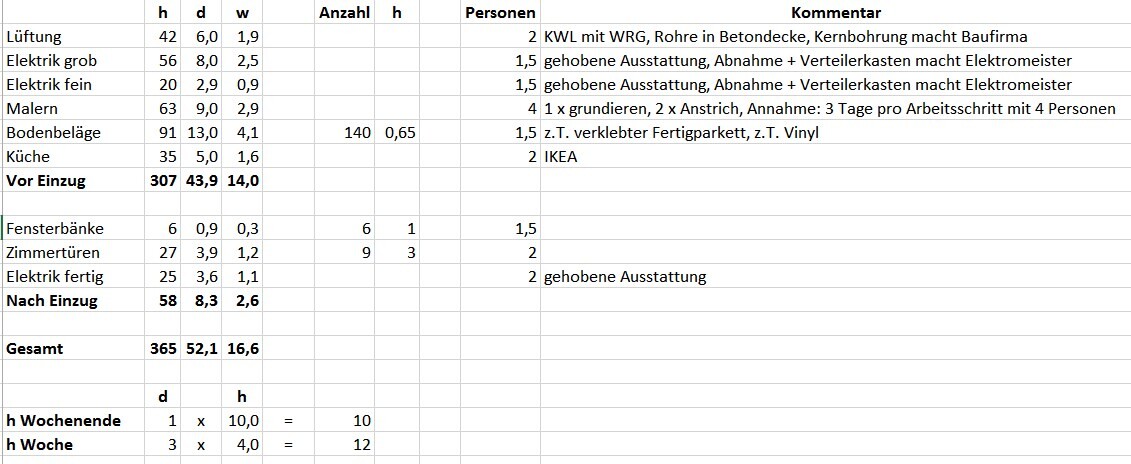
I hope the attached calculation is at least somewhat self-explanatory. It might be worth mentioning that in the estimates (h=hours, d=days, w=weeks) I have already taken the number of helpers into account. So these are not man-hours/days/weeks.
Many of you probably have more practical experience: would you consider these figures roughly realistic? Most of the tasks (those listed with 1.5 people) I will do more or less alone, with my wife as an assistant. There might be more active helpers, but I’m not counting on that for now. At least for the trades involved, I’m reasonably skilled but not exactly fast—at least until I get into a routine, then I can speed up quite a bit.
Best regards
today I would like to ask you again for what you do best: bringing a layperson’s naive ideas back down to reality.
I hope the attached calculation is at least somewhat self-explanatory. It might be worth mentioning that in the estimates (h=hours, d=days, w=weeks) I have already taken the number of helpers into account. So these are not man-hours/days/weeks.
Many of you probably have more practical experience: would you consider these figures roughly realistic? Most of the tasks (those listed with 1.5 people) I will do more or less alone, with my wife as an assistant. There might be more active helpers, but I’m not counting on that for now. At least for the trades involved, I’m reasonably skilled but not exactly fast—at least until I get into a routine, then I can speed up quite a bit.
Best regards
H
HilfeHilfe27 Feb 2017 07:12ONeill schrieb:
From my own experience, the electrical work is probably also underestimated. It really takes a lot of time.^^It's not just about that for me, but who takes on the liability here? I find it strange that an electrician would voluntarily do the distribution board.
I wouldn't want to do it that way.
E
elVincent27 Feb 2017 08:49We are also doing quite a lot of plaster-based finishing work; currently, the painting is in progress. Therefore, I can give a fairly accurate estimate of the time involved: Over the past two weekends, my brothers, father-in-law, and I have each been busy with painting tasks. If I divide the area completed by the hours spent, it comes to about 15 m² (160 sq ft) of wall surface for a single coat per person-hour.
At that point, the surfaces were fully prepared and primed, windows masked off, etc. This preparation time is in addition to the painting, and of course, most surfaces are painted twice.
We have about 450 m² (4,850 sq ft) of painting area that needs two coats, so a total of 900 m² (9,690 sq ft). This amounts to roughly 60 hours just for painting, plus the time required for masking, priming, and other wall preparations (we sanded all the plaster surfaces once with a pole sander, marked any defects, applied fine fillers, and sanded again).
In the window reveals, we found some minor surface cracks in the plaster, so we decided to cover these by embedding a reinforcing mesh into the paint. This means that the time spent on working on the window reveals in one room is roughly equal to the time spent painting the walls (this effort is already included in the 15 m² per hour figure).
Additionally, you need to factor in organizing the paints and tools—first getting an overview, selecting the paint, obtaining quotes, purchasing everything, and transporting it to the site. A recommendation here: professional-grade paints with the appropriate rollers are much easier to work with and produce better results than anything typically available at retail hardware stores.
In total, without the individual wall preparation, you will likely need more than 100 hours to complete the painting work.
Regarding what a homeowner can realistically manage: I have shifted my work hours at my job forward so that I have more time for the construction site in the evenings. Currently, I spend four evenings during the week (about 4 hours each), the whole Saturday (10 hours), and usually another 4–5 hours on Sunday at the site. This adds up to around 30 hours per week, which is quite demanding, but you know what you’re working towards. Also, it hasn’t always been that intense continuously.
What stresses me the most are the preparations before a weekend when helpers come. Everyone needs to have a task, the appropriate tools and materials must be ready, food and drinks must be organized, and so on. This also takes time and sometimes costs me sleep. However, you get more experienced with this over time, and by the next house, you’ll be handling it much more easily :-p
At that point, the surfaces were fully prepared and primed, windows masked off, etc. This preparation time is in addition to the painting, and of course, most surfaces are painted twice.
We have about 450 m² (4,850 sq ft) of painting area that needs two coats, so a total of 900 m² (9,690 sq ft). This amounts to roughly 60 hours just for painting, plus the time required for masking, priming, and other wall preparations (we sanded all the plaster surfaces once with a pole sander, marked any defects, applied fine fillers, and sanded again).
In the window reveals, we found some minor surface cracks in the plaster, so we decided to cover these by embedding a reinforcing mesh into the paint. This means that the time spent on working on the window reveals in one room is roughly equal to the time spent painting the walls (this effort is already included in the 15 m² per hour figure).
Additionally, you need to factor in organizing the paints and tools—first getting an overview, selecting the paint, obtaining quotes, purchasing everything, and transporting it to the site. A recommendation here: professional-grade paints with the appropriate rollers are much easier to work with and produce better results than anything typically available at retail hardware stores.
In total, without the individual wall preparation, you will likely need more than 100 hours to complete the painting work.
Regarding what a homeowner can realistically manage: I have shifted my work hours at my job forward so that I have more time for the construction site in the evenings. Currently, I spend four evenings during the week (about 4 hours each), the whole Saturday (10 hours), and usually another 4–5 hours on Sunday at the site. This adds up to around 30 hours per week, which is quite demanding, but you know what you’re working towards. Also, it hasn’t always been that intense continuously.
What stresses me the most are the preparations before a weekend when helpers come. Everyone needs to have a task, the appropriate tools and materials must be ready, food and drinks must be organized, and so on. This also takes time and sometimes costs me sleep. However, you get more experienced with this over time, and by the next house, you’ll be handling it much more easily :-p
The main problem often comes down to a lack of expertise. If you’re a tradesperson who works on construction sites every day and is fully proficient in the relevant trades, you can accomplish a lot of the work yourself. However, if you are a complete beginner, just figuring out the basics can take you half as much time as a professional needs to complete the entire job. And the outcome will reflect that. It’s like the saying, “I did everything myself” – “Yeah, you can tell!”
For example, assembling a kitchen for the first time will probably take three times as long as doing it the fifth time, and you will quite likely have to buy a second countertop. Many things are possible, but you shouldn’t overestimate your own skills or motivation. Focus on the “simple” tasks like painting and, if you want, flooring.
Installing a ventilation system quickly? I’m not sure it’s that simple.
And electrical work is another matter entirely. You have lots of professionals, but only unskilled helpers show up? My electrician takes 2-3 minutes to connect an RJ45 socket to a Cat7 installation cable. I gave up after 1.5 hours trying with one socket.
An 8-month construction period until moving in when doing these DIY tasks seems like pure fantasy to me. Even for professionals, 8 months is often hard to achieve.
One more note: Installing interior doors AFTER moving in? I imagine that would be quite cozy, especially in the guest bathroom.
For example, assembling a kitchen for the first time will probably take three times as long as doing it the fifth time, and you will quite likely have to buy a second countertop. Many things are possible, but you shouldn’t overestimate your own skills or motivation. Focus on the “simple” tasks like painting and, if you want, flooring.
Installing a ventilation system quickly? I’m not sure it’s that simple.
And electrical work is another matter entirely. You have lots of professionals, but only unskilled helpers show up? My electrician takes 2-3 minutes to connect an RJ45 socket to a Cat7 installation cable. I gave up after 1.5 hours trying with one socket.
An 8-month construction period until moving in when doing these DIY tasks seems like pure fantasy to me. Even for professionals, 8 months is often hard to achieve.
One more note: Installing interior doors AFTER moving in? I imagine that would be quite cozy, especially in the guest bathroom.
C
Caspar202028 Feb 2017 15:43apokolok schrieb:
Connecting an RJ45 jack to the Cat7 installation cable takes 2–3 minutes. I gave up after 1.5 hours on one jack ^^.@apokolok: And that as an IT professional?
@stefanc84: Of course, you can put a lot of effort into electrical work; but you should also expect it to take a few weeks or months longer. The question you have to ask yourselves is: can we afford that? Financially and mentally?
C
Caspar202028 Feb 2017 15:45And something that is completely overlooked in your list is the move itself. Boxes don’t pack themselves.

HilfeHilfe schrieb:
It's not just about that, but who takes responsibility here? I find it strange that an electrician would volunteer to do the distribution board.
I wouldn't want to do it that way I would also stay away from the electrical work. If something goes wrong, I don’t want to argue with the insurance company.
Similar topics