
ᐅ Water damage. Possible puncture of the underfloor heating system?
Created on: 5 Feb 2017 17:16
U
uwe81
Hello!
We moved into our new single-family house nearly two years ago. Last late summer, the laminate flooring in the hallway in front of the bathroom started to warp. At first, I thought, “Oh no, since I installed it myself, maybe I didn’t leave enough expansion gaps, and now it’s expanding due to the heat.” Now the problem has appeared again, much worse this time, so I wanted to repair it. That’s when I noticed that the entire screed is wet.
We see about 1 square meter (about 11 square feet) of wet screed in front of the bathroom door. Of course, I don’t know how wet it is under the bathroom tiles. Since we are still under warranty, the question for me is who is responsible…
I installed the floor (click laminate) myself. Unfortunately, I screwed the transition profile to the bathroom floor, which means I drilled into it (yes, I know now that was a bad idea—I had a bad feeling back then but relied on advice from the hardware store). So it’s possible that I damaged the underfloor heating. I tried not to drill too deep (the anchors are 3cm (1.2 inches) long) and used a depth stop while drilling.
My main question is: If it came from the underfloor heating, shouldn’t a significant pressure drop be measurable in the heating system? I have never refilled water. The last maintenance was last spring. The chimney sweep in autumn definitely wouldn’t have refilled anything either. We currently still have just under 1.5 bar (about 22 psi) pressure shown on the heating gauge in the basement, although the leak would be on the upper floor, about 6 meters (about 20 feet) higher.
The builder and my insurance have already been informed.
* Could this come from the underfloor heating, and if so, how can I find out?
* If yes, what steps would be necessary for repair (this is probably guesswork without inspecting the damage), and what kind of costs might be involved (my estimate is several thousand)?
* Would a good insurance policy typically cover this kind of damage (we have comprehensive coverage with Debeka)?
Thanks a lot for any advice,
Uwe
We moved into our new single-family house nearly two years ago. Last late summer, the laminate flooring in the hallway in front of the bathroom started to warp. At first, I thought, “Oh no, since I installed it myself, maybe I didn’t leave enough expansion gaps, and now it’s expanding due to the heat.” Now the problem has appeared again, much worse this time, so I wanted to repair it. That’s when I noticed that the entire screed is wet.
We see about 1 square meter (about 11 square feet) of wet screed in front of the bathroom door. Of course, I don’t know how wet it is under the bathroom tiles. Since we are still under warranty, the question for me is who is responsible…
I installed the floor (click laminate) myself. Unfortunately, I screwed the transition profile to the bathroom floor, which means I drilled into it (yes, I know now that was a bad idea—I had a bad feeling back then but relied on advice from the hardware store). So it’s possible that I damaged the underfloor heating. I tried not to drill too deep (the anchors are 3cm (1.2 inches) long) and used a depth stop while drilling.
My main question is: If it came from the underfloor heating, shouldn’t a significant pressure drop be measurable in the heating system? I have never refilled water. The last maintenance was last spring. The chimney sweep in autumn definitely wouldn’t have refilled anything either. We currently still have just under 1.5 bar (about 22 psi) pressure shown on the heating gauge in the basement, although the leak would be on the upper floor, about 6 meters (about 20 feet) higher.
The builder and my insurance have already been informed.
* Could this come from the underfloor heating, and if so, how can I find out?
* If yes, what steps would be necessary for repair (this is probably guesswork without inspecting the damage), and what kind of costs might be involved (my estimate is several thousand)?
* Would a good insurance policy typically cover this kind of damage (we have comprehensive coverage with Debeka)?
Thanks a lot for any advice,
Uwe

Hello!
Sorry for not getting back to you for a few days; I was abroad for work...
So: The developer visited and measured the moisture levels, identifying the transition area between the bathroom and hallway as the likely source. Therefore, he suspected the underfloor heating, even though it seemed odd to him that no pressure was lost.
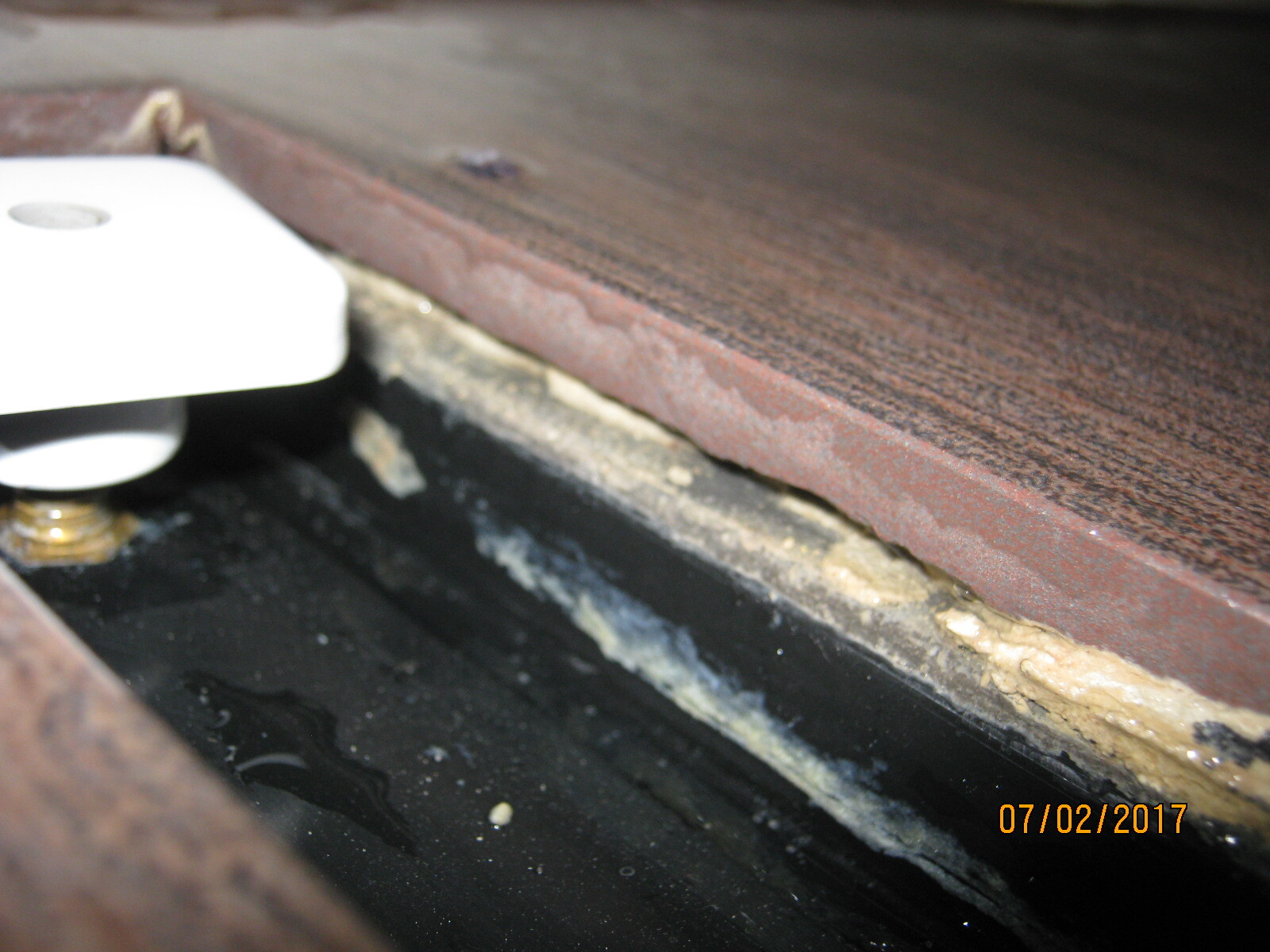
The following day, a leak detection company (sent by the insurance) came. They quickly suspected the shower. We have a tiled shower. The tiles are glued onto a substructure tray, which is sealed against the wall and screed with waterproof tape. Now, there is a gap between the drainage channel and the tiles (see attachment) that is not sealed. This was suspected as the source of the leak. Indeed, during the inspection, the drain was blocked, yet some water still "disappeared" from the shower within about half an hour.
The tiler said he would install it like that everywhere and has never had any problems so far. That seems plausible at first because he has worked with our developer for a long time, and the developer has an excellent reputation (we know many people who have built with them).
The leak detection company also performed pressure tests on the cold and hot water systems (all tight) and completely ruled out the underfloor heating.
Conclusion:
We don’t really know for sure. If it was the shower, the problem has been fixed, but I am not entirely certain. We currently have no other plausible causes. The insurance is covering the drying and the replacement of the laminate flooring.
The often-mentioned theory of a one-time damage event still remains but we can definitely rule that out ourselves.
Thank you very much for your support,
uwe81
Sorry for not getting back to you for a few days; I was abroad for work...
So: The developer visited and measured the moisture levels, identifying the transition area between the bathroom and hallway as the likely source. Therefore, he suspected the underfloor heating, even though it seemed odd to him that no pressure was lost.
The following day, a leak detection company (sent by the insurance) came. They quickly suspected the shower. We have a tiled shower. The tiles are glued onto a substructure tray, which is sealed against the wall and screed with waterproof tape. Now, there is a gap between the drainage channel and the tiles (see attachment) that is not sealed. This was suspected as the source of the leak. Indeed, during the inspection, the drain was blocked, yet some water still "disappeared" from the shower within about half an hour.
The tiler said he would install it like that everywhere and has never had any problems so far. That seems plausible at first because he has worked with our developer for a long time, and the developer has an excellent reputation (we know many people who have built with them).
The leak detection company also performed pressure tests on the cold and hot water systems (all tight) and completely ruled out the underfloor heating.
Conclusion:
We don’t really know for sure. If it was the shower, the problem has been fixed, but I am not entirely certain. We currently have no other plausible causes. The insurance is covering the drying and the replacement of the laminate flooring.
The often-mentioned theory of a one-time damage event still remains but we can definitely rule that out ourselves.
Thank you very much for your support,
uwe81
Hello!
This was the condition before the tile installer made the corrections. It has now been repaired, and these joints have been sealed with grout. According to the tile installer, this area does not need to be waterproof—and it isn’t—because the tile adhesive under the tiles (you can see the edge) rests on a waterproof membrane below and is sealed on the sides with sealing tape against the screed and the masonry.
Whether there is an issue with this waterproofing can of course not be determined without removing the tiles.
Best regards,
uwe81
This was the condition before the tile installer made the corrections. It has now been repaired, and these joints have been sealed with grout. According to the tile installer, this area does not need to be waterproof—and it isn’t—because the tile adhesive under the tiles (you can see the edge) rests on a waterproof membrane below and is sealed on the sides with sealing tape against the screed and the masonry.
Whether there is an issue with this waterproofing can of course not be determined without removing the tiles.
Best regards,
uwe81
B
Bieber081512 Feb 2017 00:19uwe81 schrieb:
Still, within about half an hour, some water disappeared from the shower.uwe81 schrieb:
We don’t know for sure. If it was the shower, the issue was fixed, but I’m not completely certain. Can you repeat the test?Similar topics