
ᐅ Floor plans for a single-family house, approximately 1,500 sq ft (140 m²), without a basement
Created on: 1 Nov 2016 14:14
S
stefanvery
Development Plan / Restrictions
Plot size: 439 sqm (4720 sq ft)
Slope: yes, approx. 1.3 m (4 ft) descent across the plot, approx. 0.5 m (1.6 ft) in the house area
Site occupancy index (floor space ratio): 0.35
Floor area ratio (FAR): 0.6
Building window, building line and boundary: see development plan
Border development:
Number of parking spaces: 2
Number of storeys: 2
Roof style: any
Architectural style: any
Orientation: southeast or southwest
Maximum height / limits: 10 m (33 ft) above street curb level
Further requirements
Homeowners’ Requirements
Style, roof type, building type: gable roof
Basement, floors: 1.5 floors without basement, approx. 1.25 m (4 ft) knee wall height
Number of occupants, age: 2 adults (32 years + 27 years), children planned
Space requirement on ground floor and upper floor: approx. 130 sqm (1400 sq ft)
Office: family use and home office
Guest sleeping per year: rare
Open or closed layout: closed
Traditional or modern design: mixed
Open kitchen, kitchen island: semi-open to dining room
Number of dining seats: 6
Fireplace: no
Heating: bio-district heating, no own heat generator in the house
Music / stereo wall: yes
Balcony, roof terrace: terraces to southeast and southwest
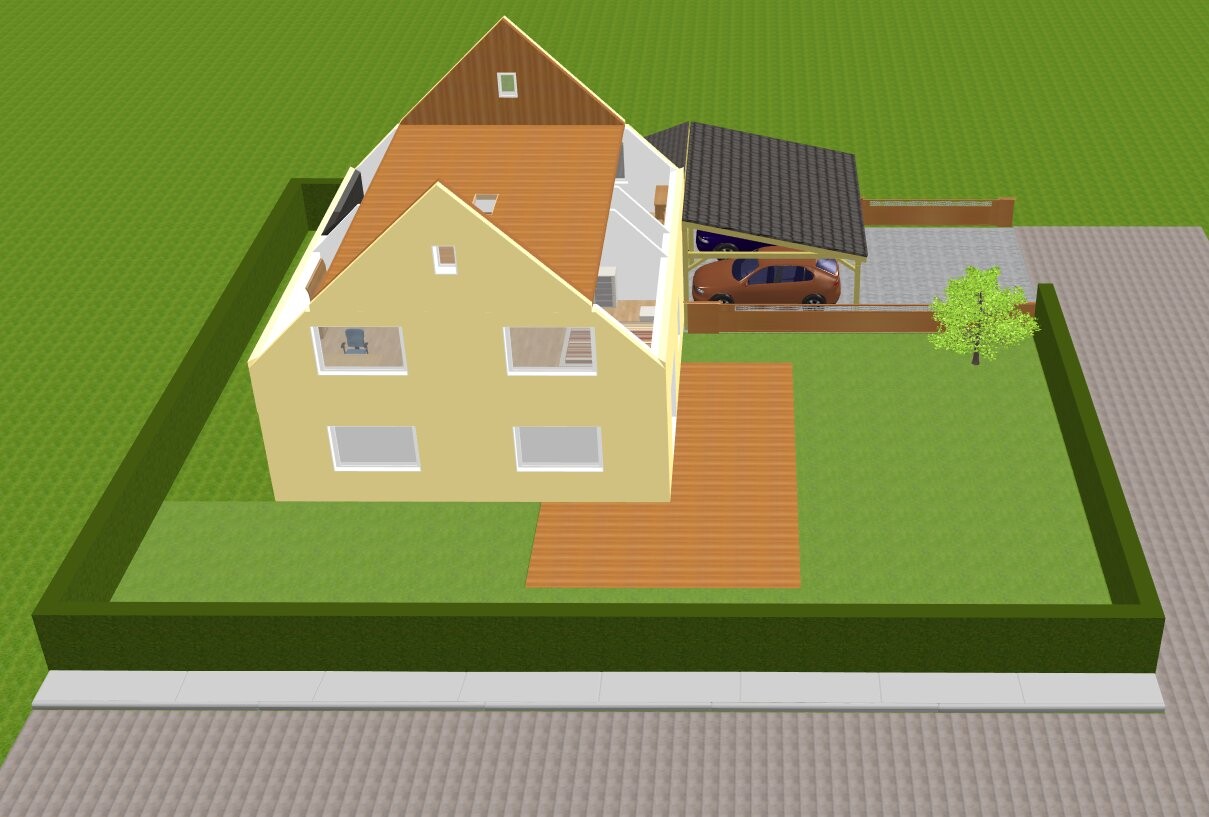
Garage, carport: 2 carports, 2 parking spaces in front of carport
Utility garden, greenhouse: yes
Other wishes / special features / daily routine: controlled residential ventilation, monolithic wall made of brick or aerated concrete. Due to the lack of a basement, the office and utility room must be located on the ground floor.
Owner’s work: flooring, painting, and installation of controlled residential ventilation
House Design
Who designed it: by us
What do you particularly like?
What do you dislike?
- We don’t find the entrance behind the carport ideal. However, with the rather small plot, there is hardly any alternative. An entrance facing south is not very good, as we want to use the south side for other rooms. If we put the carport completely behind or next to the house, the house moves too much towards the center of the plot, leaving hardly any meaningful garden space in any direction. Suggestions are very welcome here.
- When entering the bathroom, the first thing you see is the shower wall.
Price estimate according to architect/planner: depending on provider, 190,000 to 250,000, including special features, excluding ancillary building costs and materials for owner’s work
Personal budget limit for the house, including fittings: 210,000, including special features, excluding ancillary building costs and materials for owner’s work
Preferred heating technology: district heating available and mandatory
If you had to give up something, which details or extensions?
- Can you do without: actually nothing unnecessary planned
- Cannot do without: n/a
The exterior dimensions (10.24 m x 9.24 m / 33 ft 7 in x 30 ft 4 in) come from a Flair 134 – this provider has so far been by far the most affordable. The dimensions also fit our plot very well. After many other floor plans with different dimensions, we ultimately chose this one.
Basically, we are very satisfied with it; everything seems to be exactly the size we need. Nothing is too big, nothing too small. Of course, bigger would always be nicer.
Our only points of criticism are:
- the shower wall right in front when entering the bathroom
- the house entrance behind the carport. As a passage between the cars, about 1.40 m (4.6 ft) clearance is planned. Beyond that, there is a passage between the house wall and the shed, about 1.70 m (5.6 ft) wide.
What is your opinion on the overall floor plan and these two points of criticism?
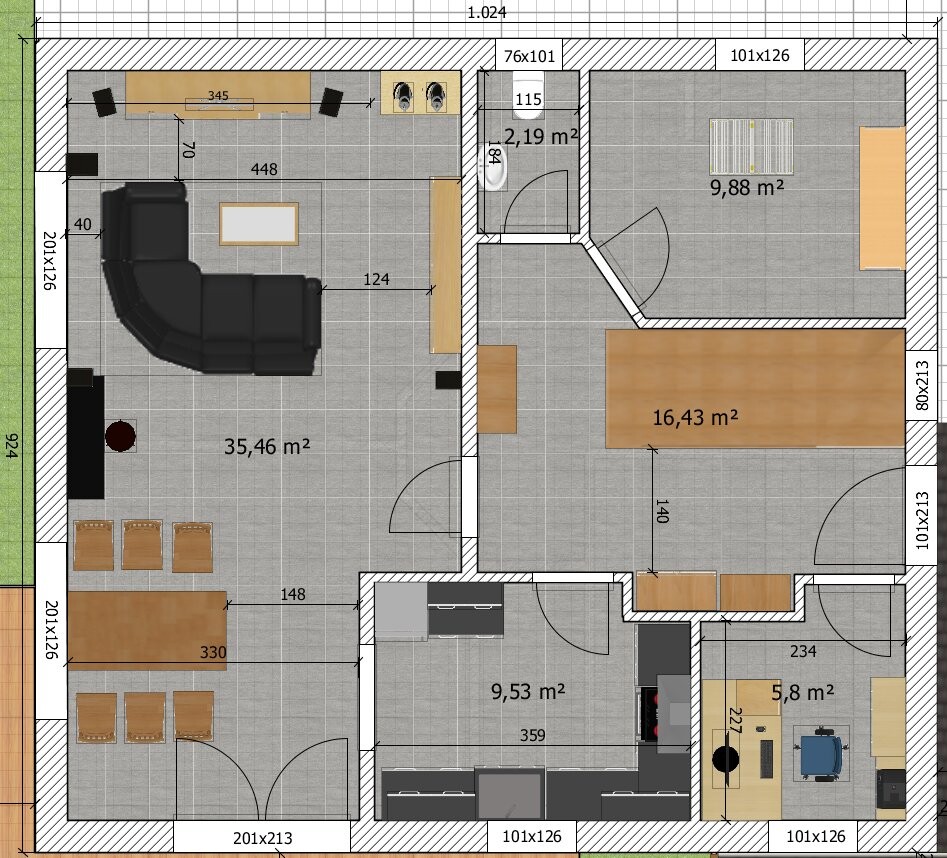
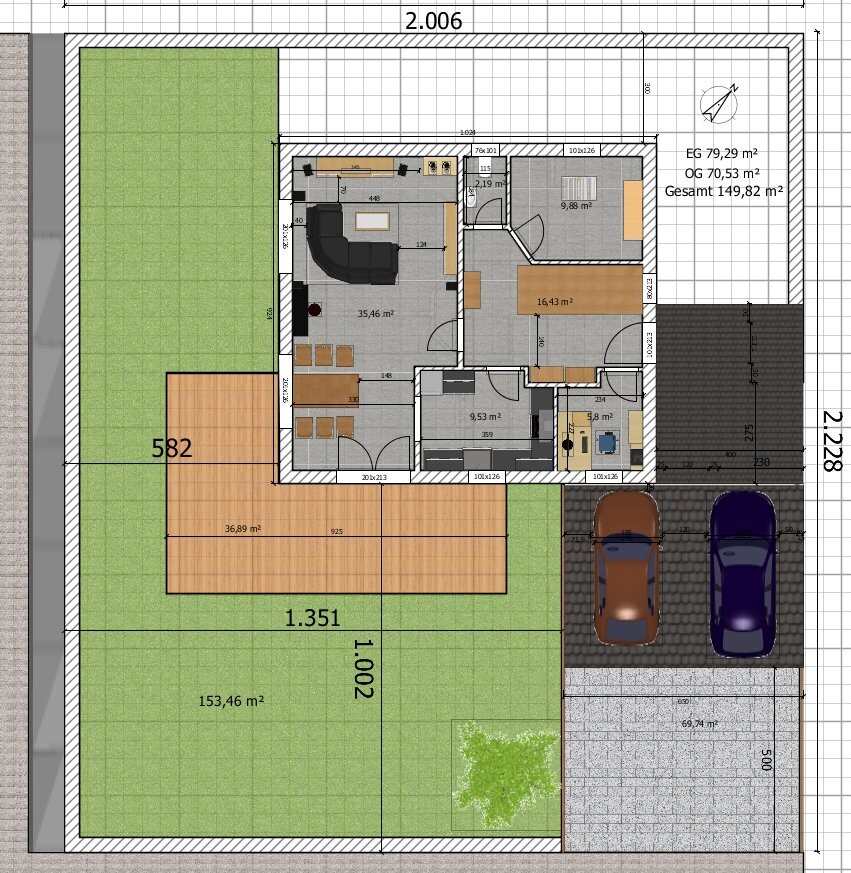
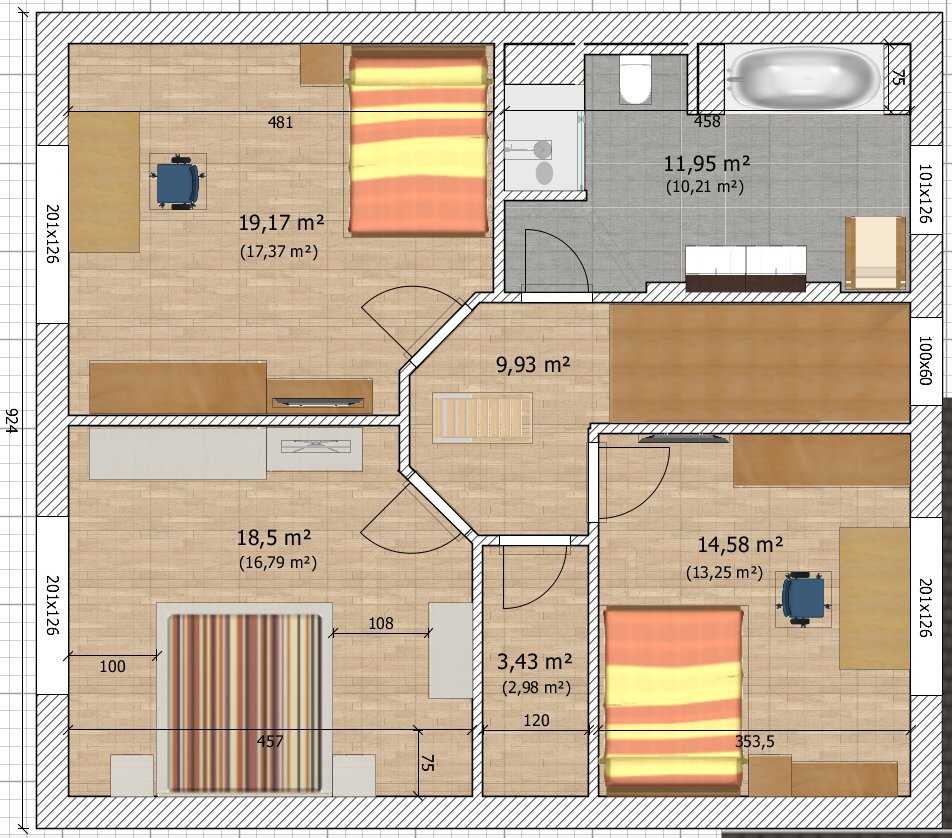
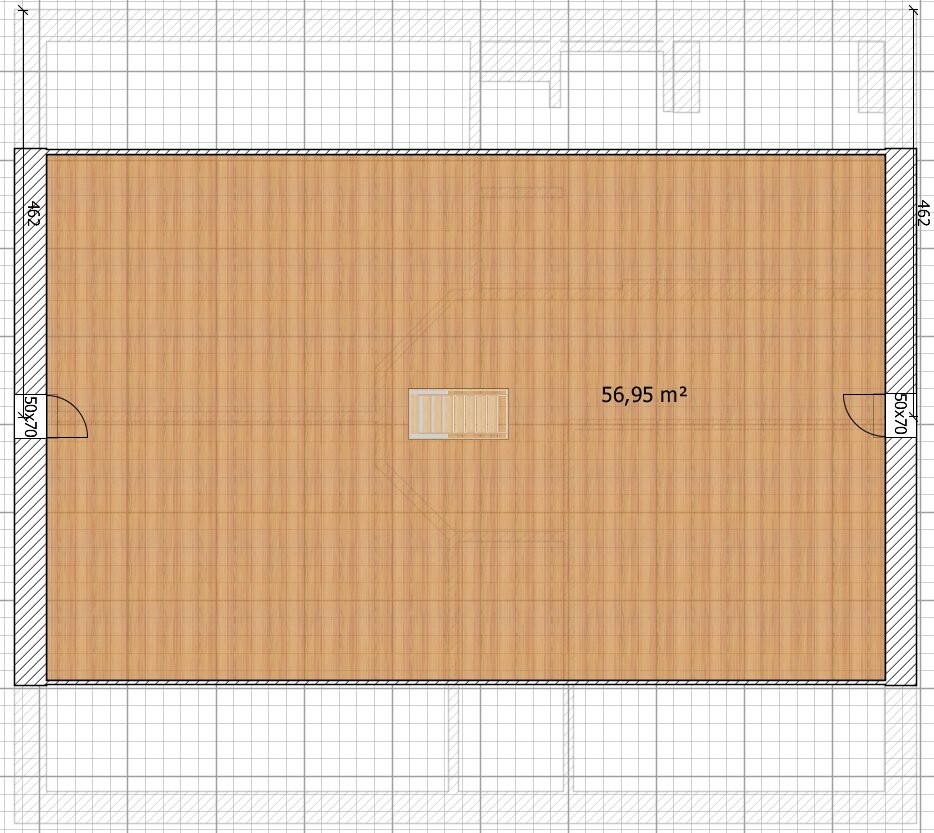
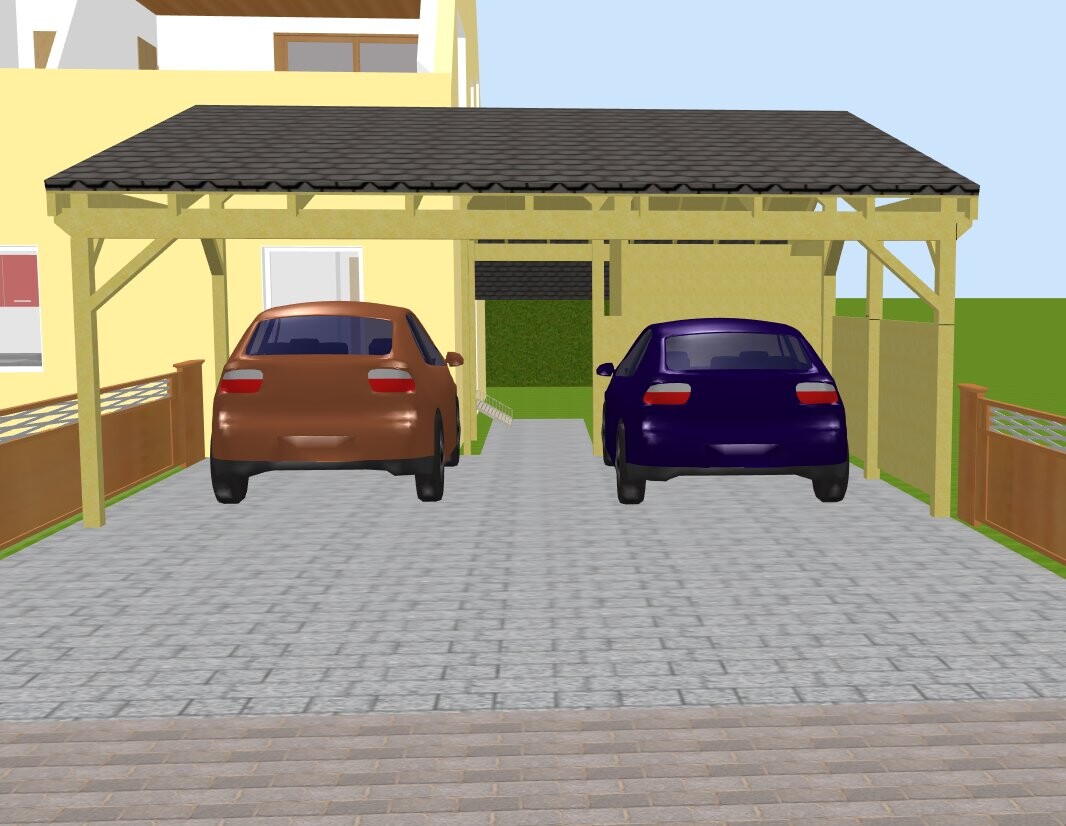

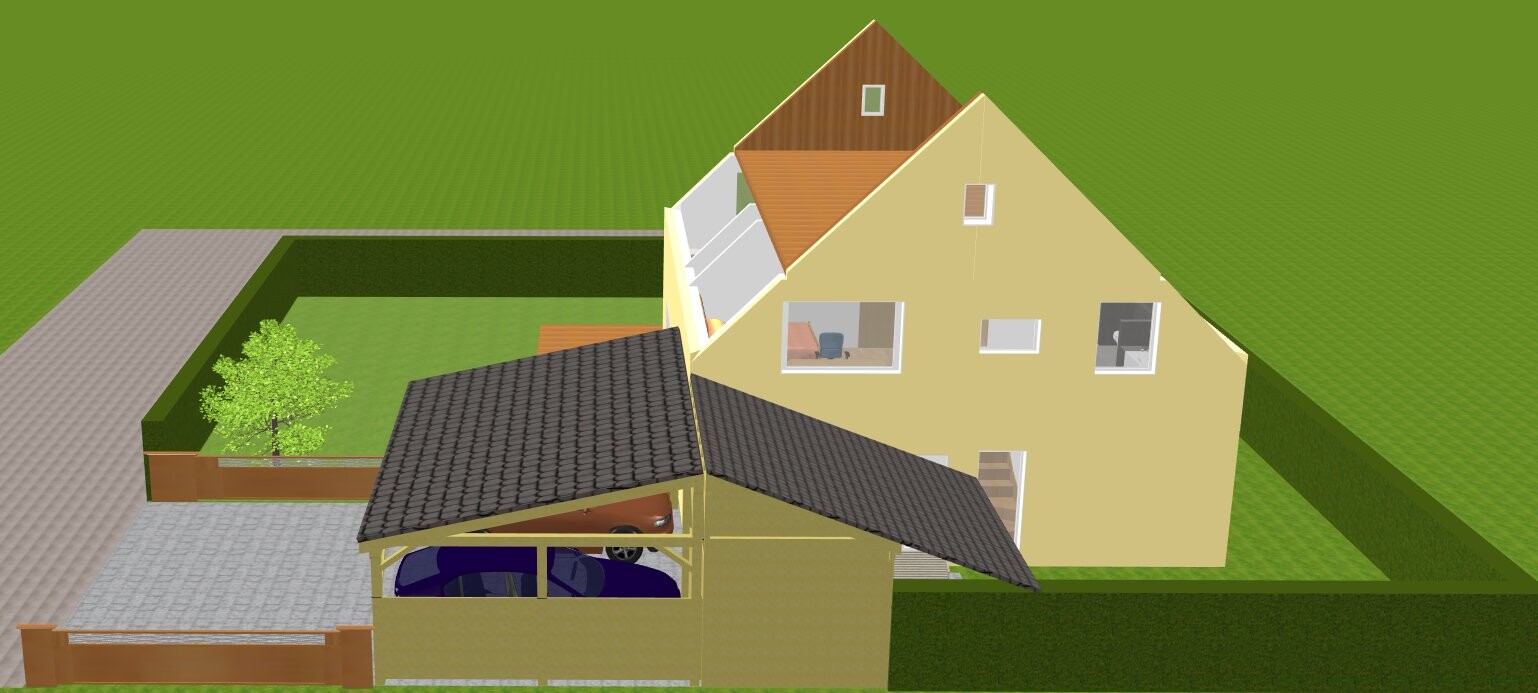
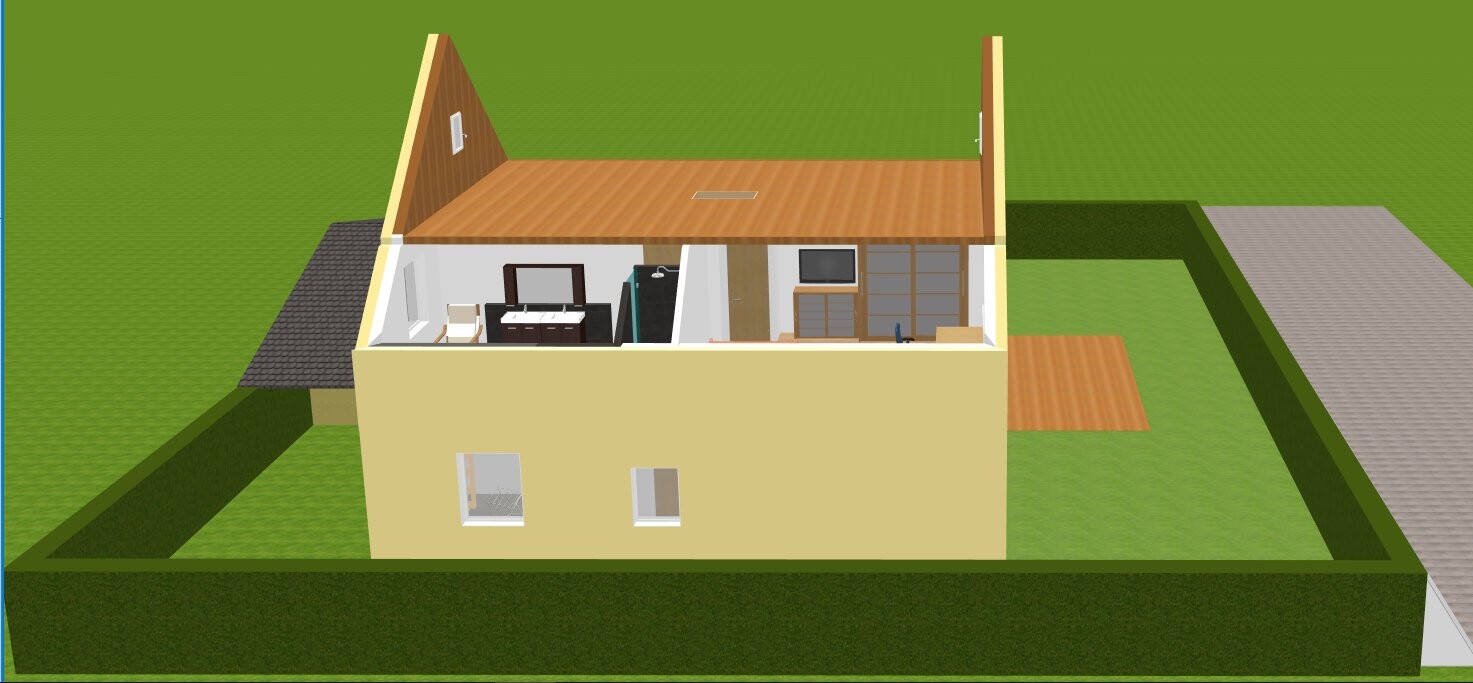
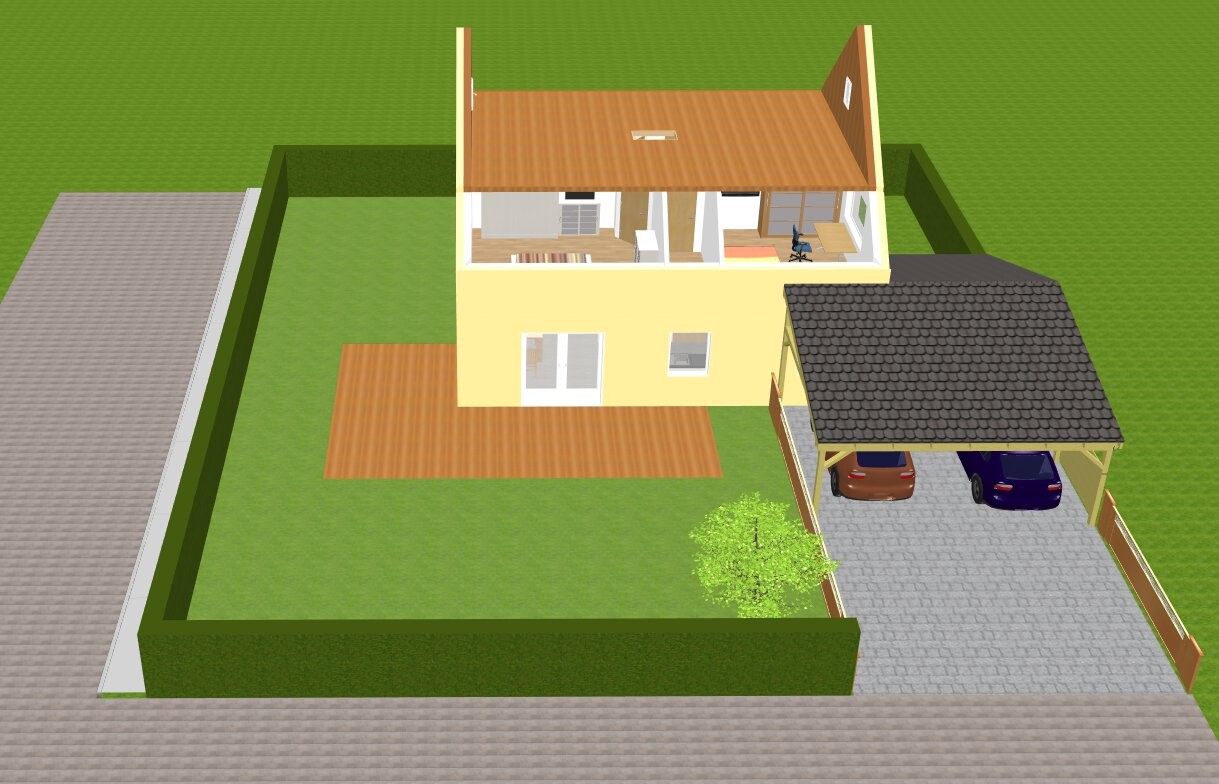
Plot size: 439 sqm (4720 sq ft)
Slope: yes, approx. 1.3 m (4 ft) descent across the plot, approx. 0.5 m (1.6 ft) in the house area
Site occupancy index (floor space ratio): 0.35
Floor area ratio (FAR): 0.6
Building window, building line and boundary: see development plan
Border development:
Number of parking spaces: 2
Number of storeys: 2
Roof style: any
Architectural style: any
Orientation: southeast or southwest
Maximum height / limits: 10 m (33 ft) above street curb level
Further requirements
Homeowners’ Requirements
Style, roof type, building type: gable roof
Basement, floors: 1.5 floors without basement, approx. 1.25 m (4 ft) knee wall height
Number of occupants, age: 2 adults (32 years + 27 years), children planned
Space requirement on ground floor and upper floor: approx. 130 sqm (1400 sq ft)
Office: family use and home office
Guest sleeping per year: rare
Open or closed layout: closed
Traditional or modern design: mixed
Open kitchen, kitchen island: semi-open to dining room
Number of dining seats: 6
Fireplace: no
Heating: bio-district heating, no own heat generator in the house
Music / stereo wall: yes
Balcony, roof terrace: terraces to southeast and southwest
Garage, carport: 2 carports, 2 parking spaces in front of carport
Utility garden, greenhouse: yes
Other wishes / special features / daily routine: controlled residential ventilation, monolithic wall made of brick or aerated concrete. Due to the lack of a basement, the office and utility room must be located on the ground floor.
Owner’s work: flooring, painting, and installation of controlled residential ventilation
House Design
Who designed it: by us
What do you particularly like?
What do you dislike?
- We don’t find the entrance behind the carport ideal. However, with the rather small plot, there is hardly any alternative. An entrance facing south is not very good, as we want to use the south side for other rooms. If we put the carport completely behind or next to the house, the house moves too much towards the center of the plot, leaving hardly any meaningful garden space in any direction. Suggestions are very welcome here.
- When entering the bathroom, the first thing you see is the shower wall.
Price estimate according to architect/planner: depending on provider, 190,000 to 250,000, including special features, excluding ancillary building costs and materials for owner’s work
Personal budget limit for the house, including fittings: 210,000, including special features, excluding ancillary building costs and materials for owner’s work
Preferred heating technology: district heating available and mandatory
If you had to give up something, which details or extensions?
- Can you do without: actually nothing unnecessary planned
- Cannot do without: n/a
The exterior dimensions (10.24 m x 9.24 m / 33 ft 7 in x 30 ft 4 in) come from a Flair 134 – this provider has so far been by far the most affordable. The dimensions also fit our plot very well. After many other floor plans with different dimensions, we ultimately chose this one.
Basically, we are very satisfied with it; everything seems to be exactly the size we need. Nothing is too big, nothing too small. Of course, bigger would always be nicer.
Our only points of criticism are:
- the shower wall right in front when entering the bathroom
- the house entrance behind the carport. As a passage between the cars, about 1.40 m (4.6 ft) clearance is planned. Beyond that, there is a passage between the house wall and the shed, about 1.70 m (5.6 ft) wide.
What is your opinion on the overall floor plan and these two points of criticism?

stefanc84 schrieb:
Regarding the development plan: I asked the municipality several times. Their response was that they don’t even review the application because, firstly, they don’t care how we build; we should build however we like. And secondly, they see the responsibility for compliance as lying with the architect. [...] I have always understood the position of the house and carport in the development plan as a suggestion. [...] That’s why I asked the building authority twice, speaking with two different employees. One said it should be understood more as a recommendation rather than a requirement.
A written quote from the other: "The driveway can also be placed elsewhere, but not within the curve area. The junction area of the two streets must be kept clear in any case. If there are no further deviations from the development plan, in our opinion the construction project can be carried out under the building permit exemption procedure. Ultimately, it is up to your planner to decide whether to apply for a formal approval process or not. They bear sole responsibility for this."
Vague information is a sign of lacking expertise. The official position of the authority is eventually given by the head of the office, and they do not care if their subordinates have different opinions on a specific issue.
Development plans are, first of all, legally binding documents, not mere suggestions; and secondly, they do not necessarily consist only of the graphical part. If symbols for houses and outbuildings/garages are shown with specific details (here clearly: pitched roofs, and for the main buildings also clearly with the required ridge orientation), I would never consider that decoration. Rather, it indicates that such details are contained in a so-called "textual determination" of the development plan.
Specifying the side for the driveway would be unusual in a residential area with streets of equal importance. Such regulation might occasionally exist where one street is a local street and the other a main road. Excluding a driveway within the junction area is also unusual but can be practiced by the municipality for “hazard prevention,” since drivers would have to pay attention to traffic from three directions at once. In this particular case, however, the authoritative decision seems to be dictated by the position of the garage shown on the plan.
Requirements for when a building permit is needed and when a building notification is sufficient differ between federal states. In the latter case, the property owner or their architect may still submit an application, which must then be processed—by approval, rejection, or exemption notice. The pointed concluding remark means, in plain terms: even a building only requiring notification must be torn down if it does not comply with regulations. For this reason, in cases where a permit is optional, a formal approval application is sometimes preferred: once the permit is granted, it is valid. The authority will stand behind this even if a caseworker mistakenly believes the house symbol in the plan is just for decoration and the citizen has full freedom of design.
https://www.instagram.com/11antgmxde/
https://www.linkedin.com/company/bauen-jetzt/
S
stefanc845 Feb 2017 22:38Hm, thank you for your interesting comments. You are misinterpreting the visual version; the written text refers more to the roof shape (everything is allowed) and ridge direction. The vague written statement comes from the head of the office. There is only one other employee in the office, as it is a small municipality.
I also believe they do not respond so casually because they do not care if we have to demolish later. Rather, they are genuinely glad for everyone who builds, and to do so as they wish, as long as the basic regulations are followed. If someone objects to a “better” positioned driveway, that would surprise me.
Otherwise, you are of course right—it is nothing binding and a residual risk remains.
I also believe they do not respond so casually because they do not care if we have to demolish later. Rather, they are genuinely glad for everyone who builds, and to do so as they wish, as long as the basic regulations are followed. If someone objects to a “better” positioned driveway, that would surprise me.
Otherwise, you are of course right—it is nothing binding and a residual risk remains.
stefanc84 schrieb:
Otherwise, you are of course right, nothing is certain and a residual risk remains.This could be eliminated by submitting a building permit / planning permission application.
P.S.: Are you the same person as the OP? If so, there would probably be a password reset function instead of creating a new account (?)
ypg schrieb:
I can only repeat myself: I find the entrance situation disastrous.
It wouldn’t feel welcoming to me.
The location of the carport might be good, but not the entrance behind it. It would make more sense to enter from the front, and then possibly rotate the stairs.You shouldn’t have to squeeze past the cars, meaning the entrance should be easily accessible even if only one car is parked. But overall, I think combining the carport and the front door canopy is acceptable. However, this can require generous widths if it is to work well with children and their vehicles.
https://www.instagram.com/11antgmxde/
https://www.linkedin.com/company/bauen-jetzt/
S
stefanc846 Feb 2017 00:02Oops, sorry, I didn’t forget my password, but apparently I have two accounts and didn’t remember that.
Regarding the entrance, I can only repeat: in my opinion, there is no other way. Alternatively, we could just return the plot and after another 5 years of searching buy one for four times the price, where everything fits side by side nicely and looks good.
I appreciate you sharing your opinion, that’s what the thread is for. But calling it a disaster isn’t very considerate and makes me seriously question our project. We would find two parking spaces arranged one behind the other even more disastrous. The entrance on the south side definitely looks more inviting, but it requires a significantly larger house footprint. At least, this was the case with every option I have tried. Having the entrance on the north side was still an option, but that also only works with parking spaces arranged one behind the other and terrain challenges. Still, I will reconsider the different options if the current plan is not approved.
Regarding the entrance, I can only repeat: in my opinion, there is no other way. Alternatively, we could just return the plot and after another 5 years of searching buy one for four times the price, where everything fits side by side nicely and looks good.
I appreciate you sharing your opinion, that’s what the thread is for. But calling it a disaster isn’t very considerate and makes me seriously question our project. We would find two parking spaces arranged one behind the other even more disastrous. The entrance on the south side definitely looks more inviting, but it requires a significantly larger house footprint. At least, this was the case with every option I have tried. Having the entrance on the north side was still an option, but that also only works with parking spaces arranged one behind the other and terrain challenges. Still, I will reconsider the different options if the current plan is not approved.
S
stefanc846 Feb 2017 00:10The distance between the two parked cars is 1.65 m (5 feet 5 inches), by the way. We used to keep our bicycles in the garage and, as children, would ride between the cars. The clearance equals the handlebar width plus about 5 cm (2 inches). The cars were never damaged. Of course, the situation in the garage is completely different from the house entrance, where, for example, neighbor children might rush in without being as aware of the issue.
Similar topics