
ᐅ Additional Costs Due to Incorrectly Designed Ventilation System and Floor-to-Ceiling Windows?
Created on: 29 Nov 2016 01:14
3
305er
Hi, we have our final planning meeting on December 13th, after which everything will be sent to the building authority (building permit / planning permission).
From the beginning, I told my salesperson that the outdoor unit of the Rotex ventilation system was incorrectly positioned in the first offer. The layout shown is not possible because the garage is supposed to be there.
I was told, "No problem. This can be changed in the planning phase and moved up."
Now I wrote to the CEO to have this corrected.
The reply was only:
On your floor plan, you moved the outdoor unit of the heat pump to a different location. This is not possible with the contractual Rotex heat pump. A Novelan LAD heat pump is required, and the outdoor unit must be moved further to the right, against the outer wall of the study room.
Here are the costs: Change to Novelan LAD + 2,138.00 €
Extension of the outdoor unit + 1,509.00 €
The reason is that the outdoor and indoor units have to be aligned at the same height/line.
Of course, I disagree with this.
Do you have any suggestions on how to solve this without extra costs or significant loss of space?
The pantry shown in the picture will be removed, and the utility room (HAR) will be made larger instead.
Point 2:
I wanted to replace the two large floor-to-ceiling terrace windows in the kitchen with one standard window, because the kitchen island will be placed against that wall.
Reply:
– Changing the floor-to-ceiling windows in the kitchen to standard windows with a masonry sill is possible at the same price in the project planning.
Question: By “standard” you mean? So two large floor-to-ceiling windows cost the same as one normal window?
Point 3:
Colored front door with a small side panel, ADDITIONAL COST 1,464€???? That seems quite high for just a bit of paint or finish, right?
Point 4:
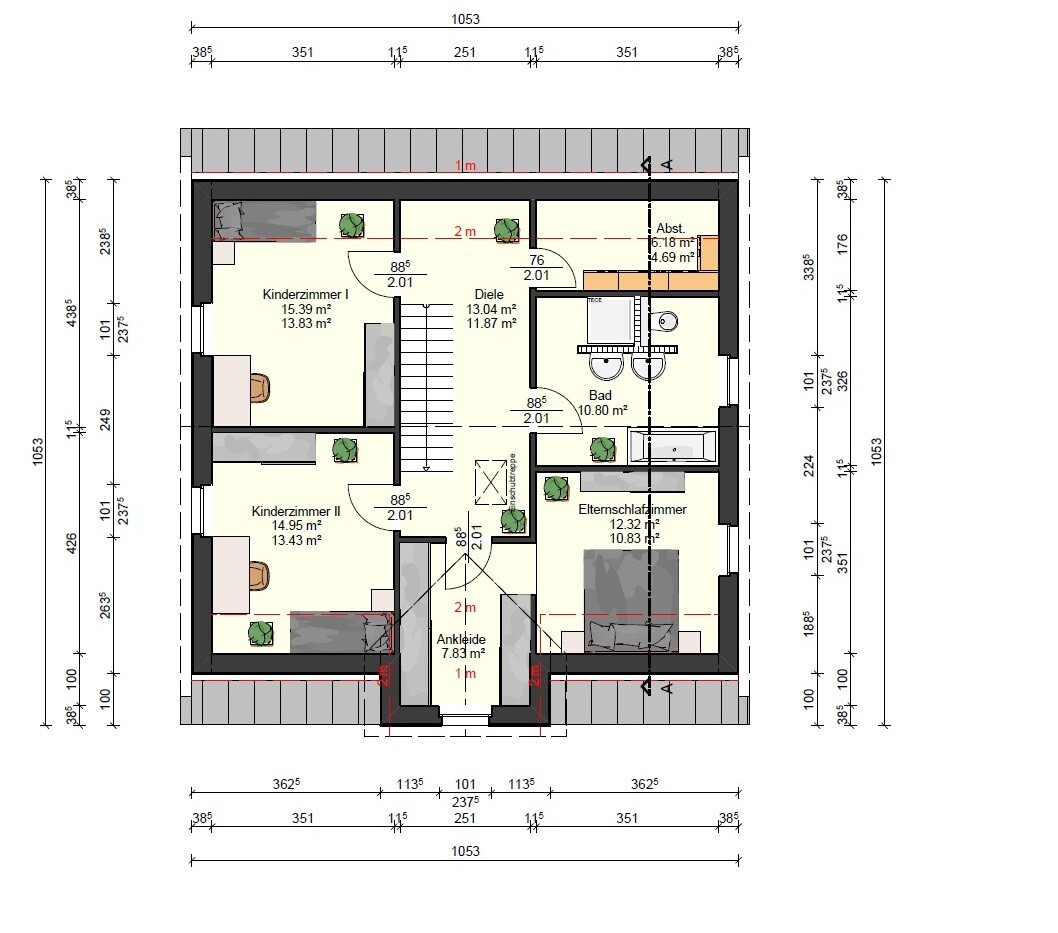
I want to install a horizontal window at the top of the hallway to bring light into the room (we don’t want double casement windows). We saw this in a prefab house with the same knee wall height as ours.
Reply:
In the current plan, the window is not possible because the wall height is insufficient. Otherwise, the window would have to be fixed and equipped with TRAV glazing. The cost would be around 1,400.00 € to 1,600.00 €.
What do you think?
Point 5:
Price reduction for removing the standard front door: -1,315.00 €
But if I want an additional door, it costs me over 4,000 €. How is that possible?
See the attached picture.
Maybe they want to remove it because the door is not good enough — no RC2 rating, no windows with privacy glass, etc.
Here is the description:
Your contract includes a white plastic front door from the standard range with a small side panel.
The side panel has clear glass; satin glass can of course be added separately.
The front door has basic security, which should correspond approximately to WK 1, but a higher standard is possible and can be arranged.
According to the contract, a handle about 30 cm (12 inches) long is agreed.
Point 6:
Are the floor-to-ceiling windows on the upper floor acceptable? Or do they let in too little light?
Would a standard window be better? What is considered standard? What size is that?
So, that’s it for now. I actually wanted to write very little, just one or two points.
Thanks
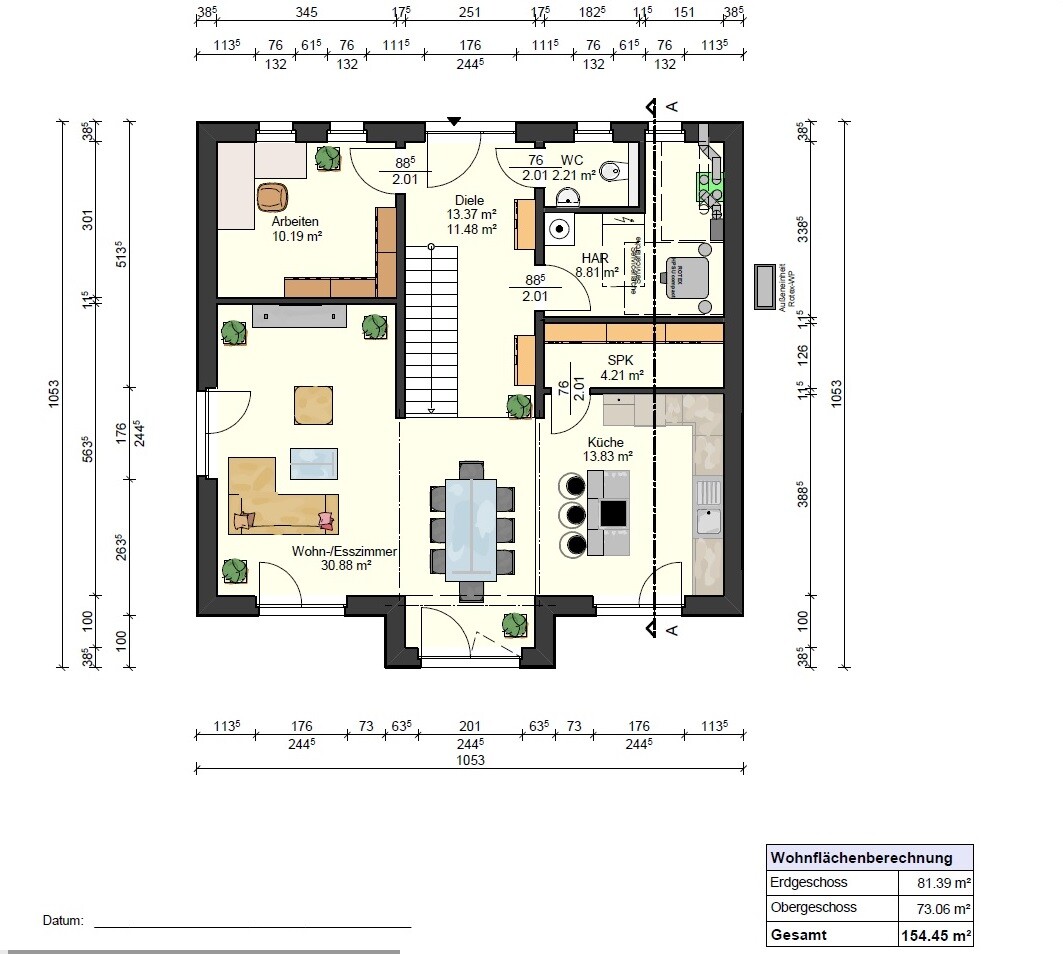
From the beginning, I told my salesperson that the outdoor unit of the Rotex ventilation system was incorrectly positioned in the first offer. The layout shown is not possible because the garage is supposed to be there.
I was told, "No problem. This can be changed in the planning phase and moved up."
Now I wrote to the CEO to have this corrected.
The reply was only:
On your floor plan, you moved the outdoor unit of the heat pump to a different location. This is not possible with the contractual Rotex heat pump. A Novelan LAD heat pump is required, and the outdoor unit must be moved further to the right, against the outer wall of the study room.
Here are the costs: Change to Novelan LAD + 2,138.00 €
Extension of the outdoor unit + 1,509.00 €
The reason is that the outdoor and indoor units have to be aligned at the same height/line.
Of course, I disagree with this.
Do you have any suggestions on how to solve this without extra costs or significant loss of space?
The pantry shown in the picture will be removed, and the utility room (HAR) will be made larger instead.
Point 2:
I wanted to replace the two large floor-to-ceiling terrace windows in the kitchen with one standard window, because the kitchen island will be placed against that wall.
Reply:
– Changing the floor-to-ceiling windows in the kitchen to standard windows with a masonry sill is possible at the same price in the project planning.
Question: By “standard” you mean? So two large floor-to-ceiling windows cost the same as one normal window?
Point 3:
Colored front door with a small side panel, ADDITIONAL COST 1,464€???? That seems quite high for just a bit of paint or finish, right?
Point 4:
I want to install a horizontal window at the top of the hallway to bring light into the room (we don’t want double casement windows). We saw this in a prefab house with the same knee wall height as ours.
Reply:
In the current plan, the window is not possible because the wall height is insufficient. Otherwise, the window would have to be fixed and equipped with TRAV glazing. The cost would be around 1,400.00 € to 1,600.00 €.
What do you think?
Point 5:
Price reduction for removing the standard front door: -1,315.00 €
But if I want an additional door, it costs me over 4,000 €. How is that possible?
See the attached picture.
Maybe they want to remove it because the door is not good enough — no RC2 rating, no windows with privacy glass, etc.
Here is the description:
Your contract includes a white plastic front door from the standard range with a small side panel.
The side panel has clear glass; satin glass can of course be added separately.
The front door has basic security, which should correspond approximately to WK 1, but a higher standard is possible and can be arranged.
According to the contract, a handle about 30 cm (12 inches) long is agreed.
Point 6:
Are the floor-to-ceiling windows on the upper floor acceptable? Or do they let in too little light?
Would a standard window be better? What is considered standard? What size is that?
So, that’s it for now. I actually wanted to write very little, just one or two points.
Thanks
I can’t comment on everything, but I can share some thoughts on a few points.
Regarding the Rotex: Of course, many things can be postponed. He didn’t tell you anything wrong. He just didn’t mention that additional costs might occur. From my perspective, your only option is to negotiate with the seller to see if they can work out any compromises.
Regarding the door: The standard option is always very basic. After all, the lower house price has to come from somewhere. Any extras are heavily marked up by the general contractor. If you ask for a credit, the amount always looks quite modest. You also don’t know their purchasing conditions. Maybe they really get the door that cheaply. The high surcharge usually comes from installation costs (labor, adhesive, screws, etc.) and, of course, a small bonus the general contractor adds to make a profit.
Floor-to-ceiling windows vs. regular windows: The reason these windows are nearly cost-neutral is that with floor-to-ceiling windows, you need less brick and plaster but more glass, while with regular windows, it’s basically the opposite. We converted three floor-to-ceiling windows into one regular, one very large regular, and one small regular window. That saved us €91 (about $100).
Windows on the upper floor: I would miss having a small window in the hallway and also in the storage room. But that’s a matter of personal taste. In the rooms, I think the windows are sufficient. Whether floor-to-ceiling windows are really necessary depends on the furniture. In my children’s room, the desk would have been right in front of the window because of the light. Working with daylight is quite pleasant.
Regarding the Rotex: Of course, many things can be postponed. He didn’t tell you anything wrong. He just didn’t mention that additional costs might occur. From my perspective, your only option is to negotiate with the seller to see if they can work out any compromises.
Regarding the door: The standard option is always very basic. After all, the lower house price has to come from somewhere. Any extras are heavily marked up by the general contractor. If you ask for a credit, the amount always looks quite modest. You also don’t know their purchasing conditions. Maybe they really get the door that cheaply. The high surcharge usually comes from installation costs (labor, adhesive, screws, etc.) and, of course, a small bonus the general contractor adds to make a profit.
Floor-to-ceiling windows vs. regular windows: The reason these windows are nearly cost-neutral is that with floor-to-ceiling windows, you need less brick and plaster but more glass, while with regular windows, it’s basically the opposite. We converted three floor-to-ceiling windows into one regular, one very large regular, and one small regular window. That saved us €91 (about $100).
Windows on the upper floor: I would miss having a small window in the hallway and also in the storage room. But that’s a matter of personal taste. In the rooms, I think the windows are sufficient. Whether floor-to-ceiling windows are really necessary depends on the furniture. In my children’s room, the desk would have been right in front of the window because of the light. Working with daylight is quite pleasant.

Good morning,
Over the past year, I also experienced what it means to make changes to the standard offered by home builders. As long as you stick almost exactly to their specifications, you get a good price-performance ratio. However, if you have some custom requests, the prices increase sharply…
I think the reason is that parts sometimes need to be newly or additionally designed, structural calculations have to be redone, etc. Furthermore, the purchasing conditions for a different front door, windows, etc., won’t be the same for the builder, which means their profit margin applies to a higher purchase price.
Point 3:
Here I can even provide some comparison figures.
For our prefabricated house, the standard price included an anthracite-colored aluminum front door without side panels. We wanted two side panels, each 50cm (20 inches) wide, and colored, which would have added €2,920 to the price.
If you compare this surcharge to our current door, which we purchased from a door and window supplier for just under €5,500, it’s obviously overpriced. Our current door with side panels also includes features like a fingerprint lock on the door handle, a 73cm (29 inch) door handle, a door viewer, RC2 security rating, electromechanical lock, and more.
Point 4:
I can’t comment on your price, but here’s another comparison.
We also wanted additional floor-to-ceiling windows with triple glazing.
One window-door element, 0.885 x 2.26 meters (35 x 89 inches), triple glazed in white, would have cost us €1,507.
One lift-and-slide door, 3.01 x 2.26 meters (118 x 89 inches), triple glazed in white, came to a full €3,940.
If you compare your surcharges with mine, they’re actually in the same range. However, there still remains the question of whether these prices are really reasonable.
Best regards,
Michael
Over the past year, I also experienced what it means to make changes to the standard offered by home builders. As long as you stick almost exactly to their specifications, you get a good price-performance ratio. However, if you have some custom requests, the prices increase sharply…
I think the reason is that parts sometimes need to be newly or additionally designed, structural calculations have to be redone, etc. Furthermore, the purchasing conditions for a different front door, windows, etc., won’t be the same for the builder, which means their profit margin applies to a higher purchase price.
Point 3:
Here I can even provide some comparison figures.
For our prefabricated house, the standard price included an anthracite-colored aluminum front door without side panels. We wanted two side panels, each 50cm (20 inches) wide, and colored, which would have added €2,920 to the price.
If you compare this surcharge to our current door, which we purchased from a door and window supplier for just under €5,500, it’s obviously overpriced. Our current door with side panels also includes features like a fingerprint lock on the door handle, a 73cm (29 inch) door handle, a door viewer, RC2 security rating, electromechanical lock, and more.
Point 4:
I can’t comment on your price, but here’s another comparison.
We also wanted additional floor-to-ceiling windows with triple glazing.
One window-door element, 0.885 x 2.26 meters (35 x 89 inches), triple glazed in white, would have cost us €1,507.
One lift-and-slide door, 3.01 x 2.26 meters (118 x 89 inches), triple glazed in white, came to a full €3,940.
If you compare your surcharges with mine, they’re actually in the same range. However, there still remains the question of whether these prices are really reasonable.
Best regards,
Michael
H
HilfeHilfe29 Nov 2016 08:49For front doors, "white goods" refers to mass-produced items and are generally cheaper than colored or slightly custom-designed ones.

I can say the same... it doesn't get cheaper... and if the construction budget is already tight from the start, any special requests will only increase costs significantly.
Especially with doors and windows, any changes will not make things cheaper.
Relocating the heating system or modifying the installation can easily cost 2,000–3,000 euros (approximately 2,200–3,300 USD), which is quite common.
It's like buying a car...
if you choose the base model, you pay amount X,
but if you want extras, you sometimes end up paying twice that amount.
Your best option is to negotiate with your building partner and try to get better prices...
Especially with doors and windows, any changes will not make things cheaper.
Relocating the heating system or modifying the installation can easily cost 2,000–3,000 euros (approximately 2,200–3,300 USD), which is quite common.
It's like buying a car...
if you choose the base model, you pay amount X,
but if you want extras, you sometimes end up paying twice that amount.
Your best option is to negotiate with your building partner and try to get better prices...
Similar topics