
Hello everyone,
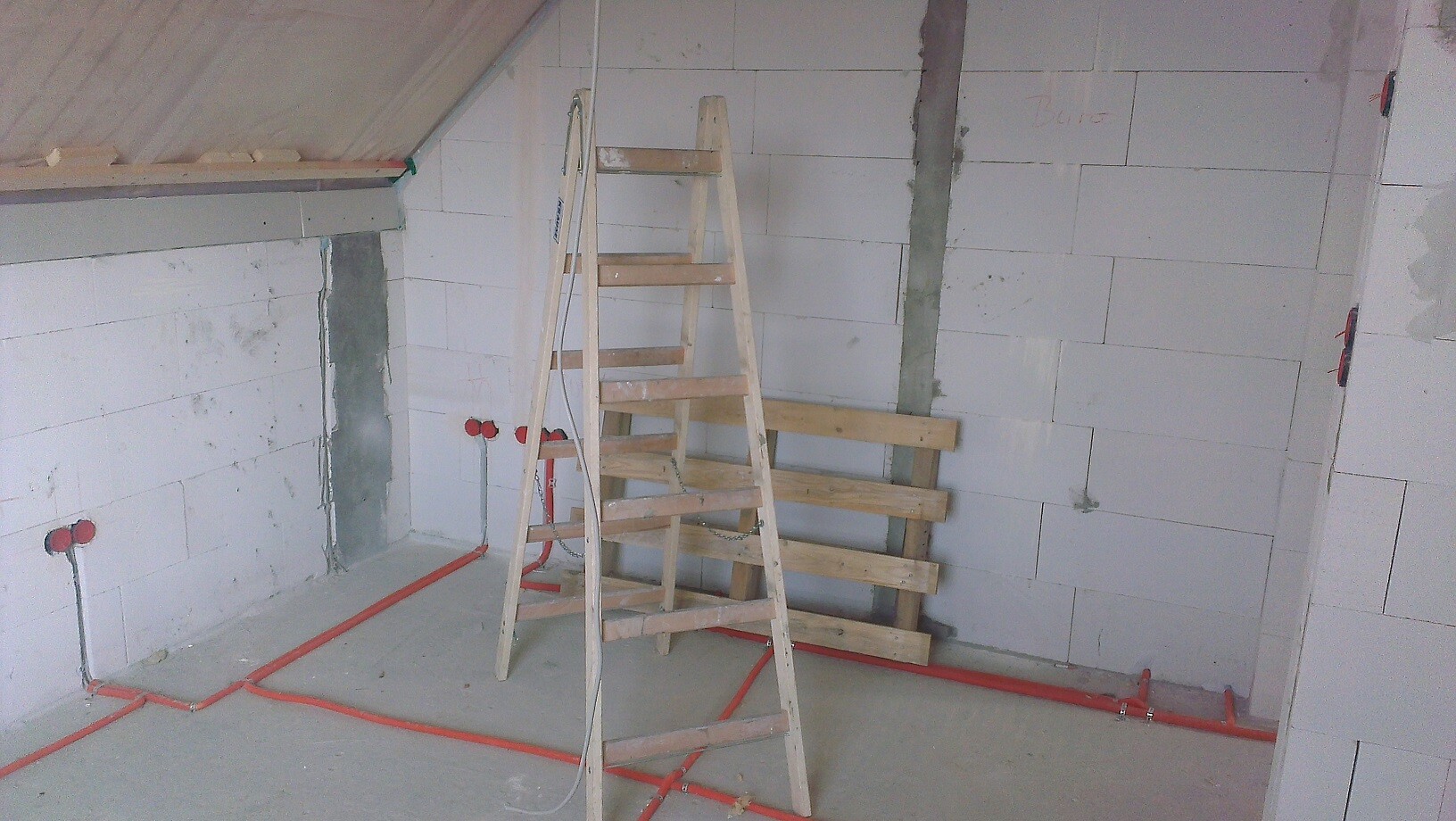
Our construction has progressed to the point where the carpenter could basically raise the roof truss. Now theory meets practice. According to the execution plan and the structural engineer’s documents, three steel posts are planned for the roof structure, located within the masonry (11 cm (4.3 inches) wall, 80 mm (3.1 inches) steel post).
The execution plan states that the recess for the steel post should be filled with concrete afterwards. The builder would carry out the work as planned, but the carpenter advises against it, arguing that later cracks could appear in the plaster between the masonry and the concreted recess. The structural engineer, architect, and builder are in agreement.
I would like to gather some experience from you and ask whether the roof purlins resting on the steel posts actually move enough over time to cause cracking in the plaster.
Thank you in advance for your answers.
Our construction has progressed to the point where the carpenter could basically raise the roof truss. Now theory meets practice. According to the execution plan and the structural engineer’s documents, three steel posts are planned for the roof structure, located within the masonry (11 cm (4.3 inches) wall, 80 mm (3.1 inches) steel post).
The execution plan states that the recess for the steel post should be filled with concrete afterwards. The builder would carry out the work as planned, but the carpenter advises against it, arguing that later cracks could appear in the plaster between the masonry and the concreted recess. The structural engineer, architect, and builder are in agreement.
I would like to gather some experience from you and ask whether the roof purlins resting on the steel posts actually move enough over time to cause cracking in the plaster.
Thank you in advance for your answers.
Hello, I’ve attached a picture to show how I imagine your issue. I suspect it was similar in our case, where steel supports were integrated into the walls at a few points and filled with concrete (in the picture, the dark vertical “line” at the back in the otherwise light wall).
So far (we have been living here for over 2 years) there have been no cracks at this spot. Although there is a relatively thick non-woven wallpaper and paint over the plaster, I just felt the surface and it seems there is no crack underneath. The indoor temperature hardly fluctuates throughout the year.
So far (we have been living here for over 2 years) there have been no cracks at this spot. Although there is a relatively thick non-woven wallpaper and paint over the plaster, I just felt the surface and it seems there is no crack underneath. The indoor temperature hardly fluctuates throughout the year.
Hello Saruss,
Thank you for your reply. That is exactly how it will look for us later, or rather, that is the plan. Both sides certainly have their reasons for recommending or advising against it. That’s why I value firsthand experiences.
Actually, I might not care much, because if I notice cracks after a year, I can always approach our site manager (architect). However, if better alternatives can be chosen in advance, I would prefer to select those.
Thanks again!
Thank you for your reply. That is exactly how it will look for us later, or rather, that is the plan. Both sides certainly have their reasons for recommending or advising against it. That’s why I value firsthand experiences.
Actually, I might not care much, because if I notice cracks after a year, I can always approach our site manager (architect). However, if better alternatives can be chosen in advance, I would prefer to select those.
Thanks again!
B
Bauexperte5 Oct 2016 23:40DN87M schrieb:
Actually, I could not care less about the whole thing, because if I notice cracks after a year, I’ll just go straight to our construction manager (architect). However, if better options could be chosen in advance, I would prefer to go with those. Not quite. Because if you deviate from your architect’s specified execution plan, they will rightly turn you away... especially if you follow the carpenter’s suggestion and problems arise as a result.
Send the carpenter to the architect; let them discuss it professionally!
Regards, Bauexperte
K
kkk2727296 Oct 2016 10:37I am wondering what the alternative solution from the carpenter looks like?
An 80mm (3 inches) post in 110mm (4.3 inches) masonry,
there isn’t much material left.
I have 6 posts in my purlin roof.
I embedded the posts into the walls but left a small gap between
the masonry and the post.
I have 175mm (7 inches) sand-lime bricks.
The gap is there to reduce sound transmission as much as possible.
At the points where the posts are embedded, mesh will be applied later during plastering.
This should definitely be done in your case as well.
An 80mm (3 inches) post in 110mm (4.3 inches) masonry,
there isn’t much material left.
I have 6 posts in my purlin roof.
I embedded the posts into the walls but left a small gap between
the masonry and the post.
I have 175mm (7 inches) sand-lime bricks.
The gap is there to reduce sound transmission as much as possible.
At the points where the posts are embedded, mesh will be applied later during plastering.
This should definitely be done in your case as well.
Similar topics