
Hello forum
Here are the key points:
Multi-family house. Built in 1961. Converted attic. Thermal insulation. Above-rafter insulation.
The roof is dry and the roof tiles are old but still watertight.
Now I have received quotes from different roofers mentioning vapor barrier and vapor retarder.
It is not completely clear to me why these are necessary.
I have read that a vapor retarder or vapor barrier is supposed to minimize or prevent moisture entering the thermal insulation.
My question is:
Moisture can also come from the outside air into the thermal insulation.
There are days in winter or summer when the relative humidity is very high.
This humidity also gets into the thermal insulation.
Or am I mistaken?
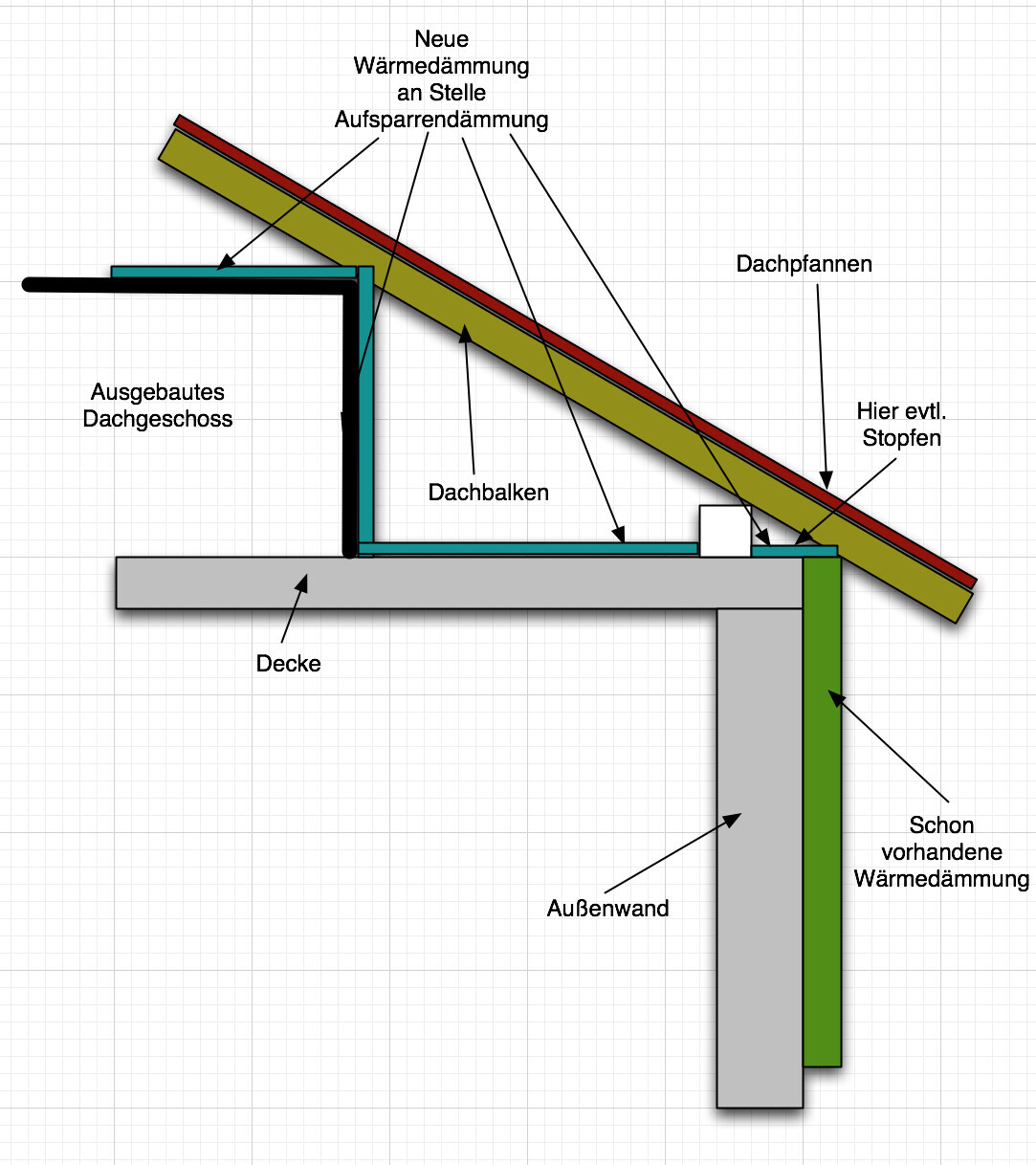
An alternative—which would also be cheaper than above-rafter insulation—would be to insert insulation mats into the space between the roof and attic.
See sketch.
Thank you very much for your feedback.
Jochen
Here are the key points:
Multi-family house. Built in 1961. Converted attic. Thermal insulation. Above-rafter insulation.
The roof is dry and the roof tiles are old but still watertight.
Now I have received quotes from different roofers mentioning vapor barrier and vapor retarder.
It is not completely clear to me why these are necessary.
I have read that a vapor retarder or vapor barrier is supposed to minimize or prevent moisture entering the thermal insulation.
My question is:
Moisture can also come from the outside air into the thermal insulation.
There are days in winter or summer when the relative humidity is very high.
This humidity also gets into the thermal insulation.
Or am I mistaken?
An alternative—which would also be cheaper than above-rafter insulation—would be to insert insulation mats into the space between the roof and attic.
See sketch.
Thank you very much for your feedback.
Jochen
spassig schrieb:
The two vapor barrier films below the insulation and the underlay membrane above the insulation must somehow be sealed together and sealed against the surrounding environment.
How and with what is this done?
Jochen This is usually done with some kind of adhesive tape designed for membranes.
Is it reliably proven that the plastic films and the adhesive tapes will remain functional for a long period—40 years—about as long as the house’s lifespan?
When do they start to leak?
How can you tell during the service life whether everything is still intact?
Damage to roof tiles can be easily checked visually from the outside.
But how do you determine whether moisture has penetrated the insulation after around 15 years and the wood has already started to rot?
Jochen
G
garfunkel1 Oct 2016 21:49Why is it not possible for humidity from the living space to enter the insulation, but humidity from outside is allowed to penetrate the insulation?
Warm air can hold more water than cold air. Everyone notices this in winter.
The exact amounts of water that air can hold at a certain temperature can be looked up.
I’ll use some example numbers to explain.
Your living space is at 20°C (68°F), and with 60% relative humidity, the air contains 1 liter of water per cubic meter (1 liter per m³).
If there is a leak in the vapor barrier/vapor retarder and warm air from the living space escapes into the insulation,
on its way outside, the warm air eventually meets colder air. The temperature of the warm air continuously decreases until it reaches equilibrium.
Now, remember that the air still contains 1 liter of water. But since cold air cannot hold as much moisture as warm air, the excess water has to go somewhere.
This water condenses as dew. Depending on the outdoor temperature and humidity, about half a liter or more/less of water may condense.
Moist and cold air coming from outside into the insulation is not a problem. Why?
-> Because air warming up from outside to inside can only hold more moisture. This means that the water won’t condense as dew, since the air always has space to absorb more water.
The same effect can be observed with thermal bridges. For example, warm air flows along a cold wall and cools down. It holds more moisture than the air can keep at that temperature, so water condenses on the wall (the coldest spot).
This is how mold forms.
If you have walls that are too cold and prone to mold, it is best to insulate these walls from the outside. This usually resolves the problem of the cold wall on the inside. In other words, the indoor wall surface is no longer cold enough for water to condense on it.
Why are vapor retarders used more today than vapor barriers?
Because nature always seeks balance, water vapor inside the insulation occasionally wants to move back into the living space. It is helpful if the vapor retarder allows some diffusion. That’s why it has become more common to use materials with limited permeability.
However, you should be aware that this does not compensate for leaks or major installation errors. It just makes the system a bit more tolerant and forgiving.
With proper installation, adhesive tapes last 25 years or more.
Some manufacturers even claim 50 years.
If that is considered too risky, you can look for alternatives. There are insulation materials, for example, that do not require a vapor retarder.
Whether this really works well is something to research further.
You could also use a paper vapor retarder. In timber frame structures, this is often used actively.
OSB boards are also often used as vapor retarders or vapor barriers. They are installed with tongue-and-groove joints (not sure if glued or not) and then taped at the joints.
Have you ever consulted an independent building expert about this?
Warm air can hold more water than cold air. Everyone notices this in winter.
The exact amounts of water that air can hold at a certain temperature can be looked up.
I’ll use some example numbers to explain.
Your living space is at 20°C (68°F), and with 60% relative humidity, the air contains 1 liter of water per cubic meter (1 liter per m³).
If there is a leak in the vapor barrier/vapor retarder and warm air from the living space escapes into the insulation,
on its way outside, the warm air eventually meets colder air. The temperature of the warm air continuously decreases until it reaches equilibrium.
Now, remember that the air still contains 1 liter of water. But since cold air cannot hold as much moisture as warm air, the excess water has to go somewhere.
This water condenses as dew. Depending on the outdoor temperature and humidity, about half a liter or more/less of water may condense.
Moist and cold air coming from outside into the insulation is not a problem. Why?
-> Because air warming up from outside to inside can only hold more moisture. This means that the water won’t condense as dew, since the air always has space to absorb more water.
The same effect can be observed with thermal bridges. For example, warm air flows along a cold wall and cools down. It holds more moisture than the air can keep at that temperature, so water condenses on the wall (the coldest spot).
This is how mold forms.
If you have walls that are too cold and prone to mold, it is best to insulate these walls from the outside. This usually resolves the problem of the cold wall on the inside. In other words, the indoor wall surface is no longer cold enough for water to condense on it.
Why are vapor retarders used more today than vapor barriers?
Because nature always seeks balance, water vapor inside the insulation occasionally wants to move back into the living space. It is helpful if the vapor retarder allows some diffusion. That’s why it has become more common to use materials with limited permeability.
However, you should be aware that this does not compensate for leaks or major installation errors. It just makes the system a bit more tolerant and forgiving.
With proper installation, adhesive tapes last 25 years or more.
Some manufacturers even claim 50 years.
If that is considered too risky, you can look for alternatives. There are insulation materials, for example, that do not require a vapor retarder.
Whether this really works well is something to research further.
You could also use a paper vapor retarder. In timber frame structures, this is often used actively.
OSB boards are also often used as vapor retarders or vapor barriers. They are installed with tongue-and-groove joints (not sure if glued or not) and then taped at the joints.
Have you ever consulted an independent building expert about this?
garfunkel schrieb:
Why is it that moisture from the living space cannot enter the insulation, but moisture from the outside is allowed to penetrate the insulation?
Warm air holds more water vapor than cold air. Everyone notices this in winter. The amount of water that air can hold at a given temperature can be looked up. I’ll use example numbers for explanation.
Your living space is at 20°C (68°F) with 60% relative humidity, which corresponds to about 1 liter of water per cubic meter of air.
Now, if there is a leak in the vapor retarder or vapor barrier, warm air from the living space can escape into the insulation. On its way outside, this warm air eventually meets colder air. The temperature of the warm air decreases until it equalizes with the surroundings.
Remember, the air still contains about 1 liter of water vapor. Since cold air cannot hold as much moisture as warm air, the excess moisture has to go somewhere.
This moisture then condenses out as dew or condensation. Depending on outside temperature and humidity, this can amount to half a liter or more or less.
Moist, cold air from outside entering the insulation is not a problem. Why?
Because air only warms up as it moves from outside to inside, so it can absorb more moisture. This means the water vapor does not condense because there is always more capacity for moisture in the air.
The same effect can be seen in thermal bridges. For example, warm air passing along a cold wall cools down and holds more moisture than it can contain at that temperature, so the water condenses on the coldest point of the wall.
This is how mold develops. If walls are too cold and prone to mold, it is best to insulate them from the outside. This usually solves the problem of cold interior walls, meaning the inside surface stays warm enough so moisture does not condense there.
Why are vapor retarders used more today than vapor barriers?
Because nature always seeks equilibrium, water vapor in the insulation can sometimes flow back into the living space. It’s beneficial if the membrane allows some diffusion. Therefore, more modern approaches favor allowing limited vapor permeability.
But it should be clear that this is no substitute for proper airtightness or major installation errors. It just makes the system a bit more tolerant and forgiving.
If correctly installed, tapes last over 25 years.
Some manufacturers even claim 50 years.
If that seems too risky, you can look for alternatives. Some insulation materials may not require a vapor retarder at all.
Whether this really works well, I don’t know—you’d have to do some research.
You could also use a vapor retarder made of paper. That’s sometimes common in timber frame construction.
Often, OSB (oriented strand board) panels are used as vapor retarders or barriers. They are tongue-and-groove fitted (not sure if glued or not) and the joints are sealed with tape.
-
Have you ever consulted an independent building expert on this?I researched online.
At a manufacturer of adhesive films, I found the term: very good aging resistance. What does that mean?
At a manufacturer of adhesive films, I found the term: high aging resistance. What does that mean?
At a manufacturer of adhesive films, I found the term: 50 years ... system warranty. You need to look at that closely.
Jochen
At a manufacturer of adhesive films, I found the term: very good aging resistance. What does that mean?
At a manufacturer of adhesive films, I found the term: high aging resistance. What does that mean?
At a manufacturer of adhesive films, I found the term: 50 years ... system warranty. You need to look at that closely.
Jochen
Similar topics