
Ok, now let’s think about the topic from a practical perspective. I’m quite familiar with KNX, but I can’t really come up with a scenario where KNX would clearly benefit us. Here are our floor plans again:
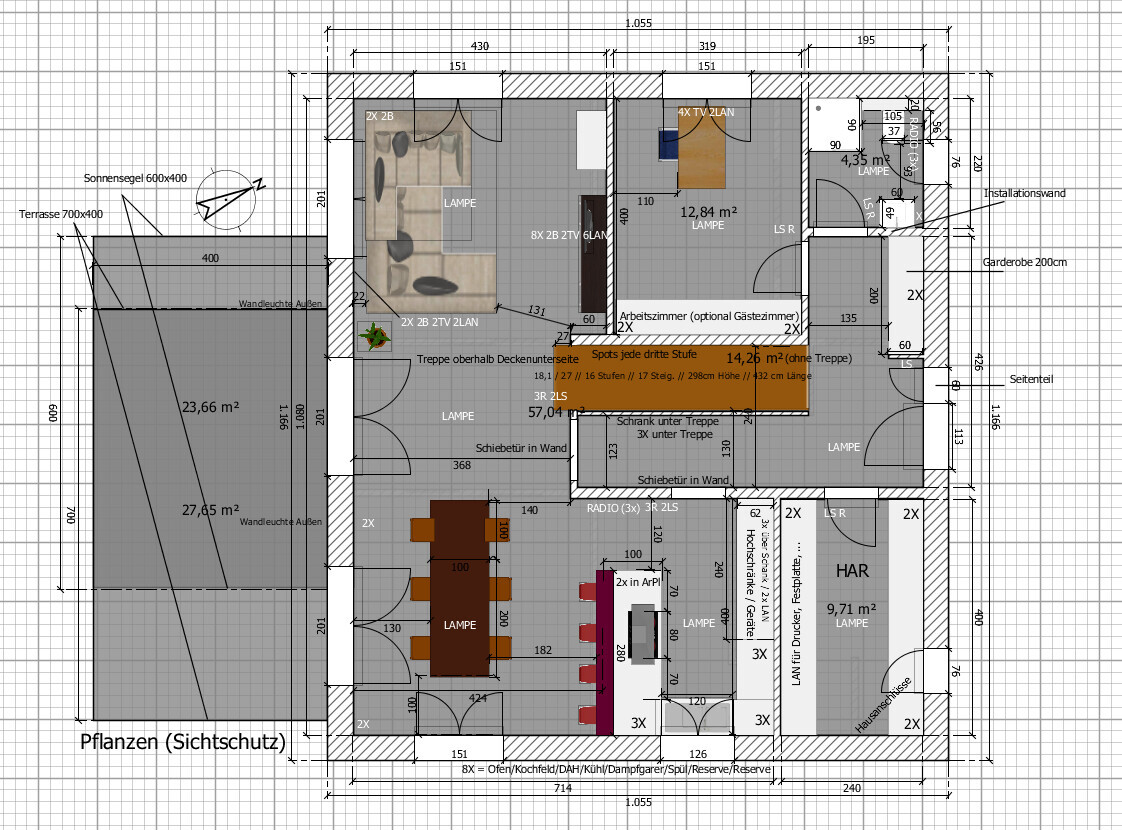
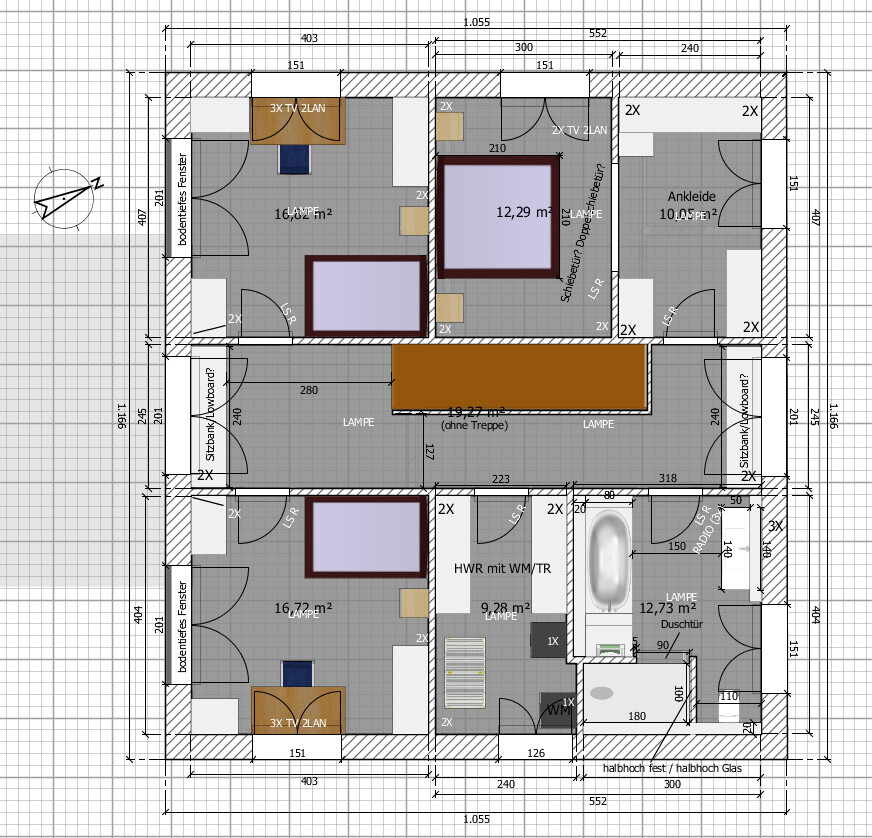
According to the current planning status, roller shutters will be installed everywhere (current planning status!). There will be a large sun sail to shade the central window and the dining room window from the sun. The dining room window facing east and the kitchen window will be in the shade shortly after noon.
A heat pump with cooling function and a ground loop exchanger for the controlled ventilation system are planned. Simple logic functions, such as bypass for the controlled ventilation or controlling the underfloor heating based on outside and return temperatures, are handled by the devices themselves. In winter, when the sun heats the floor, the return flow temperature rises, and the heat pump realizes it needs to heat less because of the external heat input. The ventilation system detects when the bypass should be activated.
Individual room control is pointless, or so everyone says in the pink forum. At least for our KfW55-standard building, it’s probably very unnecessary. Night setback is also not needed.
Energy-saving functions don’t interest me because the investment cost will always be higher than the electricity savings. Conventional smoke detectors will be installed, and please no hysterical discussions about this. There will be no gas, oil, or fireplace in the house. And if the house burns down while we’re away, it’s insured. There will be no photovoltaic system, and I’m not interested in any other extreme energy-saving measures. The washing machine has its own timer. Usually, we just load it in the afternoon and hang the laundry in the evening. It doesn’t need to run for three hours at night because of lower tariffs to save 0.3 cents per wash cycle.
The living/dining/kitchen area will have six roller shutters and four dimmable lights. Three shutters and two lights each will be controlled from switches next to the living room door and the kitchen door. The switches are arranged side by side so that the leftmost switch controls the left side of the room, and so on. So the west, south, and central living areas are controlled from the living room door; the south dining area, east dining area, and east kitchen are controlled from the kitchen door. For shading, only the two roller shutters next to the living room are relevant (south living room, as it is not under the sun sail, and west living room).
Currently, in the old building, we have internal blinds and a large west-facing facade. Apart from the five warmest days of the year, we don’t fully shade the windows. We just want to avoid direct sunlight where we are sitting, working, playing, etc. Depending on the situation, some blinds go up and others go down, and so on.
Constant light regulation is not desired. Even now, we switch lights on and off based on feeling. When we want to go to bed soon, the lights are usually off or more distant lights are on (kind of indirect lighting). I have different lighting preferences than my wife, and when we are together in the room, naturally, a compromise solution applies.
I sometimes work flexible hours, and sometimes I might sleep only four hours one night and seven hours the next day. A rule like “dim after xx o’clock” won’t work.
There is no defined TV lighting plan. It depends on the program. For briefly watching the news, all lighting can remain as is. For a moderately interesting football game, only the direct light is turned off, but indirect lighting can stay. For a ‘Game of Thrones’ episode or a good movie, everything should be off, especially since these often have dark scenes. Sometimes, for example, the hallway light stays on as indirect lighting for the living area (which makes sole hallway lighting with motion sensors pointless now).
Hallway lighting will have switches (two-way switches) next to each door, which can turn the lighting of the respective floor on and off. So yes, exactly one switch next to each door. The two lamps upstairs will switch on and off simultaneously. It is a floor-level switch. At stair landings, of course, there are exactly two switches: one for upstairs and one for downstairs. So, coming down the stairs, you can operate both switches to turn lights off upstairs and on downstairs. Or you turn off the upstairs light at the bottom of the stairs (top switch off = upstairs off; makes perfect sense to me).
Stair lighting could theoretically be controlled similarly, but that also depends a bit on the show effect, right? It could also be done with a timer or motion sensor. And if pets trigger the stair lighting, well, that’s just how it is. At the moment, we don’t have pets.
As for roller shutter control in the living/dining/kitchen areas, as I said before: short press for fully up/down and hold for precise positioning. But half-positioning is discouraged because temperature differences across the glass can cause damage. For example, next to the living room door, pressing the button three times briefly will raise (or lower) the three shutters. All other roller shutters follow the same principle and are arranged next to their respective doors. Only for bedrooms could I imagine a switch with a timer function, and I would only program the opening time for the next morning. I don’t need a closing time. A short press closes the roller shutter. But if I set my alarm clock to 6:53, I also set the roller shutter to 6:53 so that daylight wakes me at the same time (in the future, we will have joint wake-up times again, and my wife won’t have shift work anymore). BUT: all this can be done conventionally and very simply. So: the office (guest room), bedroom, and two children's rooms will have a switch (short = fully up/down) that allows an opening time to be set.
Just to summarize the shading logic during the day: roller shutters go down in the morning when leaving the room/living area and stay down until the first person returns home in the afternoon. This covers the first 10–12 hours of sunlight exposure.
The lighting in many rooms will be dimmable, but I don’t want expensive color lighting effects. The bulbs should have low blue light and good quality.
So, I think I’ve described the most important areas: roller shutters, lighting, heating, and a few other things...
How can automation like KNX help us now? What comfort gains are possible? What should we automate and why?
According to the current planning status, roller shutters will be installed everywhere (current planning status!). There will be a large sun sail to shade the central window and the dining room window from the sun. The dining room window facing east and the kitchen window will be in the shade shortly after noon.
A heat pump with cooling function and a ground loop exchanger for the controlled ventilation system are planned. Simple logic functions, such as bypass for the controlled ventilation or controlling the underfloor heating based on outside and return temperatures, are handled by the devices themselves. In winter, when the sun heats the floor, the return flow temperature rises, and the heat pump realizes it needs to heat less because of the external heat input. The ventilation system detects when the bypass should be activated.
Individual room control is pointless, or so everyone says in the pink forum. At least for our KfW55-standard building, it’s probably very unnecessary. Night setback is also not needed.
Energy-saving functions don’t interest me because the investment cost will always be higher than the electricity savings. Conventional smoke detectors will be installed, and please no hysterical discussions about this. There will be no gas, oil, or fireplace in the house. And if the house burns down while we’re away, it’s insured. There will be no photovoltaic system, and I’m not interested in any other extreme energy-saving measures. The washing machine has its own timer. Usually, we just load it in the afternoon and hang the laundry in the evening. It doesn’t need to run for three hours at night because of lower tariffs to save 0.3 cents per wash cycle.
The living/dining/kitchen area will have six roller shutters and four dimmable lights. Three shutters and two lights each will be controlled from switches next to the living room door and the kitchen door. The switches are arranged side by side so that the leftmost switch controls the left side of the room, and so on. So the west, south, and central living areas are controlled from the living room door; the south dining area, east dining area, and east kitchen are controlled from the kitchen door. For shading, only the two roller shutters next to the living room are relevant (south living room, as it is not under the sun sail, and west living room).
Currently, in the old building, we have internal blinds and a large west-facing facade. Apart from the five warmest days of the year, we don’t fully shade the windows. We just want to avoid direct sunlight where we are sitting, working, playing, etc. Depending on the situation, some blinds go up and others go down, and so on.
Constant light regulation is not desired. Even now, we switch lights on and off based on feeling. When we want to go to bed soon, the lights are usually off or more distant lights are on (kind of indirect lighting). I have different lighting preferences than my wife, and when we are together in the room, naturally, a compromise solution applies.
I sometimes work flexible hours, and sometimes I might sleep only four hours one night and seven hours the next day. A rule like “dim after xx o’clock” won’t work.
There is no defined TV lighting plan. It depends on the program. For briefly watching the news, all lighting can remain as is. For a moderately interesting football game, only the direct light is turned off, but indirect lighting can stay. For a ‘Game of Thrones’ episode or a good movie, everything should be off, especially since these often have dark scenes. Sometimes, for example, the hallway light stays on as indirect lighting for the living area (which makes sole hallway lighting with motion sensors pointless now).
Hallway lighting will have switches (two-way switches) next to each door, which can turn the lighting of the respective floor on and off. So yes, exactly one switch next to each door. The two lamps upstairs will switch on and off simultaneously. It is a floor-level switch. At stair landings, of course, there are exactly two switches: one for upstairs and one for downstairs. So, coming down the stairs, you can operate both switches to turn lights off upstairs and on downstairs. Or you turn off the upstairs light at the bottom of the stairs (top switch off = upstairs off; makes perfect sense to me).
Stair lighting could theoretically be controlled similarly, but that also depends a bit on the show effect, right? It could also be done with a timer or motion sensor. And if pets trigger the stair lighting, well, that’s just how it is. At the moment, we don’t have pets.
As for roller shutter control in the living/dining/kitchen areas, as I said before: short press for fully up/down and hold for precise positioning. But half-positioning is discouraged because temperature differences across the glass can cause damage. For example, next to the living room door, pressing the button three times briefly will raise (or lower) the three shutters. All other roller shutters follow the same principle and are arranged next to their respective doors. Only for bedrooms could I imagine a switch with a timer function, and I would only program the opening time for the next morning. I don’t need a closing time. A short press closes the roller shutter. But if I set my alarm clock to 6:53, I also set the roller shutter to 6:53 so that daylight wakes me at the same time (in the future, we will have joint wake-up times again, and my wife won’t have shift work anymore). BUT: all this can be done conventionally and very simply. So: the office (guest room), bedroom, and two children's rooms will have a switch (short = fully up/down) that allows an opening time to be set.
Just to summarize the shading logic during the day: roller shutters go down in the morning when leaving the room/living area and stay down until the first person returns home in the afternoon. This covers the first 10–12 hours of sunlight exposure.
The lighting in many rooms will be dimmable, but I don’t want expensive color lighting effects. The bulbs should have low blue light and good quality.
So, I think I’ve described the most important areas: roller shutters, lighting, heating, and a few other things...
How can automation like KNX help us now? What comfort gains are possible? What should we automate and why?
Uwe82 schrieb:
But again, the question: Why are you focusing on these details? You really seem to have a lot of time... If all experts say you should install KNX, at least prepare for it, and that you shouldn’t rely on proprietary or conventional solutions, and so far no one has complained about their KNX system at home, then I have to finally admit that my previous opinion might be wrong and I should be more open-minded about the whole thing.
Now a question about star wiring – would you really wire each socket individually from the distribution board, or would you at least group double or triple sockets together? Would you then install as many circuit breakers accordingly, meaning 100 sockets would require 100 breakers, or with grouped double and triple sockets, would it still be about 40-50 breakers?
And with star wiring, can I also decide later which sockets are switchable? Just by making changes in the utility room? Because adding 7 more 16-channel switching actuators to make around 100 sockets switchable would be quite expensive.
S
Sebastian7929 Aug 2016 11:50Just because 2-3 people tell you in an anonymous forum that something is important, does that really convince you within days/hours?
Is that the right approach...? You still don’t fully understand KNX, yet you’re already moving into detailed planning.
Is that the right approach...? You still don’t fully understand KNX, yet you’re already moving into detailed planning.

Grym schrieb:
If all experts say you should use KNX... If all experts say that jumping off a bridge is a great sport, would you do it too? If you don’t recognize the added value, using KNX will result in exactly the same setup as a conventional installation—it won’t bring you any benefits. For example, controlling blinds randomly or no constant light regulation.The art usually lies in finding a common denominator and automating that. Whether the slats are 25% or 40% closed doesn’t really matter once you get used to it.
Regarding the wiring, this is how we did it: We thought about how many outlets we wanted to be switchable. In the bedrooms, it’s a maximum of one or two. Then we run a suitable cable into the room (NYM5 or NYM7) and daisy-chain it from outlet to outlet. This way, you can connect the switchable wires at any outlet where you need them. Then wire everything in the cabinet (we use terminal blocks there, which makes it simple), configure it, and you’re done.
The circuit breakers usually stay the same—one breaker per room. The blinds are on a separate shared circuit. Only in the kitchen do we have three triple outlets, each connected to its own breaker, because that’s where the highest power-consuming appliances are often used.

A central control unit is not really necessary... however, if you want external access, complex logics, or a lot of automation, then you need some kind of server, whether it’s a Raspberry Pi with SmartVisu, an EIB PC, or Wiregate—you have to decide that for yourself. Every solution, as always, has its strengths and weaknesses.
Considering the components of the system in detail is not a bad idea... but it’s putting the cart before the horse. As I already mentioned, go through the rooms mentally and write down which functions are needed. Not every room light needs to be dimmable, and not every socket has to be switchable.
For the sockets, you do it as Uwe already said: a group of three sockets—or the whole room, if it isn’t too large—gets an NYM 5 or 7 cable, and then you wire the sockets as needed. This way, you don’t have to create a “copper mine” in your house, although it often looks like one.
You most likely won’t need 2000 meters (6600 feet) of bus cabling... Also, the power supply you proposed is oversized and more suited for large installations. With 640mA for the inner line and 160mA for the outer line, you have more than enough.
Yes, you can do that by simply rewiring the sockets and the control panel as needed. But as I mentioned before, you don’t have to wire every single socket individually. For example, I have about 100 sockets with 48 actuator channels.
Considering the components of the system in detail is not a bad idea... but it’s putting the cart before the horse. As I already mentioned, go through the rooms mentally and write down which functions are needed. Not every room light needs to be dimmable, and not every socket has to be switchable.
For the sockets, you do it as Uwe already said: a group of three sockets—or the whole room, if it isn’t too large—gets an NYM 5 or 7 cable, and then you wire the sockets as needed. This way, you don’t have to create a “copper mine” in your house, although it often looks like one.
You most likely won’t need 2000 meters (6600 feet) of bus cabling... Also, the power supply you proposed is oversized and more suited for large installations. With 640mA for the inner line and 160mA for the outer line, you have more than enough.
Grym schrieb:
And can I then define which sockets are switchable in a star wiring setup after the fact? Just by making changes in the utility room? Because adding seven 16-channel actuators to make about 100 sockets switchable would be expensive.
Yes, you can do that by simply rewiring the sockets and the control panel as needed. But as I mentioned before, you don’t have to wire every single socket individually. For example, I have about 100 sockets with 48 actuator channels.
Like Grym, I’ve done a bit more reading on the topic in the meantime.
You really go from one thing to the next with this subject... the wish list keeps growing, and growing, because you want to do it “right.” So I scrapped everything and started small again. There are so many possibilities, but (in my opinion) a lot of it is still gimmicky, or the intended purpose is questionable.
For example, to make the “all off” switch at the entrance work, I would really need to have the entire house covered with KNX for lighting and outlets. That’s quite an investment, of course. How much electricity would you really save on forgotten lights in a year? Hmm. In general, the arguments for energy savings seem pretty unrealistic to me.
What stuck in my mind was the picture of the “thousand” switches in the kitchen/dining/living room area. For that, you’d need at least KNX for lighting and blinds in this area. But then you quickly get to window contacts (e.g., terrace door open = blind doesn’t go down there; blinds down and terrace door opened = the blind at the door goes up). With blinds, you also quickly get to the weather station and then… ah! It just never ends!! So maybe just accept it and live with that one (!!) room with the switch cluster—like 99% of other homeowners.
The integration of heating and household appliances also seems uneconomical to me. If manufacturers offer modules for that, they’re insanely expensive (500€+). I’m also not convinced that controlling the heating system has a big impact. There are examples like “if the window is open, the heating turns down.” What does that do for me in a new build with underfloor heating? Absolutely nothing.
I find it interesting to have the ventilation system on KNX, so you could, for example, put “power buttons” in the toilet or kitchen to increase the output when needed. But there, too, the KNX modules are very expensive, and a ventilation system with separate room control already comes with an extra cost and would make sense for this purpose.
There are washing machines with optional KNX modules from Miele in their top models. I wouldn’t buy one just for that, let alone pay triple digits for the KNX module. My washing machine beeps when it’s done; you can hear it throughout the house. That’s enough for me. I don’t need an app alert.
Homeservers range widely in price and complexity. From cheap and fiddly to nice looking and expensive (around 2,000€). With these, you get colorful interfaces on tablets (which I consider largely optional) and more complex logic becomes possible. Basically, though, important functions should probably be kept away from the homeserver because it’s prone to failure. So only comfort features like visualization and scene control, which you can easily do without if something goes wrong, should depend on it.
The absolute limit is then the 1,000€ for the software to program the system or the workaround via the Lite version.
Overall, with the prices of the modules, software, and offered services, it becomes clear that there’s a hefty licensing fee built in everywhere and a big markup for “luxury.”
@Grym
Also think about whether all outlets actually need to be switchable. The outlet for the Christmas lights in the window, okay, or the one in the corner for the floor lamp. Maybe one for the coffee machine so it turns on in the morning (although I already find that a bit contrived in terms of real added value). But not all around the house, where 50% of outlets are either permanently unused or used intermittently anyway. A modern TV uses less than 1W in standby. Try calculating when the “all off” switch pays off. Even your grandchildren won’t see that.
There seem to be real debates about presence detectors, what makes sense and what doesn’t. The fact is, they aren’t cheap, you have to at least prepare the installation (because running cables to the ceiling afterward is awkward), and—in my opinion—they look very ugly.
You really go from one thing to the next with this subject... the wish list keeps growing, and growing, because you want to do it “right.” So I scrapped everything and started small again. There are so many possibilities, but (in my opinion) a lot of it is still gimmicky, or the intended purpose is questionable.
For example, to make the “all off” switch at the entrance work, I would really need to have the entire house covered with KNX for lighting and outlets. That’s quite an investment, of course. How much electricity would you really save on forgotten lights in a year? Hmm. In general, the arguments for energy savings seem pretty unrealistic to me.
What stuck in my mind was the picture of the “thousand” switches in the kitchen/dining/living room area. For that, you’d need at least KNX for lighting and blinds in this area. But then you quickly get to window contacts (e.g., terrace door open = blind doesn’t go down there; blinds down and terrace door opened = the blind at the door goes up). With blinds, you also quickly get to the weather station and then… ah! It just never ends!! So maybe just accept it and live with that one (!!) room with the switch cluster—like 99% of other homeowners.
The integration of heating and household appliances also seems uneconomical to me. If manufacturers offer modules for that, they’re insanely expensive (500€+). I’m also not convinced that controlling the heating system has a big impact. There are examples like “if the window is open, the heating turns down.” What does that do for me in a new build with underfloor heating? Absolutely nothing.
I find it interesting to have the ventilation system on KNX, so you could, for example, put “power buttons” in the toilet or kitchen to increase the output when needed. But there, too, the KNX modules are very expensive, and a ventilation system with separate room control already comes with an extra cost and would make sense for this purpose.
There are washing machines with optional KNX modules from Miele in their top models. I wouldn’t buy one just for that, let alone pay triple digits for the KNX module. My washing machine beeps when it’s done; you can hear it throughout the house. That’s enough for me. I don’t need an app alert.
Homeservers range widely in price and complexity. From cheap and fiddly to nice looking and expensive (around 2,000€). With these, you get colorful interfaces on tablets (which I consider largely optional) and more complex logic becomes possible. Basically, though, important functions should probably be kept away from the homeserver because it’s prone to failure. So only comfort features like visualization and scene control, which you can easily do without if something goes wrong, should depend on it.
The absolute limit is then the 1,000€ for the software to program the system or the workaround via the Lite version.
Overall, with the prices of the modules, software, and offered services, it becomes clear that there’s a hefty licensing fee built in everywhere and a big markup for “luxury.”
@Grym
Also think about whether all outlets actually need to be switchable. The outlet for the Christmas lights in the window, okay, or the one in the corner for the floor lamp. Maybe one for the coffee machine so it turns on in the morning (although I already find that a bit contrived in terms of real added value). But not all around the house, where 50% of outlets are either permanently unused or used intermittently anyway. A modern TV uses less than 1W in standby. Try calculating when the “all off” switch pays off. Even your grandchildren won’t see that.
There seem to be real debates about presence detectors, what makes sense and what doesn’t. The fact is, they aren’t cheap, you have to at least prepare the installation (because running cables to the ceiling afterward is awkward), and—in my opinion—they look very ugly.
S
Sebastian7929 Aug 2016 17:14Just by the way: I installed a "Kacketaster" in the bathrooms, so that pressing it increases the ventilation system’s performance.
Otherwise, nice post—I see it the same way.
Otherwise, nice post—I see it the same way.