
Ok, now let’s think about the topic from a practical perspective. I’m quite familiar with KNX, but I can’t really come up with a scenario where KNX would clearly benefit us. Here are our floor plans again:
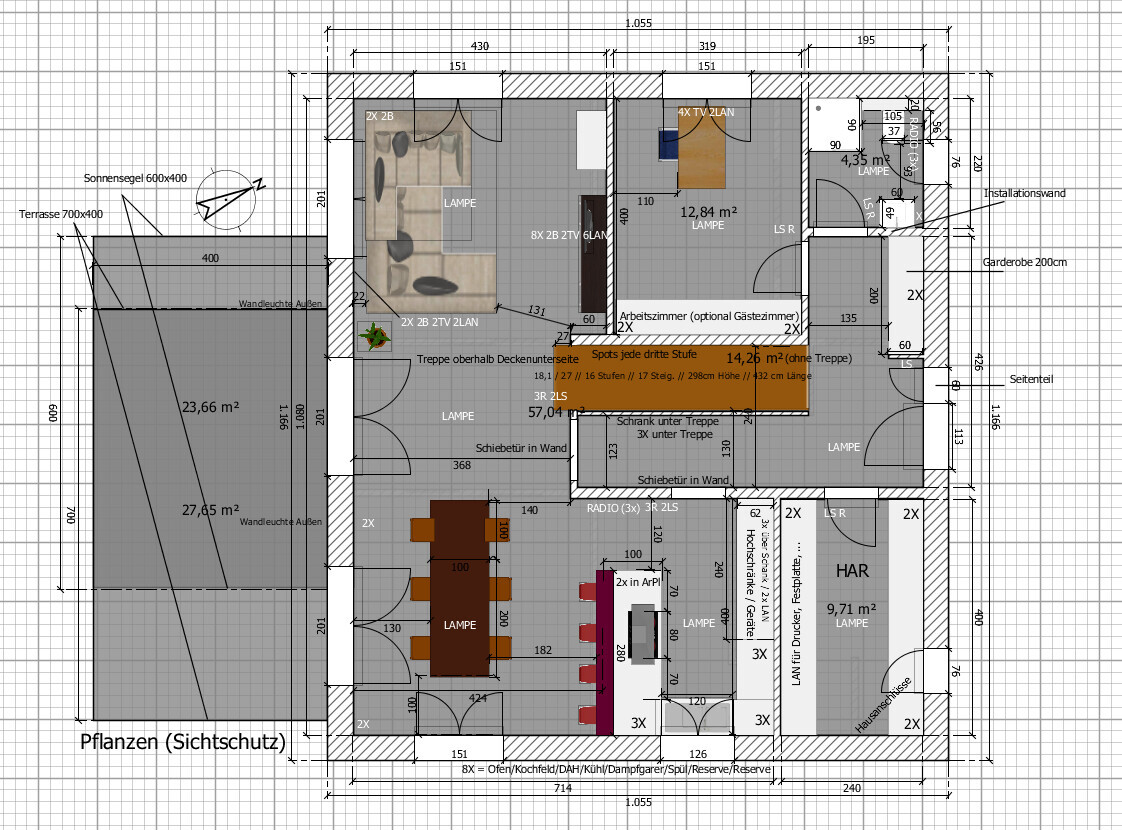
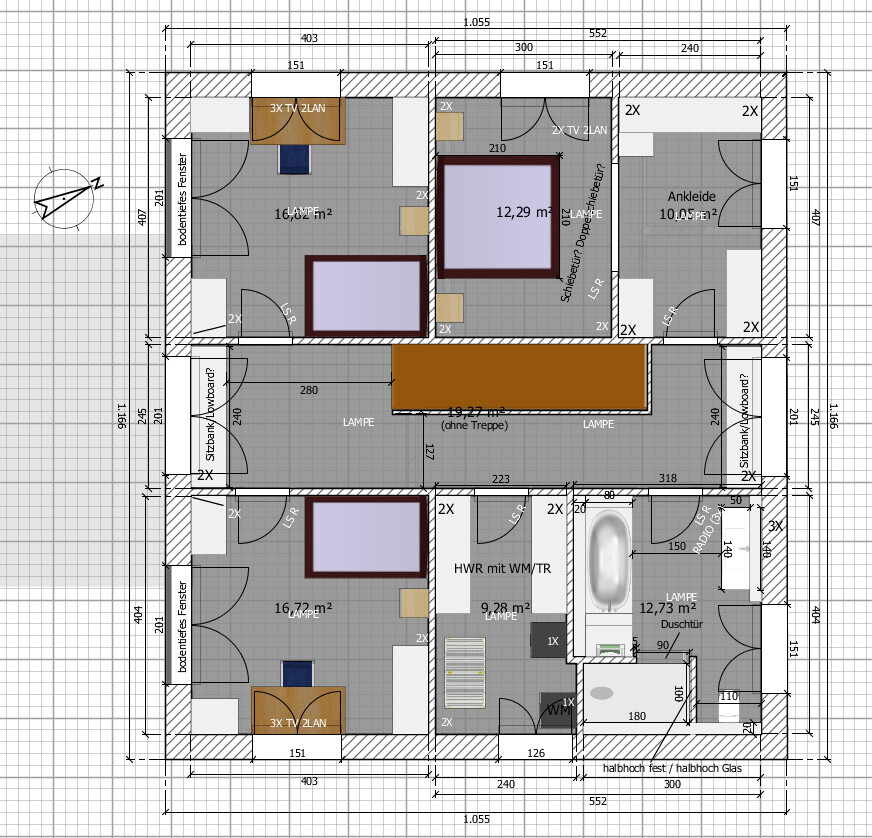
According to the current planning status, roller shutters will be installed everywhere (current planning status!). There will be a large sun sail to shade the central window and the dining room window from the sun. The dining room window facing east and the kitchen window will be in the shade shortly after noon.
A heat pump with cooling function and a ground loop exchanger for the controlled ventilation system are planned. Simple logic functions, such as bypass for the controlled ventilation or controlling the underfloor heating based on outside and return temperatures, are handled by the devices themselves. In winter, when the sun heats the floor, the return flow temperature rises, and the heat pump realizes it needs to heat less because of the external heat input. The ventilation system detects when the bypass should be activated.
Individual room control is pointless, or so everyone says in the pink forum. At least for our KfW55-standard building, it’s probably very unnecessary. Night setback is also not needed.
Energy-saving functions don’t interest me because the investment cost will always be higher than the electricity savings. Conventional smoke detectors will be installed, and please no hysterical discussions about this. There will be no gas, oil, or fireplace in the house. And if the house burns down while we’re away, it’s insured. There will be no photovoltaic system, and I’m not interested in any other extreme energy-saving measures. The washing machine has its own timer. Usually, we just load it in the afternoon and hang the laundry in the evening. It doesn’t need to run for three hours at night because of lower tariffs to save 0.3 cents per wash cycle.
The living/dining/kitchen area will have six roller shutters and four dimmable lights. Three shutters and two lights each will be controlled from switches next to the living room door and the kitchen door. The switches are arranged side by side so that the leftmost switch controls the left side of the room, and so on. So the west, south, and central living areas are controlled from the living room door; the south dining area, east dining area, and east kitchen are controlled from the kitchen door. For shading, only the two roller shutters next to the living room are relevant (south living room, as it is not under the sun sail, and west living room).
Currently, in the old building, we have internal blinds and a large west-facing facade. Apart from the five warmest days of the year, we don’t fully shade the windows. We just want to avoid direct sunlight where we are sitting, working, playing, etc. Depending on the situation, some blinds go up and others go down, and so on.
Constant light regulation is not desired. Even now, we switch lights on and off based on feeling. When we want to go to bed soon, the lights are usually off or more distant lights are on (kind of indirect lighting). I have different lighting preferences than my wife, and when we are together in the room, naturally, a compromise solution applies.
I sometimes work flexible hours, and sometimes I might sleep only four hours one night and seven hours the next day. A rule like “dim after xx o’clock” won’t work.
There is no defined TV lighting plan. It depends on the program. For briefly watching the news, all lighting can remain as is. For a moderately interesting football game, only the direct light is turned off, but indirect lighting can stay. For a ‘Game of Thrones’ episode or a good movie, everything should be off, especially since these often have dark scenes. Sometimes, for example, the hallway light stays on as indirect lighting for the living area (which makes sole hallway lighting with motion sensors pointless now).
Hallway lighting will have switches (two-way switches) next to each door, which can turn the lighting of the respective floor on and off. So yes, exactly one switch next to each door. The two lamps upstairs will switch on and off simultaneously. It is a floor-level switch. At stair landings, of course, there are exactly two switches: one for upstairs and one for downstairs. So, coming down the stairs, you can operate both switches to turn lights off upstairs and on downstairs. Or you turn off the upstairs light at the bottom of the stairs (top switch off = upstairs off; makes perfect sense to me).
Stair lighting could theoretically be controlled similarly, but that also depends a bit on the show effect, right? It could also be done with a timer or motion sensor. And if pets trigger the stair lighting, well, that’s just how it is. At the moment, we don’t have pets.
As for roller shutter control in the living/dining/kitchen areas, as I said before: short press for fully up/down and hold for precise positioning. But half-positioning is discouraged because temperature differences across the glass can cause damage. For example, next to the living room door, pressing the button three times briefly will raise (or lower) the three shutters. All other roller shutters follow the same principle and are arranged next to their respective doors. Only for bedrooms could I imagine a switch with a timer function, and I would only program the opening time for the next morning. I don’t need a closing time. A short press closes the roller shutter. But if I set my alarm clock to 6:53, I also set the roller shutter to 6:53 so that daylight wakes me at the same time (in the future, we will have joint wake-up times again, and my wife won’t have shift work anymore). BUT: all this can be done conventionally and very simply. So: the office (guest room), bedroom, and two children's rooms will have a switch (short = fully up/down) that allows an opening time to be set.
Just to summarize the shading logic during the day: roller shutters go down in the morning when leaving the room/living area and stay down until the first person returns home in the afternoon. This covers the first 10–12 hours of sunlight exposure.
The lighting in many rooms will be dimmable, but I don’t want expensive color lighting effects. The bulbs should have low blue light and good quality.
So, I think I’ve described the most important areas: roller shutters, lighting, heating, and a few other things...
How can automation like KNX help us now? What comfort gains are possible? What should we automate and why?
According to the current planning status, roller shutters will be installed everywhere (current planning status!). There will be a large sun sail to shade the central window and the dining room window from the sun. The dining room window facing east and the kitchen window will be in the shade shortly after noon.
A heat pump with cooling function and a ground loop exchanger for the controlled ventilation system are planned. Simple logic functions, such as bypass for the controlled ventilation or controlling the underfloor heating based on outside and return temperatures, are handled by the devices themselves. In winter, when the sun heats the floor, the return flow temperature rises, and the heat pump realizes it needs to heat less because of the external heat input. The ventilation system detects when the bypass should be activated.
Individual room control is pointless, or so everyone says in the pink forum. At least for our KfW55-standard building, it’s probably very unnecessary. Night setback is also not needed.
Energy-saving functions don’t interest me because the investment cost will always be higher than the electricity savings. Conventional smoke detectors will be installed, and please no hysterical discussions about this. There will be no gas, oil, or fireplace in the house. And if the house burns down while we’re away, it’s insured. There will be no photovoltaic system, and I’m not interested in any other extreme energy-saving measures. The washing machine has its own timer. Usually, we just load it in the afternoon and hang the laundry in the evening. It doesn’t need to run for three hours at night because of lower tariffs to save 0.3 cents per wash cycle.
The living/dining/kitchen area will have six roller shutters and four dimmable lights. Three shutters and two lights each will be controlled from switches next to the living room door and the kitchen door. The switches are arranged side by side so that the leftmost switch controls the left side of the room, and so on. So the west, south, and central living areas are controlled from the living room door; the south dining area, east dining area, and east kitchen are controlled from the kitchen door. For shading, only the two roller shutters next to the living room are relevant (south living room, as it is not under the sun sail, and west living room).
Currently, in the old building, we have internal blinds and a large west-facing facade. Apart from the five warmest days of the year, we don’t fully shade the windows. We just want to avoid direct sunlight where we are sitting, working, playing, etc. Depending on the situation, some blinds go up and others go down, and so on.
Constant light regulation is not desired. Even now, we switch lights on and off based on feeling. When we want to go to bed soon, the lights are usually off or more distant lights are on (kind of indirect lighting). I have different lighting preferences than my wife, and when we are together in the room, naturally, a compromise solution applies.
I sometimes work flexible hours, and sometimes I might sleep only four hours one night and seven hours the next day. A rule like “dim after xx o’clock” won’t work.
There is no defined TV lighting plan. It depends on the program. For briefly watching the news, all lighting can remain as is. For a moderately interesting football game, only the direct light is turned off, but indirect lighting can stay. For a ‘Game of Thrones’ episode or a good movie, everything should be off, especially since these often have dark scenes. Sometimes, for example, the hallway light stays on as indirect lighting for the living area (which makes sole hallway lighting with motion sensors pointless now).
Hallway lighting will have switches (two-way switches) next to each door, which can turn the lighting of the respective floor on and off. So yes, exactly one switch next to each door. The two lamps upstairs will switch on and off simultaneously. It is a floor-level switch. At stair landings, of course, there are exactly two switches: one for upstairs and one for downstairs. So, coming down the stairs, you can operate both switches to turn lights off upstairs and on downstairs. Or you turn off the upstairs light at the bottom of the stairs (top switch off = upstairs off; makes perfect sense to me).
Stair lighting could theoretically be controlled similarly, but that also depends a bit on the show effect, right? It could also be done with a timer or motion sensor. And if pets trigger the stair lighting, well, that’s just how it is. At the moment, we don’t have pets.
As for roller shutter control in the living/dining/kitchen areas, as I said before: short press for fully up/down and hold for precise positioning. But half-positioning is discouraged because temperature differences across the glass can cause damage. For example, next to the living room door, pressing the button three times briefly will raise (or lower) the three shutters. All other roller shutters follow the same principle and are arranged next to their respective doors. Only for bedrooms could I imagine a switch with a timer function, and I would only program the opening time for the next morning. I don’t need a closing time. A short press closes the roller shutter. But if I set my alarm clock to 6:53, I also set the roller shutter to 6:53 so that daylight wakes me at the same time (in the future, we will have joint wake-up times again, and my wife won’t have shift work anymore). BUT: all this can be done conventionally and very simply. So: the office (guest room), bedroom, and two children's rooms will have a switch (short = fully up/down) that allows an opening time to be set.
Just to summarize the shading logic during the day: roller shutters go down in the morning when leaving the room/living area and stay down until the first person returns home in the afternoon. This covers the first 10–12 hours of sunlight exposure.
The lighting in many rooms will be dimmable, but I don’t want expensive color lighting effects. The bulbs should have low blue light and good quality.
So, I think I’ve described the most important areas: roller shutters, lighting, heating, and a few other things...
How can automation like KNX help us now? What comfort gains are possible? What should we automate and why?
We will see. However, even with the sanitary fixtures, the general contractor already mentioned that nowadays everyone compares prices online, so they offer corresponding prices (and if anyone prefers, they can also purchase all the bathroom fixtures themselves and the plumbing company will install them). Of course, just to avoid further tedious discussions here: we will do the electrical and plumbing selections before signing the contract and include everything in the contract.
For example, it would also be sufficient if the electrician only installs the flush-mounted bus coupler per room, and we can buy the sensor/switch ourselves and install it (if their price is not close to the online price).
It is also possible to exclude individual trades. I also have a certified electrician in the family.
For example, it would also be sufficient if the electrician only installs the flush-mounted bus coupler per room, and we can buy the sensor/switch ourselves and install it (if their price is not close to the online price).
It is also possible to exclude individual trades. I also have a certified electrician in the family.
S
Sebastian7929 Aug 2016 10:27Well then, I’m curious to see how your stance will change.

You only really need bus couplers if there is a tactile sensor, push button, or motion detector installed from the start.
If it’s only going to be prepared initially, a simple empty junction box with a cover is sufficient, with the green cable placed inside. Later on, you can install anything you need in that box if the need arises.
The away mode you’re referring to is a basic central function, also called a scene. For this, you only need a double push button at the entrance, with which you can switch between the "present" and "away" scenes in the simplest form. Once activated, a sequence of actions will take place, such as setting the roller shutters to automatic, turning off lights and sockets, etc.
Dimmable lighting is quite useful. For this, all light points should be fed with a 5x1.5 NYM cable, so you can later decide whether to dim them simply, control them via DALI, or use another system.
Heating and ventilation are topics of their own—you need to assess whether it even makes sense to integrate these systems into the bus. The gateways are often disproportionately expensive. However, it can be done later if necessary. In any case, lay the bus cable and, if needed, NYM cables in advance.
I would generally recommend installing window contacts on all windows, as they are necessary for various logic functions. For example, to avoid standing outside in your underwear when the terrace shutter goes down.
You probably won’t find a bus-connected washing machine, or if you do, the price will be so high that it’s simply not worth it.
Whether you choose a star, tree, or open ring topology for routing the green cable, it will be correct—as long as it does not form a closed loop.
Imagine this: on the ground floor, the green cable starts from your utility room and runs sequentially through the rooms, passing through each junction box (for a combination of 2, 3, or 4 switches, it’s sufficient to only equip one with the bus). It then returns to the utility room. The end is left open; this would be a large open ring.
You can also create open rings room by room—in total, you would have a star configuration. Or you can lay a main cable from which open rings branch off as spur lines for each room. This would be a tree structure.
As you can see, it doesn’t really matter. There is only one rule: no closed loop.
The advantage of open rings is obvious. You always have two cable ends in the utility room. If the cable is accidentally drilled through during construction or later, it’s no problem—you simply connect the other end, and the room’s bus system will work again everywhere.
If it’s only going to be prepared initially, a simple empty junction box with a cover is sufficient, with the green cable placed inside. Later on, you can install anything you need in that box if the need arises.
The away mode you’re referring to is a basic central function, also called a scene. For this, you only need a double push button at the entrance, with which you can switch between the "present" and "away" scenes in the simplest form. Once activated, a sequence of actions will take place, such as setting the roller shutters to automatic, turning off lights and sockets, etc.
Dimmable lighting is quite useful. For this, all light points should be fed with a 5x1.5 NYM cable, so you can later decide whether to dim them simply, control them via DALI, or use another system.
Heating and ventilation are topics of their own—you need to assess whether it even makes sense to integrate these systems into the bus. The gateways are often disproportionately expensive. However, it can be done later if necessary. In any case, lay the bus cable and, if needed, NYM cables in advance.
I would generally recommend installing window contacts on all windows, as they are necessary for various logic functions. For example, to avoid standing outside in your underwear when the terrace shutter goes down.
You probably won’t find a bus-connected washing machine, or if you do, the price will be so high that it’s simply not worth it.
Whether you choose a star, tree, or open ring topology for routing the green cable, it will be correct—as long as it does not form a closed loop.
Imagine this: on the ground floor, the green cable starts from your utility room and runs sequentially through the rooms, passing through each junction box (for a combination of 2, 3, or 4 switches, it’s sufficient to only equip one with the bus). It then returns to the utility room. The end is left open; this would be a large open ring.
You can also create open rings room by room—in total, you would have a star configuration. Or you can lay a main cable from which open rings branch off as spur lines for each room. This would be a tree structure.
As you can see, it doesn’t really matter. There is only one rule: no closed loop.
The advantage of open rings is obvious. You always have two cable ends in the utility room. If the cable is accidentally drilled through during construction or later, it’s no problem—you simply connect the other end, and the room’s bus system will work again everywhere.

One more note about bus couplers: These depend on the manufacturer, so you cannot use just any device. Also, most components nowadays have integrated bus couplers, so you simply install them in the box, connect the two wires to the terminal, and that's it. So, if you want to do this yourself, just leave the box open with the cable inside and buy your devices separately.
But why are you focusing on these details now? At the moment, you seem to think you don’t need this, or you’re not convinced by the scenarios. I often get the impression that you want to see the end of the process before you have even taken the first step.
But why are you focusing on these details now? At the moment, you seem to think you don’t need this, or you’re not convinced by the scenarios. I often get the impression that you want to see the end of the process before you have even taken the first step.
Is a central controller necessary, and are there good open-source solutions like openHAB or Smarthome.py, or are proprietary systems still superior for this purpose?
I’ve gathered a few items I would probably need:
Weather station:
MDT SCN-WS3HW.01 Weather Station Home
258 EUR
16-channel switching actuator or 8-channel shutter actuator:
MDT AKU-1616.01 Universal actuator with 16 channels
263 EUR
(3 Venetian blinds; 16 roller shutters = 3 of these devices, leaving exactly 10 free switching channels = 789 EUR)
Bus cable:
EIB-Y(St)Y 2x2x0.8 Tr.500 EIB/Bus cable
133 EUR per 500 meters (547 yards)
(Example: 2,000 meters (2,187 yards) = 532 EUR)
Presence detector:
MDT-SCN-P360K4.01 Presence detector
110 EUR
(Upstairs hallway + stairs = 1; downstairs hallway = 1; total 2 = 220 EUR; however, I also read recommendations to install one presence detector in every room, which would be 13 total = 1,430 EUR)
Window contact, e.g. Gira: 15 EUR
(20 windows/doors = 300 EUR)
MDT STC-1280.01 Bus power supply with diagnostic function, rated 1280 mA
260 EUR
Dimming actuator:
MDT AKD-0401.01 4-channel dimming actuator
268 EUR
(16 lights, of which at least 9 are dimmable (living room, dining, kitchen, children’s room, bedroom, dressing room, work area) = 3 or 4 dimming actuators = 804 – 1,072 EUR)
Are all indoor and outdoor lights wired in a star topology using NYM-J 5x1.5 cable?
Do the push-buttons require power supply or only bus power?
I’ve gathered a few items I would probably need:
Weather station:
MDT SCN-WS3HW.01 Weather Station Home
258 EUR
16-channel switching actuator or 8-channel shutter actuator:
MDT AKU-1616.01 Universal actuator with 16 channels
263 EUR
(3 Venetian blinds; 16 roller shutters = 3 of these devices, leaving exactly 10 free switching channels = 789 EUR)
Bus cable:
EIB-Y(St)Y 2x2x0.8 Tr.500 EIB/Bus cable
133 EUR per 500 meters (547 yards)
(Example: 2,000 meters (2,187 yards) = 532 EUR)
Presence detector:
MDT-SCN-P360K4.01 Presence detector
110 EUR
(Upstairs hallway + stairs = 1; downstairs hallway = 1; total 2 = 220 EUR; however, I also read recommendations to install one presence detector in every room, which would be 13 total = 1,430 EUR)
Window contact, e.g. Gira: 15 EUR
(20 windows/doors = 300 EUR)
MDT STC-1280.01 Bus power supply with diagnostic function, rated 1280 mA
260 EUR
Dimming actuator:
MDT AKD-0401.01 4-channel dimming actuator
268 EUR
(16 lights, of which at least 9 are dimmable (living room, dining, kitchen, children’s room, bedroom, dressing room, work area) = 3 or 4 dimming actuators = 804 – 1,072 EUR)
Are all indoor and outdoor lights wired in a star topology using NYM-J 5x1.5 cable?
Do the push-buttons require power supply or only bus power?
Grym schrieb:
Do the push buttons need power as well, or just the bus? The power is supplied through the bus. You will also need an IP gateway and a 30V power supply with the appropriate capacity (depending on the devices). And don’t forget the €75 for the Lite version of ETS, the Pro version costs around €1000, unless you manage to get vouchers for either one.
But again, the question is: why are you dealing with these details? You really seem to have too much time on your hands...
Similar topics