
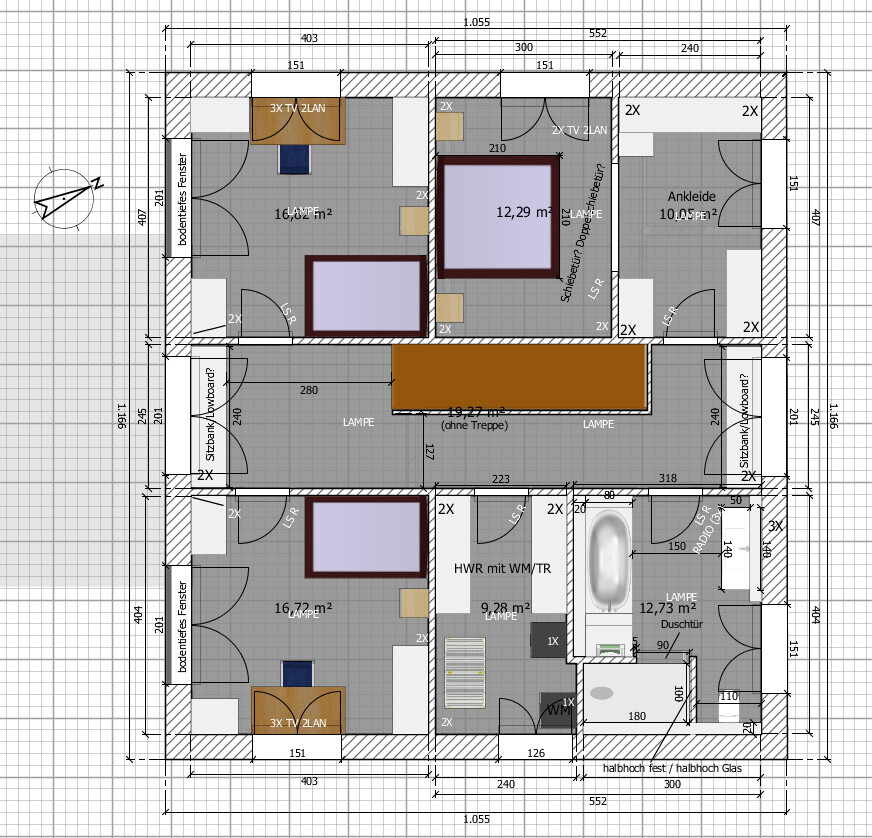
Ok, now let’s think about the topic from a practical perspective. I’m quite familiar with KNX, but I can’t really come up with a scenario where KNX would clearly benefit us. Here are our floor plans again:
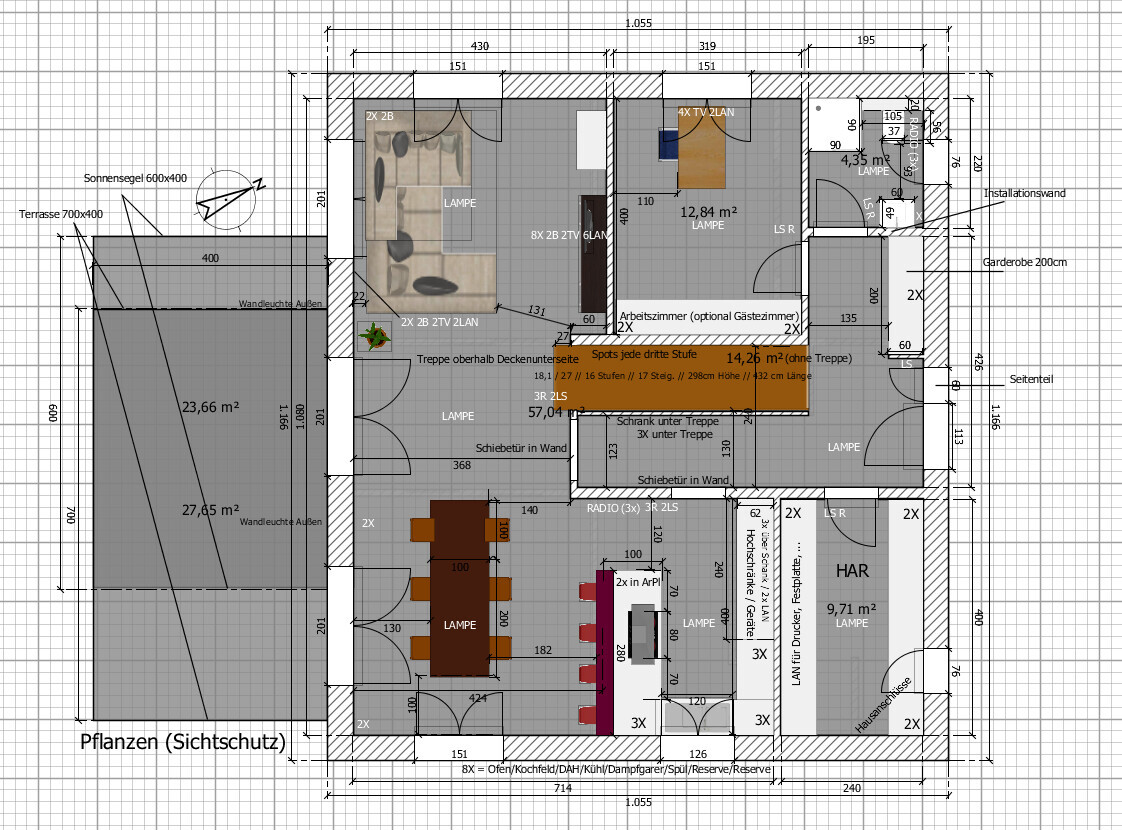
According to the current planning status, roller shutters will be installed everywhere (current planning status!). There will be a large sun sail to shade the central window and the dining room window from the sun. The dining room window facing east and the kitchen window will be in the shade shortly after noon.
A heat pump with cooling function and a ground loop exchanger for the controlled ventilation system are planned. Simple logic functions, such as bypass for the controlled ventilation or controlling the underfloor heating based on outside and return temperatures, are handled by the devices themselves. In winter, when the sun heats the floor, the return flow temperature rises, and the heat pump realizes it needs to heat less because of the external heat input. The ventilation system detects when the bypass should be activated.
Individual room control is pointless, or so everyone says in the pink forum. At least for our KfW55-standard building, it’s probably very unnecessary. Night setback is also not needed.
Energy-saving functions don’t interest me because the investment cost will always be higher than the electricity savings. Conventional smoke detectors will be installed, and please no hysterical discussions about this. There will be no gas, oil, or fireplace in the house. And if the house burns down while we’re away, it’s insured. There will be no photovoltaic system, and I’m not interested in any other extreme energy-saving measures. The washing machine has its own timer. Usually, we just load it in the afternoon and hang the laundry in the evening. It doesn’t need to run for three hours at night because of lower tariffs to save 0.3 cents per wash cycle.
The living/dining/kitchen area will have six roller shutters and four dimmable lights. Three shutters and two lights each will be controlled from switches next to the living room door and the kitchen door. The switches are arranged side by side so that the leftmost switch controls the left side of the room, and so on. So the west, south, and central living areas are controlled from the living room door; the south dining area, east dining area, and east kitchen are controlled from the kitchen door. For shading, only the two roller shutters next to the living room are relevant (south living room, as it is not under the sun sail, and west living room).
Currently, in the old building, we have internal blinds and a large west-facing facade. Apart from the five warmest days of the year, we don’t fully shade the windows. We just want to avoid direct sunlight where we are sitting, working, playing, etc. Depending on the situation, some blinds go up and others go down, and so on.
Constant light regulation is not desired. Even now, we switch lights on and off based on feeling. When we want to go to bed soon, the lights are usually off or more distant lights are on (kind of indirect lighting). I have different lighting preferences than my wife, and when we are together in the room, naturally, a compromise solution applies.
I sometimes work flexible hours, and sometimes I might sleep only four hours one night and seven hours the next day. A rule like “dim after xx o’clock” won’t work.
There is no defined TV lighting plan. It depends on the program. For briefly watching the news, all lighting can remain as is. For a moderately interesting football game, only the direct light is turned off, but indirect lighting can stay. For a ‘Game of Thrones’ episode or a good movie, everything should be off, especially since these often have dark scenes. Sometimes, for example, the hallway light stays on as indirect lighting for the living area (which makes sole hallway lighting with motion sensors pointless now).
Hallway lighting will have switches (two-way switches) next to each door, which can turn the lighting of the respective floor on and off. So yes, exactly one switch next to each door. The two lamps upstairs will switch on and off simultaneously. It is a floor-level switch. At stair landings, of course, there are exactly two switches: one for upstairs and one for downstairs. So, coming down the stairs, you can operate both switches to turn lights off upstairs and on downstairs. Or you turn off the upstairs light at the bottom of the stairs (top switch off = upstairs off; makes perfect sense to me).
Stair lighting could theoretically be controlled similarly, but that also depends a bit on the show effect, right? It could also be done with a timer or motion sensor. And if pets trigger the stair lighting, well, that’s just how it is. At the moment, we don’t have pets.
As for roller shutter control in the living/dining/kitchen areas, as I said before: short press for fully up/down and hold for precise positioning. But half-positioning is discouraged because temperature differences across the glass can cause damage. For example, next to the living room door, pressing the button three times briefly will raise (or lower) the three shutters. All other roller shutters follow the same principle and are arranged next to their respective doors. Only for bedrooms could I imagine a switch with a timer function, and I would only program the opening time for the next morning. I don’t need a closing time. A short press closes the roller shutter. But if I set my alarm clock to 6:53, I also set the roller shutter to 6:53 so that daylight wakes me at the same time (in the future, we will have joint wake-up times again, and my wife won’t have shift work anymore). BUT: all this can be done conventionally and very simply. So: the office (guest room), bedroom, and two children's rooms will have a switch (short = fully up/down) that allows an opening time to be set.
Just to summarize the shading logic during the day: roller shutters go down in the morning when leaving the room/living area and stay down until the first person returns home in the afternoon. This covers the first 10–12 hours of sunlight exposure.
The lighting in many rooms will be dimmable, but I don’t want expensive color lighting effects. The bulbs should have low blue light and good quality.
So, I think I’ve described the most important areas: roller shutters, lighting, heating, and a few other things...
How can automation like KNX help us now? What comfort gains are possible? What should we automate and why?
According to the current planning status, roller shutters will be installed everywhere (current planning status!). There will be a large sun sail to shade the central window and the dining room window from the sun. The dining room window facing east and the kitchen window will be in the shade shortly after noon.
A heat pump with cooling function and a ground loop exchanger for the controlled ventilation system are planned. Simple logic functions, such as bypass for the controlled ventilation or controlling the underfloor heating based on outside and return temperatures, are handled by the devices themselves. In winter, when the sun heats the floor, the return flow temperature rises, and the heat pump realizes it needs to heat less because of the external heat input. The ventilation system detects when the bypass should be activated.
Individual room control is pointless, or so everyone says in the pink forum. At least for our KfW55-standard building, it’s probably very unnecessary. Night setback is also not needed.
Energy-saving functions don’t interest me because the investment cost will always be higher than the electricity savings. Conventional smoke detectors will be installed, and please no hysterical discussions about this. There will be no gas, oil, or fireplace in the house. And if the house burns down while we’re away, it’s insured. There will be no photovoltaic system, and I’m not interested in any other extreme energy-saving measures. The washing machine has its own timer. Usually, we just load it in the afternoon and hang the laundry in the evening. It doesn’t need to run for three hours at night because of lower tariffs to save 0.3 cents per wash cycle.
The living/dining/kitchen area will have six roller shutters and four dimmable lights. Three shutters and two lights each will be controlled from switches next to the living room door and the kitchen door. The switches are arranged side by side so that the leftmost switch controls the left side of the room, and so on. So the west, south, and central living areas are controlled from the living room door; the south dining area, east dining area, and east kitchen are controlled from the kitchen door. For shading, only the two roller shutters next to the living room are relevant (south living room, as it is not under the sun sail, and west living room).
Currently, in the old building, we have internal blinds and a large west-facing facade. Apart from the five warmest days of the year, we don’t fully shade the windows. We just want to avoid direct sunlight where we are sitting, working, playing, etc. Depending on the situation, some blinds go up and others go down, and so on.
Constant light regulation is not desired. Even now, we switch lights on and off based on feeling. When we want to go to bed soon, the lights are usually off or more distant lights are on (kind of indirect lighting). I have different lighting preferences than my wife, and when we are together in the room, naturally, a compromise solution applies.
I sometimes work flexible hours, and sometimes I might sleep only four hours one night and seven hours the next day. A rule like “dim after xx o’clock” won’t work.
There is no defined TV lighting plan. It depends on the program. For briefly watching the news, all lighting can remain as is. For a moderately interesting football game, only the direct light is turned off, but indirect lighting can stay. For a ‘Game of Thrones’ episode or a good movie, everything should be off, especially since these often have dark scenes. Sometimes, for example, the hallway light stays on as indirect lighting for the living area (which makes sole hallway lighting with motion sensors pointless now).
Hallway lighting will have switches (two-way switches) next to each door, which can turn the lighting of the respective floor on and off. So yes, exactly one switch next to each door. The two lamps upstairs will switch on and off simultaneously. It is a floor-level switch. At stair landings, of course, there are exactly two switches: one for upstairs and one for downstairs. So, coming down the stairs, you can operate both switches to turn lights off upstairs and on downstairs. Or you turn off the upstairs light at the bottom of the stairs (top switch off = upstairs off; makes perfect sense to me).
Stair lighting could theoretically be controlled similarly, but that also depends a bit on the show effect, right? It could also be done with a timer or motion sensor. And if pets trigger the stair lighting, well, that’s just how it is. At the moment, we don’t have pets.
As for roller shutter control in the living/dining/kitchen areas, as I said before: short press for fully up/down and hold for precise positioning. But half-positioning is discouraged because temperature differences across the glass can cause damage. For example, next to the living room door, pressing the button three times briefly will raise (or lower) the three shutters. All other roller shutters follow the same principle and are arranged next to their respective doors. Only for bedrooms could I imagine a switch with a timer function, and I would only program the opening time for the next morning. I don’t need a closing time. A short press closes the roller shutter. But if I set my alarm clock to 6:53, I also set the roller shutter to 6:53 so that daylight wakes me at the same time (in the future, we will have joint wake-up times again, and my wife won’t have shift work anymore). BUT: all this can be done conventionally and very simply. So: the office (guest room), bedroom, and two children's rooms will have a switch (short = fully up/down) that allows an opening time to be set.
Just to summarize the shading logic during the day: roller shutters go down in the morning when leaving the room/living area and stay down until the first person returns home in the afternoon. This covers the first 10–12 hours of sunlight exposure.
The lighting in many rooms will be dimmable, but I don’t want expensive color lighting effects. The bulbs should have low blue light and good quality.
So, I think I’ve described the most important areas: roller shutters, lighting, heating, and a few other things...
How can automation like KNX help us now? What comfort gains are possible? What should we automate and why?
Well, that’s the problem with KNX. You don’t see it; it just runs quietly in the background.
And yes, many things that KNX does by default can also be done using conventional methods. BUT with traditional systems, the wiring can be considerably more complicated, and the overall appearance usually suffers.
I like it minimalist. I don’t want to have 10 switches scattered everywhere. I have 4 blinds in the kitchen, 2 in the dining room, 6 in the living room, 3 in the bedroom, 1 in the bathroom, 2 in the office, 1 in the garage, and 1 in the guest bathroom.
And yes, I want to be able to control some or all of them individually. Try doing that the traditional way.
I can already picture the electrician calculating. 4 switches for the kitchen, 3 for the bedroom, 6 for the living room, and so on... Then I might want the option to raise or lower all the blinds in the kitchen at once, and all in the living room and bedroom of course. Oh, and I’d also like a switch at the patio door for the terrace, and one at the kitchen patio door, and one in the bedroom (and yes, I have 3 terraces: one facing south, two facing west).
And I still want to control the lights... WOW WOW WOW, that would take up a lot of wall space for switches!!!
NO NO NO, I do NOT want three rows of five switches in the living room.
With KNX, it’s easy. And I don’t have a switch overload. The largest installation consists of double switch boxes. In the bedroom, I treated myself to a voice control system. I talk to my house when I’m in bed… ‘James’ takes care of the rest.
I’m not trying to convince anyone here. Everyone has to decide for themselves.
I like convenience, flexibility, and above all, a stylish look—and having 10 switches on the wall to turn lights on and off and operate my blinds simply doesn’t work for me.
Especially if I want to control them from different locations, that becomes a struggle with traditional systems.
One more thing is important to me. I can automate things whenever I want. And when I go on vacation, my house just keeps doing what it normally does. The blinds go up in the morning and down in the evening. Plus, sometimes the radio turns up loud, and the lights switch on and off… All this WITHOUT any additional effort.
One thing I forgot: when I’m not home and a motion or presence sensor detects movement, my phone rings. I can check my cameras on my phone and possibly alert the friendly men in blue/green that someone is going through my stuff…
And yes, many things that KNX does by default can also be done using conventional methods. BUT with traditional systems, the wiring can be considerably more complicated, and the overall appearance usually suffers.
I like it minimalist. I don’t want to have 10 switches scattered everywhere. I have 4 blinds in the kitchen, 2 in the dining room, 6 in the living room, 3 in the bedroom, 1 in the bathroom, 2 in the office, 1 in the garage, and 1 in the guest bathroom.
And yes, I want to be able to control some or all of them individually. Try doing that the traditional way.
I can already picture the electrician calculating. 4 switches for the kitchen, 3 for the bedroom, 6 for the living room, and so on... Then I might want the option to raise or lower all the blinds in the kitchen at once, and all in the living room and bedroom of course. Oh, and I’d also like a switch at the patio door for the terrace, and one at the kitchen patio door, and one in the bedroom (and yes, I have 3 terraces: one facing south, two facing west).
And I still want to control the lights... WOW WOW WOW, that would take up a lot of wall space for switches!!!
NO NO NO, I do NOT want three rows of five switches in the living room.
With KNX, it’s easy. And I don’t have a switch overload. The largest installation consists of double switch boxes. In the bedroom, I treated myself to a voice control system. I talk to my house when I’m in bed… ‘James’ takes care of the rest.
I remain skeptical about the use of KNX. Many things that are understandable (like the last example from Tom1607) are nothing new and can also be implemented easily in other ways without having to maintain the necessary infrastructure.
I’m not trying to convince anyone here. Everyone has to decide for themselves.
I like convenience, flexibility, and above all, a stylish look—and having 10 switches on the wall to turn lights on and off and operate my blinds simply doesn’t work for me.
Especially if I want to control them from different locations, that becomes a struggle with traditional systems.
One more thing is important to me. I can automate things whenever I want. And when I go on vacation, my house just keeps doing what it normally does. The blinds go up in the morning and down in the evening. Plus, sometimes the radio turns up loud, and the lights switch on and off… All this WITHOUT any additional effort.
One thing I forgot: when I’m not home and a motion or presence sensor detects movement, my phone rings. I can check my cameras on my phone and possibly alert the friendly men in blue/green that someone is going through my stuff…
I am currently living in a rented house from the 1970s. The house has roller shutters installed everywhere.
In the living room, I have three roller shutters side by side. Each has its own switch, yes, but it doesn’t really feel like battery-powered because the switches are positioned at the window. So they’re not arranged as three light switches one below the other.
For added convenience, there is a small control panel from Gira above the three roller shutter switches. It allows programming times at which all three shutters can be raised or lowered together. Or, with a single button, all three can be operated at once.
Is this setup complicated from an electrical point of view? The three switches are stacked vertically anyway, with a control panel above that groups the three switches together. A problem? I don’t see one.
Also, I haven’t understood how it actually saves switches. Do you generally control the shutters only in groups so that individual switches can be omitted? Or is it only about the format of the switches?
The pictures from mycraft are interesting. It looks like some of the cables are shorter—at least within the room itself. But instead of a single cable run to the room, there are three. Hmm. I would think it’s better to have 2m (6.5 ft) more cable inside the room than several meters more running to the electrical cabinet, wouldn’t you?
I’d be curious about the price difference. So without any fancy extras—just changing the wiring method.
In the living room, I have three roller shutters side by side. Each has its own switch, yes, but it doesn’t really feel like battery-powered because the switches are positioned at the window. So they’re not arranged as three light switches one below the other.
For added convenience, there is a small control panel from Gira above the three roller shutter switches. It allows programming times at which all three shutters can be raised or lowered together. Or, with a single button, all three can be operated at once.
Is this setup complicated from an electrical point of view? The three switches are stacked vertically anyway, with a control panel above that groups the three switches together. A problem? I don’t see one.
Also, I haven’t understood how it actually saves switches. Do you generally control the shutters only in groups so that individual switches can be omitted? Or is it only about the format of the switches?
The pictures from mycraft are interesting. It looks like some of the cables are shorter—at least within the room itself. But instead of a single cable run to the room, there are three. Hmm. I would think it’s better to have 2m (6.5 ft) more cable inside the room than several meters more running to the electrical cabinet, wouldn’t you?
I’d be curious about the price difference. So without any fancy extras—just changing the wiring method.
S
Sebastian7927 Aug 2016 23:15@Mycraft:
Yes, exactly – why are you listing the trades now? It should be clear what I meant – you did the parametrization and probably the planning yourself, so your costs are in a completely different range than someone who lets everything be done (and that usually only works out well by chance).
I know many people, but none who had to remodel their electrical wiring. And why wouldn’t the wiring allow adding a new outlet? What would KNX do better in this case?
Especially this flexibility that is always brought up is rarely used... as if I wake up tomorrow and say, “Wow, I’ll make the outlet in the back left of the living room switchable right now.”
But okay, we’re just going in circles. I find KNX interesting and there are many nice applications – but some of the arguments are simply made up.
Yes, exactly – why are you listing the trades now? It should be clear what I meant – you did the parametrization and probably the planning yourself, so your costs are in a completely different range than someone who lets everything be done (and that usually only works out well by chance).
I know many people, but none who had to remodel their electrical wiring. And why wouldn’t the wiring allow adding a new outlet? What would KNX do better in this case?
Especially this flexibility that is always brought up is rarely used... as if I wake up tomorrow and say, “Wow, I’ll make the outlet in the back left of the living room switchable right now.”
But okay, we’re just going in circles. I find KNX interesting and there are many nice applications – but some of the arguments are simply made up.
That’s not so far-fetched.
I have rearranged my aquarium several times. Guess how the lights are controlled.
But yes, once you’re living in a place, you don’t change everything every two weeks. Still, it happens from time to time.
Just recently, I replaced a faulty switch at a friend’s house—they built with KNX back in 1994—and took the opportunity to make a few adjustments to suit their current living situation. Their conservatory recently got new shading with some additional blinds. I simply reprogrammed that.
The blinds were grouped together because they always operated ‘the same way,’ and she didn’t want to walk through the rooms anymore. At the time, she insisted on controlling everything individually. We also adjusted it so that the garage door and courtyard gate open together when the courtyard gate is opened, and so that the light in the archway turns on and stays on for 20 minutes.
These were all just minor changes in the programming. She wanted them done more or less with the idea of ‘since you’re already here.’
I also asked her why she hadn’t told me about all this much earlier. It’s just a small thing. Her answer: ‘I didn’t know it was possible.’ She knew they had spent a lot of money on it back then, but her husband handled everything, and she never really took care of it.
By the way, she’s now interested and has started making a list of everything she wants to change. ‘Next time you come, bring your laptop.’
You can see that even after more than 20 years, there’s still room for optimization.
I have rearranged my aquarium several times. Guess how the lights are controlled.
But yes, once you’re living in a place, you don’t change everything every two weeks. Still, it happens from time to time.
Just recently, I replaced a faulty switch at a friend’s house—they built with KNX back in 1994—and took the opportunity to make a few adjustments to suit their current living situation. Their conservatory recently got new shading with some additional blinds. I simply reprogrammed that.
The blinds were grouped together because they always operated ‘the same way,’ and she didn’t want to walk through the rooms anymore. At the time, she insisted on controlling everything individually. We also adjusted it so that the garage door and courtyard gate open together when the courtyard gate is opened, and so that the light in the archway turns on and stays on for 20 minutes.
These were all just minor changes in the programming. She wanted them done more or less with the idea of ‘since you’re already here.’
I also asked her why she hadn’t told me about all this much earlier. It’s just a small thing. Her answer: ‘I didn’t know it was possible.’ She knew they had spent a lot of money on it back then, but her husband handled everything, and she never really took care of it.
By the way, she’s now interested and has started making a list of everything she wants to change. ‘Next time you come, bring your laptop.’
You can see that even after more than 20 years, there’s still room for optimization.
Sebastian is of course right that planning and configuration, if not done personally, still represent a significant cost factor in a KNX system. Then there may also be maintenance costs if something goes wrong or needs to be changed. This does not apply to conventional electrical installations. This aspect is often overlooked in comparisons, where only the material cost is considered.

Sebastian79 schrieb:
Why are you listing the trades now? It should be clear what I meant – you did the programming and probably the planning yourself – so in terms of costs, you’re in a very different position than someone who lets everything be done (and that only turns out well in rare cases).I listed the trades because the argument about programming and planning is hardly relevant. For example, I can’t do drywall installation or tile setting.
Someone who can will most likely do that work themselves and save thousands. The same goes for landscaping... a garden landscaper only pays for materials and does the rest themselves. I, on the other hand, have to pay a lot.
So the savings balance out, and a garden landscaper can hire a system integrator... which wasn’t necessary for my build.
For example, you laid all the cables yourself and drilled the boxes, which saved you money compared to my build. I had the boxes drilled and cables installed... not because I couldn’t do it, but simply because I didn’t want to.
So, in the end, we theoretically spent about the same amount of money.
Alex85 schrieb:
Is it really that complicated electrically? The three switches are right above each other, with a controller above that groups the three switches. Drama? I don’t see any.Well, now imagine multiplying that by five... because modern houses have about that many windows. That’s where it gets complicated electrically... do you install five controllers somewhere? How do you link the controllers together? (Let’s exclude wireless for now.) If you don’t connect them, do you have to walk to each controller every time you want to change the times for the blinds to go up or down?
What if one of the partners works shifts and a fixed schedule for blinds to go down at X time and up at Y time is simply not practical? Do you just leave the bedroom blinds manual? Then you have to raise and lower them yourself every time... and so on...
Alex85 schrieb:
I also haven’t understood how switches are saved. Are the blinds generally controlled only in groups so switches become unnecessary? Or is it just about the size of the switches?No, you just have the same or even more number of push buttons in a smaller space. You can control blinds individually or in groups, the same with lights and other consumers.
That means this:
is replaced by something like this:
Alex85 schrieb:
I would think it’s better to have 2m more cable inside a room than x meters more cable going to the distribution panel, right?Hmm, yes, that used to be the common thinking... but a cable to a room reaches its capacity limit after a certain length – many people don’t realize that. And when lights and all sockets are connected to it, the rooms farther away are usually just barely within the standard. If you switch on a few devices in that room and then the blind goes down... that can become critical. Not necessarily, but it can, so every situation has to be evaluated individually.
With star wiring, you have enough reserve. That’s also why even with conventional wiring, rooms are now divided into multiple circuits… so basically, whichever way you do it, you end up installing roughly the same amount of cable. But with star wiring, you save the distribution boxes inside walls. Consequently, a real price difference does not exist...
Sebastian79 schrieb:
Nobody really takes advantage of this so-called flexibility... as if I’d wake up tomorrow and say, "Wow, I’ll just make that socket on the far left of the living room switchable now."Actually, I have done exactly that multiple times... to increase comfort... and the WAF (wife acceptance factor) goes up every day. Appetite comes while eating, as they say.
ONeill schrieb:
Sebastian is right in that programming and configuration, if not done yourself, always represent a big cost factor for a KNX system. Then you may also have maintenance costs if something doesn’t work or needs changing. That’s not the case with conventional electrics. This point is often overlooked when comparing, and only the material cost is considered.I just described that... this varies case by case. Of course, if you don’t lift a finger on your build, then yes, it’s a cost factor.
And yes, with conventional electrics you don’t have that... but as Tom’s example shows, you can live with KNX for 20 years without changing anything. And 20 years later... as you can see, there have been quite a few changes. Now it only takes a few clicks and everything is up to date again...
Conventional means, after 20 years, basically opening up walls and rewiring...