
ᐅ Planning / Floor Plan for a Single-Family Home (approx. 140 sqm, Basement, Ground Floor, Top Floor)
Created on: 11 Aug 2016 10:49
S
Schorsch584
Hello everyone,
Last fall, we (my wife, 28; our son, 9 months; and I, 32) bought a plot of land and have since been brainstorming, sketching, and exploring how to plan and design our house.
The more you look, the more you see, and sometimes it gets more confusing.
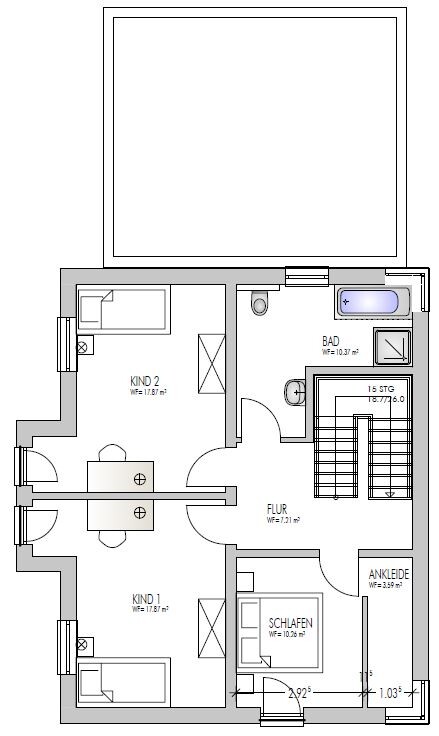
In principle, we are satisfied with the layout and room distribution, but the upstairs (attic floor) still has some issues. We would appreciate opinions from experienced homeowners and builders on whether our ideas and the floor plans we sketched are really practical and livable.
Here are the basic details:
Building Regulations/Restrictions
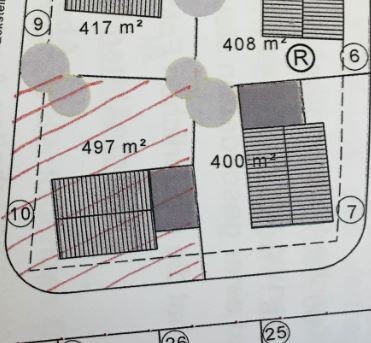
Plot size: 497 sqm (see location plan)
Slope: no
Number of floors: 2
Roof type: anything allowed
Architectural style: anything allowed except bungalow
Client Requirements
Style, roof type, building type => Single-family home with bay window, gable roof, 25 – 28 degrees (relatively shallow)
Basement, floors => basement, ground floor + attic floor (knee wall 1.80 – 2.00 m (6.0 – 6.5 ft))
Number of people, ages => currently 3 (he 32, she 28, son 9 months); a second child is desired
Space requirements on ground floor, upper floor:
[I]Ground floor => living, dining, kitchen, guest WC/shower, storage/pantry
Attic floor => 2 children’s rooms, bathroom, master bedroom with walk-in closet
Office => for family use
Open or closed layout => open living/dining area
Conservative or modern style => modern but cozy
Open kitchen, kitchen island => open; kitchen layout not fixed yet, depending on what fits best
Number of dining seats => at least 4 but ideally space for 6 to 8
Fireplace => no
Music/sound wall => no
Balcony, roof terrace => no
Garage, carport => double garage with direct access to the house
Utility garden, greenhouse => regular garden, nothing special planned
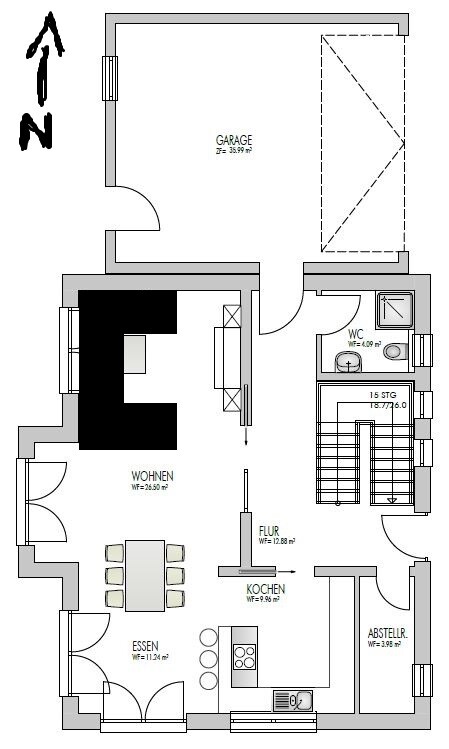
Other wishes/features => we like the half-turned staircase with landing, though it takes quite a bit of space; we have a rather large sofa (3.50 m x 2.00 m (11.5 ft x 6.5 ft)); I manually inserted this sofa on the ground floor plan, as the one included by the builder does not fit the proportions at all.
House Design
Who planned it:
=> Designer from a building company based on our specifications (hand drawing)
What do we like?
=> We really like the ground floor layout and the open, bright feel (maybe kitchen a bit small with little countertop space)
What do we dislike?
=> The attic floor! Children’s rooms a bit too big, should be around 15 sqm (160 sq ft) each; master bedroom and walk-in closet too small; bathroom layout is not ideal; due to the staircase location, the room arrangement upstairs is tricky.
Price estimate by architect/planner: about 330,000 EUR (turnkey excluding flooring and painting)
Personal price limit for the house including fittings: 350,000 EUR
Preferred heating system: gas condensing boiler or air-to-water heat pump
If you had to give up something, which details/upgrades
Could you do without? => actually nothing, it’s not really special already; maybe a different staircase design
Could you not do without? => direct access to the garage; open living/dining area
[/I]
Unfortunately, the builder did not include dimensions on the plans, only area sizes, but I hope you can get an idea from that.
Thanks in advance for your feedback.
Best regards,
Schorsch584
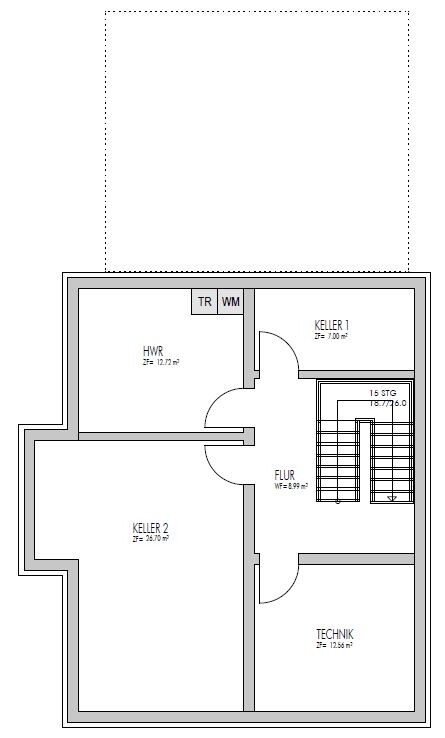
Last fall, we (my wife, 28; our son, 9 months; and I, 32) bought a plot of land and have since been brainstorming, sketching, and exploring how to plan and design our house.
The more you look, the more you see, and sometimes it gets more confusing.
In principle, we are satisfied with the layout and room distribution, but the upstairs (attic floor) still has some issues. We would appreciate opinions from experienced homeowners and builders on whether our ideas and the floor plans we sketched are really practical and livable.
Here are the basic details:
Building Regulations/Restrictions
Plot size: 497 sqm (see location plan)
Slope: no
Number of floors: 2
Roof type: anything allowed
Architectural style: anything allowed except bungalow
Client Requirements
Style, roof type, building type => Single-family home with bay window, gable roof, 25 – 28 degrees (relatively shallow)
Basement, floors => basement, ground floor + attic floor (knee wall 1.80 – 2.00 m (6.0 – 6.5 ft))
Number of people, ages => currently 3 (he 32, she 28, son 9 months); a second child is desired
Space requirements on ground floor, upper floor:
[I]Ground floor => living, dining, kitchen, guest WC/shower, storage/pantry
Attic floor => 2 children’s rooms, bathroom, master bedroom with walk-in closet
Office => for family use
Open or closed layout => open living/dining area
Conservative or modern style => modern but cozy
Open kitchen, kitchen island => open; kitchen layout not fixed yet, depending on what fits best
Number of dining seats => at least 4 but ideally space for 6 to 8
Fireplace => no
Music/sound wall => no
Balcony, roof terrace => no
Garage, carport => double garage with direct access to the house
Utility garden, greenhouse => regular garden, nothing special planned
Other wishes/features => we like the half-turned staircase with landing, though it takes quite a bit of space; we have a rather large sofa (3.50 m x 2.00 m (11.5 ft x 6.5 ft)); I manually inserted this sofa on the ground floor plan, as the one included by the builder does not fit the proportions at all.
House Design
Who planned it:
=> Designer from a building company based on our specifications (hand drawing)
What do we like?
=> We really like the ground floor layout and the open, bright feel (maybe kitchen a bit small with little countertop space)
What do we dislike?
=> The attic floor! Children’s rooms a bit too big, should be around 15 sqm (160 sq ft) each; master bedroom and walk-in closet too small; bathroom layout is not ideal; due to the staircase location, the room arrangement upstairs is tricky.
Price estimate by architect/planner: about 330,000 EUR (turnkey excluding flooring and painting)
Personal price limit for the house including fittings: 350,000 EUR
Preferred heating system: gas condensing boiler or air-to-water heat pump
If you had to give up something, which details/upgrades
Could you do without? => actually nothing, it’s not really special already; maybe a different staircase design
Could you not do without? => direct access to the garage; open living/dining area
[/I]
Unfortunately, the builder did not include dimensions on the plans, only area sizes, but I hope you can get an idea from that.
Thanks in advance for your feedback.
Best regards,
Schorsch584

A stair landing is definitely something special! On one hand, it offers comfort; on the other, it looks impressive when viewed straight on, and this should be considered in the design.
However, I don’t see that here. It would be more successful if the stair treads and openings were visible within a single room.
Other stair designs can also be comfortable, as long as they have a comfortable rise-to-run ratio and are sufficiently wide.
In this case, you planned the house around your staircase, which means the staircase’s positive features are lost.
I often warn against focusing too much on a single element to the point where everything else becomes a compromise—even the orientation of the stairs here.
Your architect is employed and will simply draw everything to match what you, as laypersons, instruct him to do—which is tricky, but I admit I can understand that.
Instead of having the nose right in the dining area, the living room could have been enlarged.
And if you enjoy cooking with friends, this kitchen isn’t very sociable, since everyone ends up facing away from each other. There is plenty of open space downstairs, but it feels cramped upstairs.
What kind of plot do you have? I must have missed that.
However, I don’t see that here. It would be more successful if the stair treads and openings were visible within a single room.
Other stair designs can also be comfortable, as long as they have a comfortable rise-to-run ratio and are sufficiently wide.
In this case, you planned the house around your staircase, which means the staircase’s positive features are lost.
I often warn against focusing too much on a single element to the point where everything else becomes a compromise—even the orientation of the stairs here.
Your architect is employed and will simply draw everything to match what you, as laypersons, instruct him to do—which is tricky, but I admit I can understand that.
Instead of having the nose right in the dining area, the living room could have been enlarged.
And if you enjoy cooking with friends, this kitchen isn’t very sociable, since everyone ends up facing away from each other. There is plenty of open space downstairs, but it feels cramped upstairs.
What kind of plot do you have? I must have missed that.
 Schorsch58411 Aug 2016 19:31
kbt09 schrieb:
One should also be aware that knee wall heights of 180 to 200 cm (71 to 79 inches) mean that the window opening will likely be up to about 165 to 185 cm (65 to 73 inches) high, with the glazing reaching up to approximately 155 to 175 cm (61 to 69 inches). However, if roller shutters are added, the top edge of the window will be reduced by around 20 cm (8 inches) or more. So looking out of the window while standing won’t really be possible.
With a knee wall height of max. 200 cm (79 inches), you also cannot place a shower against the exterior wall. A showerhead needs some space above it so that it doesn’t hit your head, and there should be some clearance between the showerhead and the ceiling to avoid water splashing directly on the ceiling.
Why not consider a full second floor?Thanks for the tip regarding the shower. I think the difference between a full second floor and a knee wall of 2.00 m (79 inches) won’t be that big. We will bring that up as well. Thanks.
develloper schrieb:
If the basement doesn’t have to fulfill an important function like a hobby room, home office, etc., I personally tend to leave it out and use the saved money to enlarge the house... A basic cellar mainly just provides storage space.
I don’t know if that’s an option for you?!
CheersFor us, an important function is also having storage space, especially because the ground floor and upper floor don’t offer much of it. Additionally, we prefer not to have the building services, washing machine, etc. in the living area.
RobsonMKK schrieb:
Hi Dev, it really depends on the floor area ratio.
I was quite surprised when I realized where I currently am and what I’m allowed to do.
So a basement can definitely make sense.The floor area ratio is 0.6. With a 497 sqm (0.12 acre) plot, that shouldn’t be an issue.
ypg schrieb:
A stair with a landing is really something special! On one hand for comfort, on the other for the appearance when you can look at it from the front and this is also considered in the design.
I don’t see that here, though. It would be more successful if the treads and openings were visible within one room.
Other staircase designs can also be comfortable if they have a good rise-to-run ratio and are nice and wide.
You designed the house around your staircase, so the positive aspects of the stair are lost.
I usually warn against focusing too much on a single element at the expense of everything else, which here even affects the orientation of the stairs.
Your architect is an employee and will simply draw everything as you, the laypersons, instruct him—that’s the trouble, but I admit I understand it.
Instead of the kitchen’s nose pointing into the dining area, it could have been better to enlarge the living room.
And if you like cooking with friends, this kitchen is not very social because everyone stands with their backs to each other. There is plenty of free space downstairs, but upstairs it is tight.
What kind of plot do you have? I must have missed that?Yes, that’s exactly what appealed to us about the stair with a landing. As it is drafted now, it has unfortunately lost some of that charm, that’s true. It’s also nice when there are large windows along the stairwell letting light into the stairway and hallway.
We will definitely ask the planner again for suggestions because this staircase solution just doesn’t work.
Regarding the bay window, can you roughly say how much extra a bay window usually costs?

MarcWen schrieb:
Always these bumps in the living/dining area.
ThankYouThankYouThankYou!!!!!
What do you all need to put away? A basement is generally useful, but not if it comes at the expense of living space. Extending the house by 1.5 meters (5 feet) adds about 30 cubic meters (1,060 cubic feet) of living area. That allows for a lot of storage. Plus, you can save yourself a staircase. Modern home systems hardly make any noise and don’t create dirt, and they don’t require much space either. I have a basement but am trying to convince my wife that the washing machine belongs on the upper floor (where there is room for it). This would save a lot of trips up and down stairs and has many advantages. Usually, you don’t run the washing machine at night anyway. But then you hear arguments like “it makes noise,” “it looks ugly,” “if it leaks, the whole house will flood,” “it makes a mess,” etc., until finally the conclusion is “the washing machine belongs in the basement!” Then they want a laundry chute so they don’t have to carry baskets down to the basement all the time.
Long story short: things were different in the past, but today we have completely different options and sometimes just need to free ourselves from old habits to find much better solutions.
Long story short: things were different in the past, but today we have completely different options and sometimes just need to free ourselves from old habits to find much better solutions.
Similar topics