
I am currently looking for new faucets, starting with the bathroom. Right now, there is a common single-lever mixer, but in our case, the water is either hot/warm or cold and should not be mixed—or it would be pointless.
Is there another solution besides having two cold water taps connected separately to the respective pipes, since washbasins usually only have one hole?
Basically something like the old-style taps with turn knobs on the left and right, but without the turning handles. Maybe with push buttons?
It should be a bit modern. Also, you don’t want to have to turn the taps for ages until the strongest flow finally comes out.
I have also thought about sensor faucets, but I’m bothered by the batteries.
Somehow, I am missing the right term to search for (searching for “two-temperature faucet” or “faucet without mixer” returns no results).
Is there another solution besides having two cold water taps connected separately to the respective pipes, since washbasins usually only have one hole?
Basically something like the old-style taps with turn knobs on the left and right, but without the turning handles. Maybe with push buttons?
It should be a bit modern. Also, you don’t want to have to turn the taps for ages until the strongest flow finally comes out.
I have also thought about sensor faucets, but I’m bothered by the batteries.
Somehow, I am missing the right term to search for (searching for “two-temperature faucet” or “faucet without mixer” returns no results).
 Sir_Kermit24 Jul 2016 16:29
Hello,
However, the desired final temperature depends on the temperatures of the cold and hot water and can be calculated using the mixing rule. In any case, from an energy perspective, it does not initially matter how the desired temperature is achieved. It is primarily about the specific heat capacity of water and the required temperature differences for a desired amount (mass) of shower water. For example: I need 1 kg of water at 40 degrees Celsius (104°F) and must increase the temperature by 30 degrees Celsius (54°F) (assuming the water supply temperature is 10 degrees Celsius (50°F)). Whether I reach this with or without mixing, it always involves the same amount of energy in joules, specifically 30 x 4187 J. This is the basic theory, which you can test with an online mixing calculator.
To get 1 kg of water at 40 degrees Celsius (104°F), you need 0.6 kg of water heated from 10 to 60 degrees Celsius (50 to 140°F) and 0.4 kg of water at 10 degrees Celsius (50°F).
In the first case, the energy is 30 x 4187 joules; in the mixing case, it is 0.6 x 50 x 4187 joules.
What is not irrelevant are changes in efficiency (during system startup) and losses. These, however, depend heavily on the type of use and the design of the water supply system in the building.
See the contribution from @Saruss https://www.hausbau-forum.de/threads/Wasserhahn-ohne-mischer-nur-heiss-kalt.16550/page-2
Kermit
daniels87 schrieb:
When the heated water is mixed down, there is also less flow through the hot water pipe.
However, the desired final temperature depends on the temperatures of the cold and hot water and can be calculated using the mixing rule. In any case, from an energy perspective, it does not initially matter how the desired temperature is achieved. It is primarily about the specific heat capacity of water and the required temperature differences for a desired amount (mass) of shower water. For example: I need 1 kg of water at 40 degrees Celsius (104°F) and must increase the temperature by 30 degrees Celsius (54°F) (assuming the water supply temperature is 10 degrees Celsius (50°F)). Whether I reach this with or without mixing, it always involves the same amount of energy in joules, specifically 30 x 4187 J. This is the basic theory, which you can test with an online mixing calculator.
To get 1 kg of water at 40 degrees Celsius (104°F), you need 0.6 kg of water heated from 10 to 60 degrees Celsius (50 to 140°F) and 0.4 kg of water at 10 degrees Celsius (50°F).
In the first case, the energy is 30 x 4187 joules; in the mixing case, it is 0.6 x 50 x 4187 joules.
What is not irrelevant are changes in efficiency (during system startup) and losses. These, however, depend heavily on the type of use and the design of the water supply system in the building.
See the contribution from @Saruss https://www.hausbau-forum.de/threads/Wasserhahn-ohne-mischer-nur-heiss-kalt.16550/page-2
Kermit
D
daniels8724 Jul 2016 16:41That was referring only to the faucet. I don’t understand why it would be better to supply only hot or cold water.
Since we don’t have a circulation pipe, I have an additional small regulated instantaneous water heater for the bathroom sinks that heats until warm water arrives on the upper floor.
1. Do I always have to wait then, and
2. Doesn’t the entire pipe from the basement to the upper floor fill with warm water, which then cools down inside the pipe? In winter this doesn’t matter because it’s within the thermal envelope, but outside the heating season it is a loss. However, this is probably negligible.
Since we don’t have a circulation pipe, I have an additional small regulated instantaneous water heater for the bathroom sinks that heats until warm water arrives on the upper floor.
1. Do I always have to wait then, and
2. Doesn’t the entire pipe from the basement to the upper floor fill with warm water, which then cools down inside the pipe? In winter this doesn’t matter because it’s within the thermal envelope, but outside the heating season it is a loss. However, this is probably negligible.
Sir_Kermit24 Jul 2016 17:13Hello,
If the temperature is fixed, you can blindly turn it to hot and it will be fine. That might be quite useful after a big party in the evening. Whether to avoid a mixing faucet altogether is up to each person, but I would definitely install one. Therefore, we wouldn’t have “digital” water at our place either. And the tap water is usually around 9 to 15 degrees Celsius (48 to 59 degrees Fahrenheit), depending on the region, so sometimes it could be too cold. As far as I remember, the original poster was only talking about the shower. In that case, cold showers should never happen.
A supply temperature of 60 degrees Celsius (140 degrees Fahrenheit) can pose a risk for smaller children who are adventurous or experimental. Here, limiting the temperature would be useful.
daniels87 schrieb:
I don’t understand why it’s supposed to be better to have only hot or cold water.
If the temperature is fixed, you can blindly turn it to hot and it will be fine. That might be quite useful after a big party in the evening. Whether to avoid a mixing faucet altogether is up to each person, but I would definitely install one. Therefore, we wouldn’t have “digital” water at our place either. And the tap water is usually around 9 to 15 degrees Celsius (48 to 59 degrees Fahrenheit), depending on the region, so sometimes it could be too cold. As far as I remember, the original poster was only talking about the shower. In that case, cold showers should never happen.
A supply temperature of 60 degrees Celsius (140 degrees Fahrenheit) can pose a risk for smaller children who are adventurous or experimental. Here, limiting the temperature would be useful.
daniels87 schrieb:
That’s not quite correct. When the heated water is mixed down, there is also less flow through the hot water pipe. For example, if the faucet is fully open and delivers 5 liters per minute (1.3 gallons per minute), and it is set to 50/50 hot/cold, only 2.5 liters per minute (0.7 gallons per minute) come from the hot water line. This is more environmentally sensible than running hot water fully open at 5 liters per minute (1.3 gallons per minute).
.I need to correct you on that. If you don’t open the tap fully (hot), no hot water will come because the tankless water heater won’t even activate. It’s an electronic unit, not a hydraulic one, but it still requires a minimum flow rate to start. For quick uses like washing hands, I just use cold water anyway, since it takes a few liters before the warm water even arrives. The eco-conscious side of me also makes sure not to set the water hotter than necessary. With a storage tank, the temperature is probably around 60°C (140°F) and then mixed down to 40°C (104°F) or whatever you actually need. Heat losses also come into play. My tankless water heater outputs only 40°C (104°F) from the start, unless I specifically want 60°C (140°F). Besides saving energy by heating less, you also avoid storage tank losses.
@ Saruss, did you include this item in the 20-day calculation? That the tankless water heater needs to heat less from the outset?
By the way, I also found something I like even more than the term “two-handle faucet,” which is the “three-hole faucet” configuration, where there are no knobs but rather levers or push buttons as preferred, and these can be installed completely independently, for example in the wall.
Attempt at a personal calculation:
An 18 kW (kilowatt) tankless water heater consumes about 9 kWh (kilowatt-hours) per hour of showering. What I don’t understand is why calculations found online via Google base their numbers on the maximum output of the water heater. Nobody showers with water heated to 60°C (140°F)... so I calculate using 40°C (104°F), meaning the water heater only needs about 50% of its capacity.
Edit: I checked again. The water heater actually runs at only 3.5 kW while showering. Since our electricity consumption is recorded, it’s easy to verify by looking at the usage graph when someone showers at 4 a.m., as then only the water heater is consuming power. This might be related to the quite low water flow rate, since the lower the flow, the less energy is used. In any case, this is another reason not to assume the maximum power of the tankless water heater!
We shower together for about 10 minutes per day. That makes 70 minutes per week, or roughly 10 kWh per week, and 520 kWh per year. Plus a few extra kWh for cleaning water; washing dishes doesn’t require hot water from the water heater.
This roughly matches our experience based on electricity bills from the last 4 years.
All of this still needs to be related to water consumption. According to various statistics, the proportion of hot water accounts for about 30%. For us, that would be 10 cubic meters (cbm) per year and 27 liters (9 gallons) per day. That seems quite low. I assume that "hot water share" refers to water at 60°C (140°F); normally cold water is mixed during showering, so I wouldn’t equate 27 liters of "hot water" directly with 27 liters of "shower water." On average, 27 liters of hot water would result in about 50 liters (13 gallons) of shower water, which then fits.
However, I doubt that switching to a different type of water heating would save any electricity here. But a fair comparison could only be made if the hot water consumption was similar to ours.
An 18 kW (kilowatt) tankless water heater consumes about 9 kWh (kilowatt-hours) per hour of showering. What I don’t understand is why calculations found online via Google base their numbers on the maximum output of the water heater. Nobody showers with water heated to 60°C (140°F)... so I calculate using 40°C (104°F), meaning the water heater only needs about 50% of its capacity.
Edit: I checked again. The water heater actually runs at only 3.5 kW while showering. Since our electricity consumption is recorded, it’s easy to verify by looking at the usage graph when someone showers at 4 a.m., as then only the water heater is consuming power. This might be related to the quite low water flow rate, since the lower the flow, the less energy is used. In any case, this is another reason not to assume the maximum power of the tankless water heater!
We shower together for about 10 minutes per day. That makes 70 minutes per week, or roughly 10 kWh per week, and 520 kWh per year. Plus a few extra kWh for cleaning water; washing dishes doesn’t require hot water from the water heater.
This roughly matches our experience based on electricity bills from the last 4 years.
All of this still needs to be related to water consumption. According to various statistics, the proportion of hot water accounts for about 30%. For us, that would be 10 cubic meters (cbm) per year and 27 liters (9 gallons) per day. That seems quite low. I assume that "hot water share" refers to water at 60°C (140°F); normally cold water is mixed during showering, so I wouldn’t equate 27 liters of "hot water" directly with 27 liters of "shower water." On average, 27 liters of hot water would result in about 50 liters (13 gallons) of shower water, which then fits.
However, I doubt that switching to a different type of water heating would save any electricity here. But a fair comparison could only be made if the hot water consumption was similar to ours.
It’s actually even simpler... I just had a mental block. I checked the power consumption meter. Current consumption is 230 W (computer, base load). Then I turned on the hot water (40°C (104°F)) in the shower and looked at the meter again. Consumption: 5 kW. Turned the tap off, checked the meter again: 230 W.
So the tankless water heater runs at about 4.7 kW at 40°C (104°F) while showering. Minus the power for the booster pump that ensures water pressure, which is 500 W (measured the same way but with the cold water tap). That leaves 4.2 kW purely for the water heater out of the 18 kW maximum capacity.
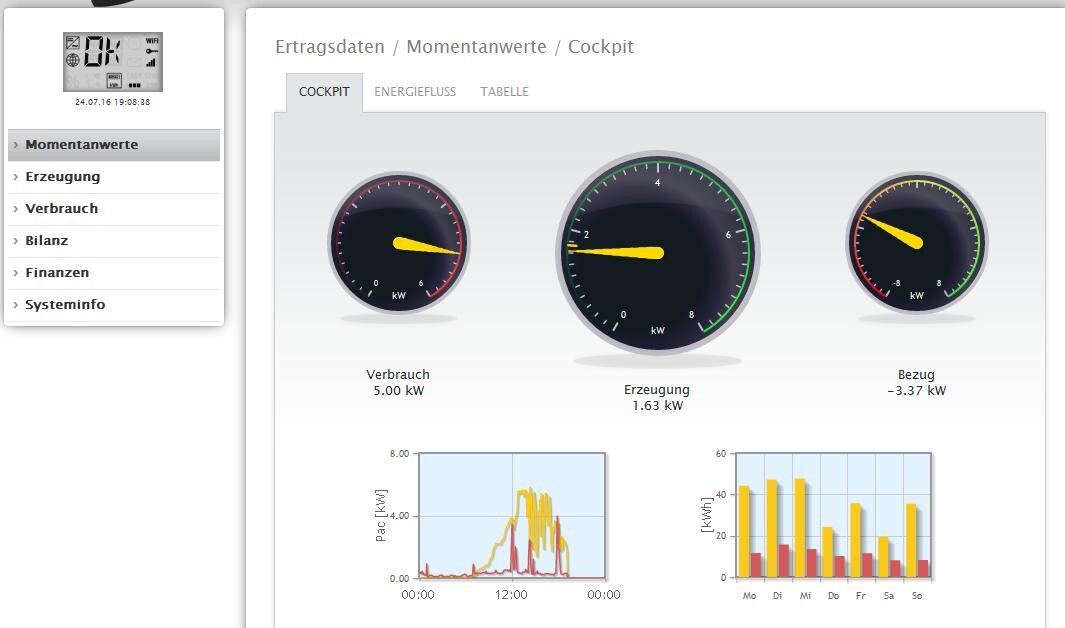
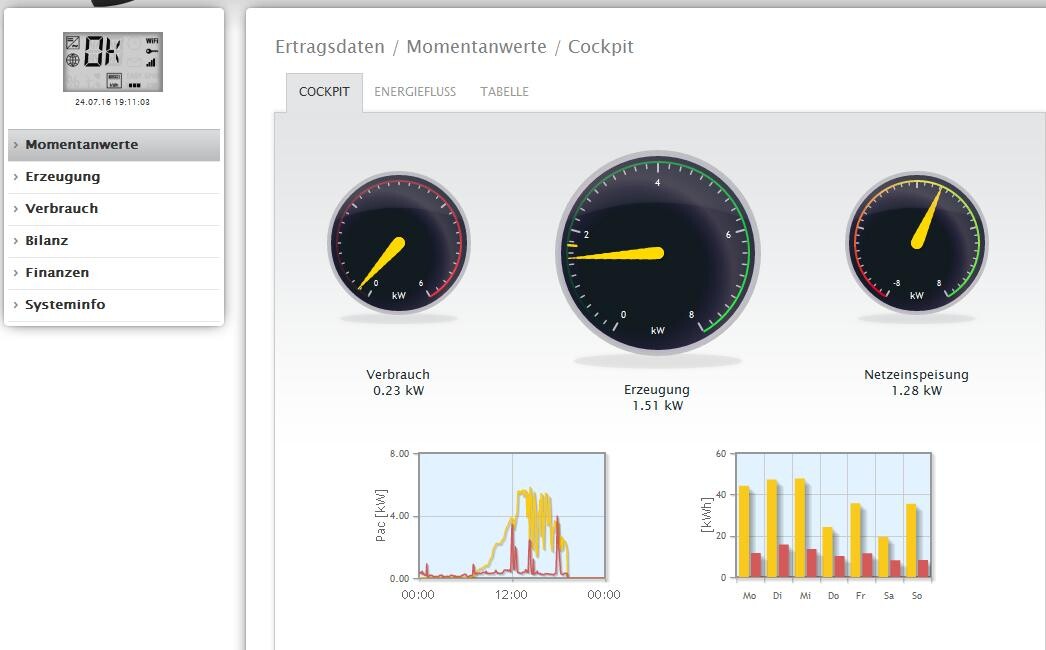
So the tankless water heater runs at about 4.7 kW at 40°C (104°F) while showering. Minus the power for the booster pump that ensures water pressure, which is 500 W (measured the same way but with the cold water tap). That leaves 4.2 kW purely for the water heater out of the 18 kW maximum capacity.
Similar topics