
Hello everyone, we are planning to build and are currently having discussions with several construction companies.
Our wish is to build a two-story house. We want to have little to no sloping ceilings in the attic. So far, we have always planned for an urban villa with a hip roof. However, in our last meeting with another builder, we were told that our only option is to build a traditional single-family house 🙁. We did not want that... and even worse, we are required to build with a basement, which we definitely did not want.
The advisor explained that this is due to the knee wall height. We are complete beginners and now don’t understand anything at all. I am attaching an excerpt from the building regulations.
Can someone tell me if what we were told is really true? Why can’t we build a hip roof while complying with the specified roof pitch? We also wanted to avoid a basement for cost reasons and don’t understand why there is no other option.
Can anyone help us?
Thank you very much in advance.
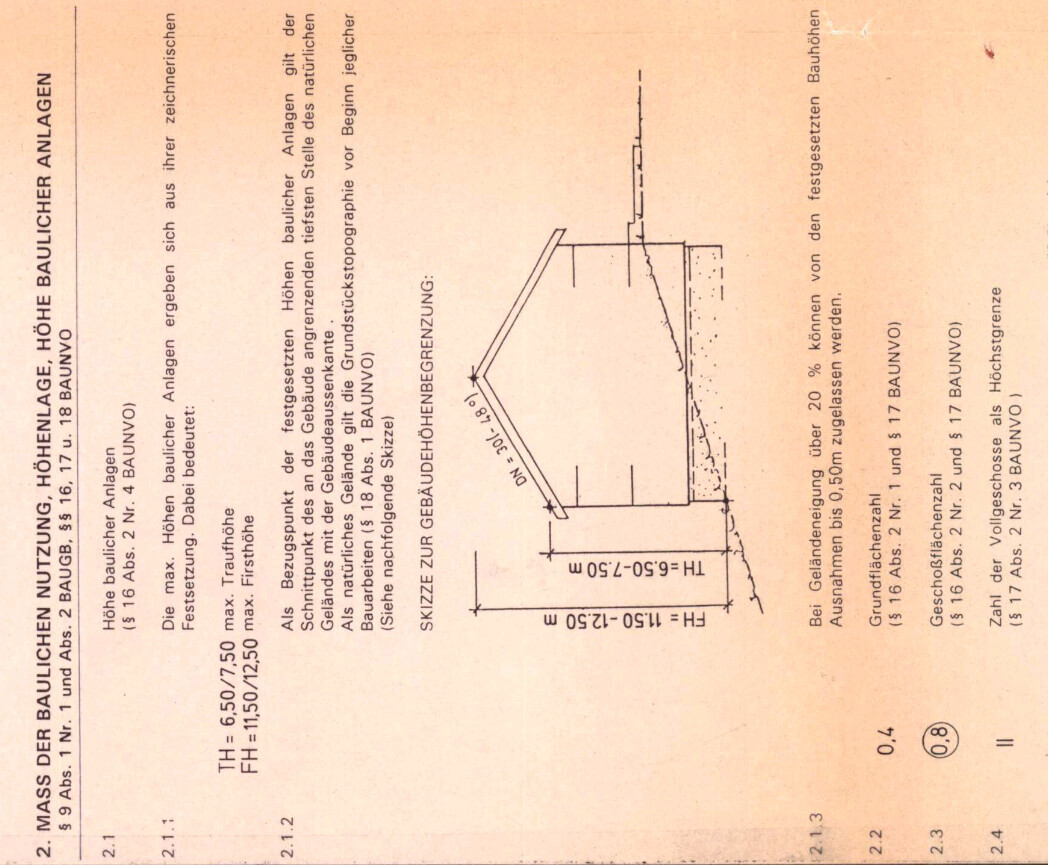
Our wish is to build a two-story house. We want to have little to no sloping ceilings in the attic. So far, we have always planned for an urban villa with a hip roof. However, in our last meeting with another builder, we were told that our only option is to build a traditional single-family house 🙁. We did not want that... and even worse, we are required to build with a basement, which we definitely did not want.
The advisor explained that this is due to the knee wall height. We are complete beginners and now don’t understand anything at all. I am attaching an excerpt from the building regulations.
Can someone tell me if what we were told is really true? Why can’t we build a hip roof while complying with the specified roof pitch? We also wanted to avoid a basement for cost reasons and don’t understand why there is no other option.
Can anyone help us?
Thank you very much in advance.
The drawing basically says it all. The mentioned plot is located on a slope and is intended to be built partially into the hillside on one side (as shown). This means the basement could essentially function as a cellar but doesn’t have to if the house is only set slightly into the hill.
You are allowed to build two full stories but with an eaves height of 6.5–7.5 meters (21.3–24.6 feet). The house in my avatar picture has an eaves height of 6.2 meters (20.3 feet), so the basement can be a maximum of about 1.3 meters (4.3 feet) high. With a few tricks, you can certainly make something work; however, due to the very precise specifications, a consistent overall appearance is likely desired. Is there already neighboring development? What is built there?
A townhouse or urban villa might be possible if you raise the stories slightly and minimize how far you build into the hill.
You are allowed to build two full stories but with an eaves height of 6.5–7.5 meters (21.3–24.6 feet). The house in my avatar picture has an eaves height of 6.2 meters (20.3 feet), so the basement can be a maximum of about 1.3 meters (4.3 feet) high. With a few tricks, you can certainly make something work; however, due to the very precise specifications, a consistent overall appearance is likely desired. Is there already neighboring development? What is built there?
A townhouse or urban villa might be possible if you raise the stories slightly and minimize how far you build into the hill.
Why do you have to build with a basement? The specified eave height of up to 7.5 meters (25 feet) should easily allow for two full stories without a knee wall. Two full stories are also permitted... Regarding roof styles, nothing is mentioned—are these all the building regulations?
If a hip roof is not allowed, you can also put a gable roof on a "townhouse" style building, which also looks good.
I’m simply attaching a section drawing of our house on a slope with a gable roof and two full stories, without sloping ceilings and without a basement.
The green area represents the terrain slope; we have a slope of 10 meters (33 feet) over 30 meters (98 feet) in length. The crawl space is only under one corner of the house and measures 2.5 x 2.5 meters (8 x 8 feet). The offset between the ground floor level and the ground surface is 1 meter (3.3 feet).
Maybe the construction company simply doesn’t offer what you want? Because based on the information in your file, it does not appear to me that the house you want is not allowed to be built.

If a hip roof is not allowed, you can also put a gable roof on a "townhouse" style building, which also looks good.
I’m simply attaching a section drawing of our house on a slope with a gable roof and two full stories, without sloping ceilings and without a basement.
The green area represents the terrain slope; we have a slope of 10 meters (33 feet) over 30 meters (98 feet) in length. The crawl space is only under one corner of the house and measures 2.5 x 2.5 meters (8 x 8 feet). The offset between the ground floor level and the ground surface is 1 meter (3.3 feet).
Maybe the construction company simply doesn’t offer what you want? Because based on the information in your file, it does not appear to me that the house you want is not allowed to be built.
The only roofing regulation is that the pitch must be at least 30 degrees. However, after consulting with the local authority, anything is allowed as long as it does not negatively affect the neighbors. In the "old" new development area, all houses except one are built in a traditional style. The only exception on the street is a bungalow. No houses have been built yet in the new development area—everything is still in the planning phase.
We were told that without a basement, we cannot reach the eaves height, and if we build a basement, we must use a gable roof. Anything else is 100% not allowed and will definitely cause problems during the project review.
We also considered having a half basement, but according to the construction company, this option does not exist. As it turns out, it does exist. We are really overwhelmed 🙁
We were told that without a basement, we cannot reach the eaves height, and if we build a basement, we must use a gable roof. Anything else is 100% not allowed and will definitely cause problems during the project review.
We also considered having a half basement, but according to the construction company, this option does not exist. As it turns out, it does exist. We are really overwhelmed 🙁
Two full storeys result in an eaves height of 6.5 meters (21 feet). Adding a pitched roof on top, you could exceed 11.5 meters (38 feet). It’s all just a matter of the house’s width.
You should start by contacting several companies with your development plan and talk to their sales representatives. Every conversation will bring you a step closer. Since you already have a plot of land (meaning you have approval), construction companies will definitely be willing to assist you. (Without land, their interest is usually much lower.) You are still at the very beginning of the process, and it’s perfectly fine not to have a clear idea of what’s best yet. You already know some of your preferences (no sloping ceilings on the upper floor), which is enough to provide to a few companies. You should also begin considering your budget.
You should start by contacting several companies with your development plan and talk to their sales representatives. Every conversation will bring you a step closer. Since you already have a plot of land (meaning you have approval), construction companies will definitely be willing to assist you. (Without land, their interest is usually much lower.) You are still at the very beginning of the process, and it’s perfectly fine not to have a clear idea of what’s best yet. You already know some of your preferences (no sloping ceilings on the upper floor), which is enough to provide to a few companies. You should also begin considering your budget.
B
Bauexperte18 May 2016 20:36Good evening,
The eave height (EH) that is ultimately implemented results from the combination of roof pitch (RP), permitted ridge height (RH), and the natural terrain slope at its lowest point. With the extended exception according to section 2.1.3, a two-story building should always be achievable. However, a basement makes sense with this terrain slope.
Regards, Bauexperte
Irena30 schrieb:No, it is not true.
Can someone tell me if what we were told is really true?
The eave height (EH) that is ultimately implemented results from the combination of roof pitch (RP), permitted ridge height (RH), and the natural terrain slope at its lowest point. With the extended exception according to section 2.1.3, a two-story building should always be achievable. However, a basement makes sense with this terrain slope.
Irena30 schrieb:Whether you are allowed to build a hip roof (HR) is not determined by the excerpt; it only mentions a roof pitch between 30° and 48°. If there is no further note on the zoning plan itself, it "may" be possible that a hip roof is permitted; although 30° pitch on a hip roof can be unusual. If the excerpt—and thus its example drawing—is binding, then only a gable roof (GR) is allowed; however, a 30° gable roof is pleasing to the eye.
Why can't we build a hip roof while adhering to the specified pitch?
Regards, Bauexperte
Similar topics