
E
Escandiel27 Apr 2016 11:09Good morning,
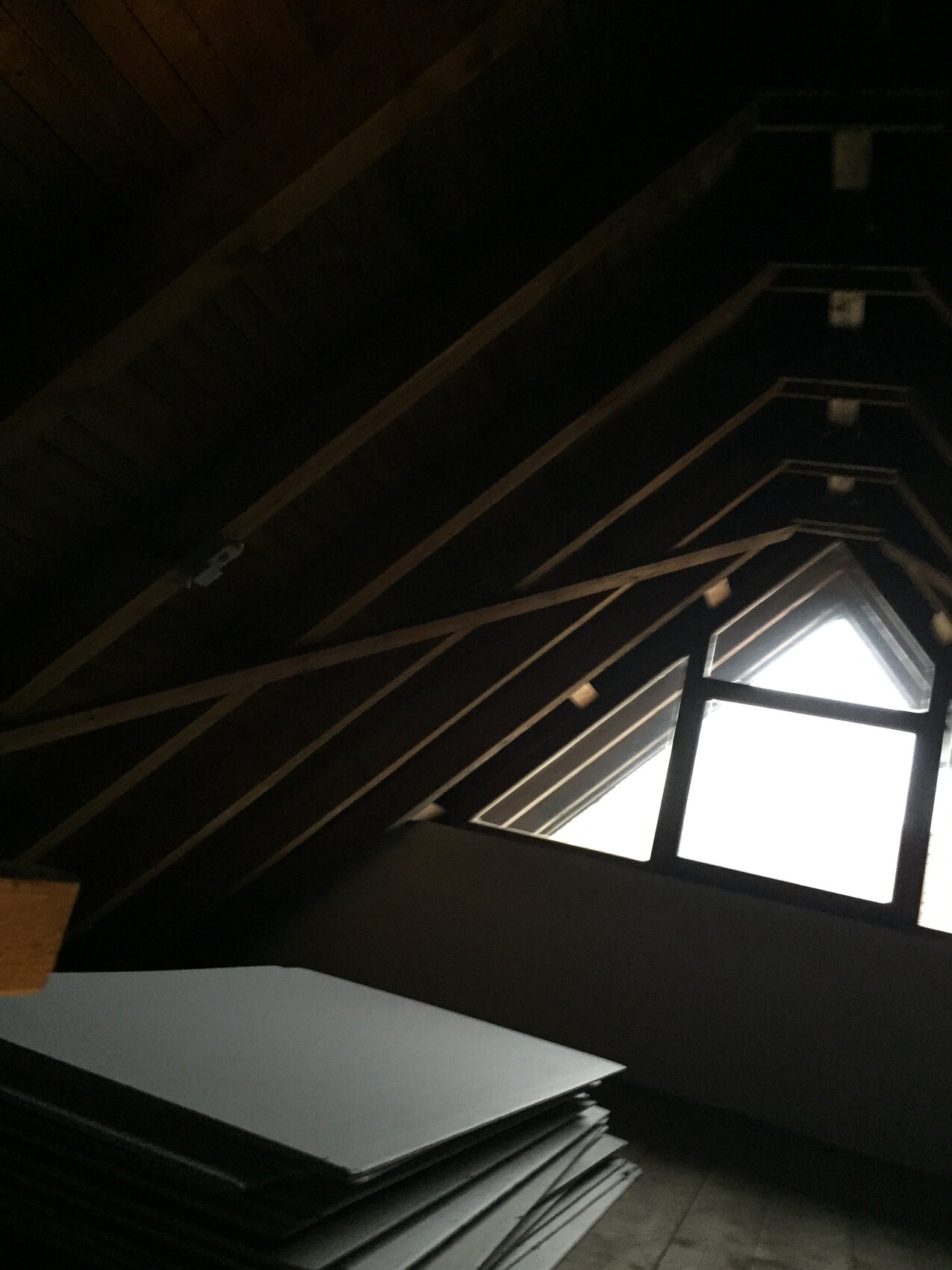
we bought a large multi-family house in 2014 and now want to convert the attic space.
Built in 1987.
Since the builder passed away and his wife had little experience or plans, I don’t have much information.
It is a pitched roof.
From what I could see, we have a standard tiled roof covering.
Beneath that is probably the battens and counter battens.
Now it gets interesting.
I was told that you can either install a membrane as an underlay or use wooden boards instead, as these manage moisture better.
We definitely have these wooden boards nailed to the rafters.
In addition, there is also a gray/black/silver membrane visible through the gaps.
So practically: rafters, wooden boards, membrane, battens/counter battens, roof tiles.
Currently, we have 200 m² of
ALUJET Topjet vapor barrier foil,
blue B2 (DIN 4102) Sd-value > 100 m (328 ft)
plus adhesive tape, electric stapler, etc.
Wooden battens on the rafters for drywall.
Drywall panels, 1200x1600x12.5 mm (47x63x0.5 inches)
for the entire roof area.
Rockwool glass wool insulation.
Underfloor heating system, electrical installation, etc. all already in place.
1. First point: we have already spent almost everything and have very little cash left.
Now my questions:
1.
At what spacing do I need to install the wooden battens so that the drywall does not fall down?
2.
Is the vapor barrier/damper membrane sufficient?
Do I even need one?
The house is an older building with a large window front – double-glazed wooden windows.
One of these windows can be opened.
3.
How thick should the glass wool insulation be? Should the rafters be fully filled?
4.
Do I need to insulate again between the vapor barrier and the drywall?
My father-in-law insists on this, but I’m not so sure… moisture should not get into the insulation material, right? Then I could just leave out the membrane.
5.
Do I absolutely need an airtightness test? If yes, can it be done by myself?
What equipment is needed?
My father manages an emissions measurement team, so we might have access to devices.
6.
The house has a ventilation system installed but currently unused... I have a roughly 30 cm (12 inch) diameter exhaust pipe running from the floor through the roof to the outside.
On the roof, there is a small cap to prevent rain from entering.
It doesn’t always work during heavy storms, as water runs along the pipe and drips onto the floor.
Can I simply seal it with PU foam or another waterproof filler so that no more water enters there?
I would rather not remove it because it would be perfect for connecting a complete home climate control system…
In the worst case, it will just stay as it is, fortunately where we wanted to keep storage space.
7. Question about the floor.
The attic floor is quite uneven.
A “decking floor” was installed a long time ago but not very well.
I would like to level it, but I don’t know how, because using a loose fill is not an option.
Explanation:
The ceiling of the floor below is about 30 cm (12 inches) lower than the staircase entrance.
These 30 cm (12 inches) are completely filled with insulation material, and above this, wooden battens of the decking floor were installed crosswise.
Additionally, the floor below has another 20 cm (8 inches) of insulation and a wood ceiling.
Therefore, I definitely cannot add loose fill on top, or I would ruin all the existing insulation.
Should I simply install a second decking floor?
The old floor cannot be removed… it seems to run under the rafters somehow, it’s not clear how or where it was fixed.
However, at the edges of the roof, there are huge, very thick beams resting… I guess they rest exactly on this floor and were anchored that way.
These beams are connected to the rafters and therefore cannot be removed.
8.
On my rafters, on each side of the roof, there are 2 boards each about 4 meters (13 feet) long, 25 cm (10 inches) wide, and 12 mm (0.5 inch) thick screwed on diagonally along the rafters. They run exactly from one end to the middle and then form a “triangle” going down to the other side.
Of course, I can increase the insulation thickness by 12 mm (0.5 inch) and lay the vapor barrier on top, but this would cause bumps that will probably complicate the installation.
Also, I don’t know how to deal with the wood profiles then… longer screws every few meters?
I also wonder if I really need these diagonal boards… they don’t look very stable and I’m not sure if they actually support the roof, but what else could they be for?
Who should I call to find out if these are really necessary?
A structural engineer? And what would that cost?
That’s it.
It would be great if you could ease some of my concerns.
Thanks a lot.
Best regards.
we bought a large multi-family house in 2014 and now want to convert the attic space.
Built in 1987.
Since the builder passed away and his wife had little experience or plans, I don’t have much information.
It is a pitched roof.
From what I could see, we have a standard tiled roof covering.
Beneath that is probably the battens and counter battens.
Now it gets interesting.
I was told that you can either install a membrane as an underlay or use wooden boards instead, as these manage moisture better.
We definitely have these wooden boards nailed to the rafters.
In addition, there is also a gray/black/silver membrane visible through the gaps.
So practically: rafters, wooden boards, membrane, battens/counter battens, roof tiles.
Currently, we have 200 m² of
ALUJET Topjet vapor barrier foil,
blue B2 (DIN 4102) Sd-value > 100 m (328 ft)
plus adhesive tape, electric stapler, etc.
Wooden battens on the rafters for drywall.
Drywall panels, 1200x1600x12.5 mm (47x63x0.5 inches)
for the entire roof area.
Rockwool glass wool insulation.
Underfloor heating system, electrical installation, etc. all already in place.
1. First point: we have already spent almost everything and have very little cash left.
Now my questions:
1.
At what spacing do I need to install the wooden battens so that the drywall does not fall down?
2.
Is the vapor barrier/damper membrane sufficient?
Do I even need one?
The house is an older building with a large window front – double-glazed wooden windows.
One of these windows can be opened.
3.
How thick should the glass wool insulation be? Should the rafters be fully filled?
4.
Do I need to insulate again between the vapor barrier and the drywall?
My father-in-law insists on this, but I’m not so sure… moisture should not get into the insulation material, right? Then I could just leave out the membrane.
5.
Do I absolutely need an airtightness test? If yes, can it be done by myself?
What equipment is needed?
My father manages an emissions measurement team, so we might have access to devices.
6.
The house has a ventilation system installed but currently unused... I have a roughly 30 cm (12 inch) diameter exhaust pipe running from the floor through the roof to the outside.
On the roof, there is a small cap to prevent rain from entering.
It doesn’t always work during heavy storms, as water runs along the pipe and drips onto the floor.
Can I simply seal it with PU foam or another waterproof filler so that no more water enters there?
I would rather not remove it because it would be perfect for connecting a complete home climate control system…
In the worst case, it will just stay as it is, fortunately where we wanted to keep storage space.
7. Question about the floor.
The attic floor is quite uneven.
A “decking floor” was installed a long time ago but not very well.
I would like to level it, but I don’t know how, because using a loose fill is not an option.
Explanation:
The ceiling of the floor below is about 30 cm (12 inches) lower than the staircase entrance.
These 30 cm (12 inches) are completely filled with insulation material, and above this, wooden battens of the decking floor were installed crosswise.
Additionally, the floor below has another 20 cm (8 inches) of insulation and a wood ceiling.
Therefore, I definitely cannot add loose fill on top, or I would ruin all the existing insulation.
Should I simply install a second decking floor?
The old floor cannot be removed… it seems to run under the rafters somehow, it’s not clear how or where it was fixed.
However, at the edges of the roof, there are huge, very thick beams resting… I guess they rest exactly on this floor and were anchored that way.
These beams are connected to the rafters and therefore cannot be removed.
8.
On my rafters, on each side of the roof, there are 2 boards each about 4 meters (13 feet) long, 25 cm (10 inches) wide, and 12 mm (0.5 inch) thick screwed on diagonally along the rafters. They run exactly from one end to the middle and then form a “triangle” going down to the other side.
Of course, I can increase the insulation thickness by 12 mm (0.5 inch) and lay the vapor barrier on top, but this would cause bumps that will probably complicate the installation.
Also, I don’t know how to deal with the wood profiles then… longer screws every few meters?
I also wonder if I really need these diagonal boards… they don’t look very stable and I’m not sure if they actually support the roof, but what else could they be for?
Who should I call to find out if these are really necessary?
A structural engineer? And what would that cost?
That’s it.
It would be great if you could ease some of my concerns.
Thanks a lot.
Best regards.
E
Escandiel27 Apr 2016 11:36Where is the Edit button....
Regarding point 8, I can also reinforce all the rafters along this diagonal with small wooden blocks... basically putting my 12mm (0.5 inches) pieces everywhere on it... it’s just annoying extra work.
Regarding point 8, I can also reinforce all the rafters along this diagonal with small wooden blocks... basically putting my 12mm (0.5 inches) pieces everywhere on it... it’s just annoying extra work.
N
nightdancer29 Apr 2016 13:17Escandiel schrieb:
Good morning,
we bought a large multi-family house in 2014 and now want to convert the attic.
Year of construction 1987.
.Do you have a building permit / planning permission for that? Go see an architect, otherwise this will never work.
E
Escandiel2 May 2016 09:15Why do we need a building permit / planning permission for this??
The roof is practically already built... only insulation, walls, and a better floor are missing.
Besides, I just want to use it for myself.
I’m not planning to make any major changes... if I install drywall partitions inside my apartment, I don’t have to report that to the authorities. It wouldn’t be much different on the roof—wooden framing, insulation, drywall, fresh flooring.
What happens if I don’t register it?
Our building authority is not exactly the fastest in the world.
Just the business deregistration in the middle of a residential area took 1.2 years...
The roof is practically already built... only insulation, walls, and a better floor are missing.
Besides, I just want to use it for myself.
I’m not planning to make any major changes... if I install drywall partitions inside my apartment, I don’t have to report that to the authorities. It wouldn’t be much different on the roof—wooden framing, insulation, drywall, fresh flooring.
What happens if I don’t register it?
Our building authority is not exactly the fastest in the world.
Just the business deregistration in the middle of a residential area took 1.2 years...
E
Escandiel2 May 2016 09:36So, I just called the building authority, and they said everything is fine. It’s only about 50 m² (540 sq ft) that will be converted into living space.
You only need a permit for a separate apartment or kitchens/bathrooms in the attic.
Otherwise, pay attention to fire protection F30... but that’s already covered anyway. All other requirements are understood.
So now only my remaining questions need to be clarified.
You only need a permit for a separate apartment or kitchens/bathrooms in the attic.
Otherwise, pay attention to fire protection F30... but that’s already covered anyway. All other requirements are understood.
So now only my remaining questions need to be clarified.
Similar topics