
Hello everyone,
Our land purchase contract states that we must retain a certain amount of rainwater and release it into a drainage system with a time delay.
What exactly does that mean? I looked it up and found something called a rainwater cistern. Is that what this refers to? What costs should we expect? Does anyone know? Are there any affordable alternatives? Do you have similar requirements?
Thank you in advance for your help!
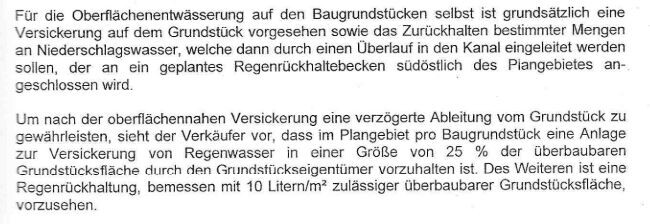
Our land purchase contract states that we must retain a certain amount of rainwater and release it into a drainage system with a time delay.
What exactly does that mean? I looked it up and found something called a rainwater cistern. Is that what this refers to? What costs should we expect? Does anyone know? Are there any affordable alternatives? Do you have similar requirements?
Thank you in advance for your help!
B
Bieber081529 Mar 2016 13:41Milanni123 schrieb:
In our land purchase contract, it states that we must retain a certain amount of rainwater and release it into a sewer with a delay. It also says that water must infiltrate on the property. Interesting...
What is referred to here as a cistern, in my opinion, means a soakaway chamber or soak pit. It is essentially a cistern without a bottom (in fact, the bottom consists of an infiltrating layer). In your case (retention, then discharge into a sewer), you can imagine it like this: when it rains (heavily), more water flows into the chamber per hour than can infiltrate from the bottom at the same time. The water level in the chamber rises until it overflows. This is the retention, which relieves the sewer and the main drainage basin of the development.
A (real) cistern is a water storage tank. You can install it, but you don’t have to. If you do, the cistern’s overflow must be connected to a retention/infiltration system (see above). The water stored in the cistern can also be used for garden or household purposes.
For pure infiltration, besides the soakaway chamber there are other options, such as infiltration trenches or infiltration basins. What is suitable depends on the property (soil survey) and, of course, the requirements; apparently, you only have to retain water, not fully infiltrate it.

Hi,
what confuses me a bit is the phrase "furthermore." It can also be understood as meaning that both a retention tank _and_ an infiltration tank need to be installed.
Rainwater retention, calculated at 10 liters/m² (4 gallons/ft²), quickly amounts to a good 2-3 m³ (70-105 cubic feet). However, it only has an overflow, no infiltration. Do you really have to bury two tanks? That would be somewhat excessive.
Best regards,
Andreas
what confuses me a bit is the phrase "furthermore." It can also be understood as meaning that both a retention tank _and_ an infiltration tank need to be installed.
Rainwater retention, calculated at 10 liters/m² (4 gallons/ft²), quickly amounts to a good 2-3 m³ (70-105 cubic feet). However, it only has an overflow, no infiltration. Do you really have to bury two tanks? That would be somewhat excessive.
Best regards,
Andreas
 Häuslebau3r29 Mar 2016 16:53
If I were Milannis, I would call the local building authority and ask what exactly is meant, then get that confirmed in writing. That way, you avoid guessing for a long time 🙂
Best regards, Andi
Best regards, Andi
M
Milanni12329 Mar 2016 19:13Hello everyone! Thanks for your replies!
I think Andi is right... I’ll call them tomorrow and ask what exactly they want. 😀
...I almost fear they don’t even know themselves. 🙄
I think Andi is right... I’ll call them tomorrow and ask what exactly they want. 😀
...I almost fear they don’t even know themselves. 🙄
B
Bieber081529 Mar 2016 20:48Let me explain what 10 L/m² means and whether there might be a missing time reference (10 L/m²/h).
But the quote above is from your purchase contract, which you have already signed, right? Aren’t unclear points usually clarified before signing?
But the quote above is from your purchase contract, which you have already signed, right? Aren’t unclear points usually clarified before signing?
B
Baustelle201630 Mar 2016 00:04I understand this as meaning that you need to provide a retention volume of 10 liters per square meter of buildable area. With 200 square meters (2150 square feet) of buildable area, that would be 2000 liters (530 gallons). The buildable area of the plot is usually specified in the zoning plan / planning permission, if available. However, the part about using 25 percent of the buildable area as the size for the infiltration area is not entirely clear to me; in my example, that would be 50 (! ) square meters (540 square feet)... So no... Are you building in a water protection zone?
Suppliers of infiltration systems (underground stormwater infiltration tanks) usually calculate the required infiltration area and size based on a hydrogeological report (around 350–400 EUR). We ended up paying 4500 euros for this, but there are definitely much cheaper options. However, due to requirements from the local water protection authority, we couldn’t implement those. Thanks a lot for that... It would have cost a maximum of 2000 euros, excluding piping. Looking forward to hearing what you find out tomorrow! Best regards, t
Suppliers of infiltration systems (underground stormwater infiltration tanks) usually calculate the required infiltration area and size based on a hydrogeological report (around 350–400 EUR). We ended up paying 4500 euros for this, but there are definitely much cheaper options. However, due to requirements from the local water protection authority, we couldn’t implement those. Thanks a lot for that... It would have cost a maximum of 2000 euros, excluding piping. Looking forward to hearing what you find out tomorrow! Best regards, t
Similar topics