
Hello parquet enthusiasts,
we are building a one-and-a-half-story house and plan to install oak country-style plank flooring. We have a large L-shaped room for the living/dining area and open kitchen (about 60m² (645 sq ft)). We intend to install and glue the flooring ourselves. However, some craftsman friends strongly advised against doing it ourselves. We have installed laminate flooring several times before and feel confident about that. Does engineered wood flooring really have to be installed only by a professional?
We understand that an expansion joint will likely need to be incorporated (where the corner of the L is, or where the screed will have an expansion joint).
We would also be interested in your experiences with underfloor heating and mechanical ventilation with heat recovery regarding the lower indoor humidity. Because of these conditions, some specialists have advised us against parquet, as larger gaps can occur in winter, which is less suitable for wooden flooring.
Thank you for your feedback,
sunny84
we are building a one-and-a-half-story house and plan to install oak country-style plank flooring. We have a large L-shaped room for the living/dining area and open kitchen (about 60m² (645 sq ft)). We intend to install and glue the flooring ourselves. However, some craftsman friends strongly advised against doing it ourselves. We have installed laminate flooring several times before and feel confident about that. Does engineered wood flooring really have to be installed only by a professional?
We understand that an expansion joint will likely need to be incorporated (where the corner of the L is, or where the screed will have an expansion joint).
We would also be interested in your experiences with underfloor heating and mechanical ventilation with heat recovery regarding the lower indoor humidity. Because of these conditions, some specialists have advised us against parquet, as larger gaps can occur in winter, which is less suitable for wooden flooring.
Thank you for your feedback,
sunny84
These Hamburg-based workers? Sure, it’s possible.
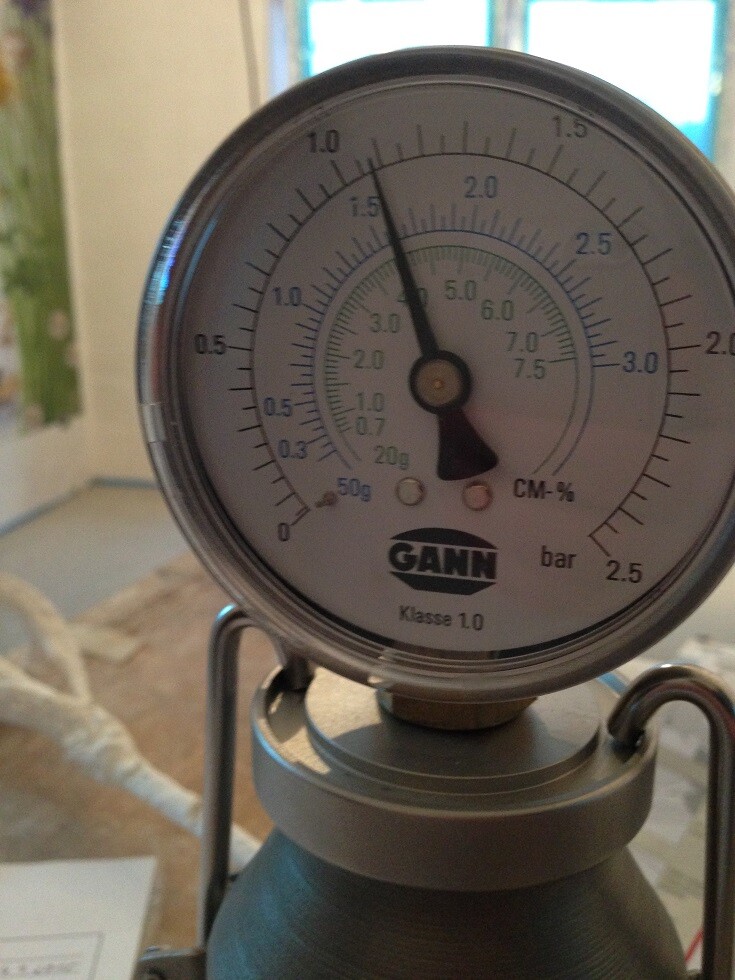
You can probably install real wood floors once laminate flooring is also suitable. From what I remember, that requires a residual moisture level of 1.5% or lower. If you are building with a construction company, there will be an official moisture measurement of the floor anyway. Only when that is acceptable can the tile setter begin. You can then ask the tile setter if you may also start laying your parquet flooring. It’s best to request a copy of the measurement report or take a photo of the moisture meter during the measurement (it looks like in the attachment; we had a residual moisture of 1.6%, with a sample weighing exactly 50 grams), so you have proof of the flooring readiness later on.
You can probably install real wood floors once laminate flooring is also suitable. From what I remember, that requires a residual moisture level of 1.5% or lower. If you are building with a construction company, there will be an official moisture measurement of the floor anyway. Only when that is acceptable can the tile setter begin. You can then ask the tile setter if you may also start laying your parquet flooring. It’s best to request a copy of the measurement report or take a photo of the moisture meter during the measurement (it looks like in the attachment; we had a residual moisture of 1.6%, with a sample weighing exactly 50 grams), so you have proof of the flooring readiness later on.

Hello "sunny84".
You have already received a reply from "neige".
However, it does not fully reflect the problems you are likely facing.
Let’s put it this way:
There are trades that are not suitable for amateurs. Parquet installation by gluing onto the subfloor is one of them.
Parquet layers spend 3.5 years training to learn the specifics of different subfloors, how to treat them, handling leveling compounds, residual moisture testing, flatness checks, and the right notch sizes for the smoothing compound.
Advertising, admittedly, suggests that you can do everything yourself.
If you can ice skate, you’ll manage parquet installation too.
Just joking here!
The same applies to parquet renovation, which you did not inquire about here.
In my professional experience, I have had to inspect new homes where young couples glued parquet themselves.
To make a long story short: The workmanship was poor, and the parquet had to be removed from three floor levels. This was because the floors could not be safely used due to numerous detachment issues (hollow spots).
Therefore, I strongly advise against attempting to install glued parquet yourself.
Just because someone has installed laminate flooring as a floating floor does not necessarily mean they can glue parquet boards onto a screed correctly.
A professional knows whether, where, and how to create expansion joints on the surface and with what materials.
Please also keep in mind that as the installer, you must understand and apply the technical rules for parquet installation.
It does not matter whether you are a private person with DIY intentions or a trained parquet layer!
If something goes wrong later, you will be solely responsible for the damage.
There are simply too many “pitfalls” that you as a layperson cannot know—pitfalls even some (so-called experienced) professionals stumble over.
And this can get very costly!
------------------
A well-intentioned piece of advice from practical experience for practical use: KlaRa
You have already received a reply from "neige".
However, it does not fully reflect the problems you are likely facing.
Let’s put it this way:
There are trades that are not suitable for amateurs. Parquet installation by gluing onto the subfloor is one of them.
Parquet layers spend 3.5 years training to learn the specifics of different subfloors, how to treat them, handling leveling compounds, residual moisture testing, flatness checks, and the right notch sizes for the smoothing compound.
Advertising, admittedly, suggests that you can do everything yourself.
If you can ice skate, you’ll manage parquet installation too.
Just joking here!
The same applies to parquet renovation, which you did not inquire about here.
In my professional experience, I have had to inspect new homes where young couples glued parquet themselves.
To make a long story short: The workmanship was poor, and the parquet had to be removed from three floor levels. This was because the floors could not be safely used due to numerous detachment issues (hollow spots).
Therefore, I strongly advise against attempting to install glued parquet yourself.
Just because someone has installed laminate flooring as a floating floor does not necessarily mean they can glue parquet boards onto a screed correctly.
A professional knows whether, where, and how to create expansion joints on the surface and with what materials.
Please also keep in mind that as the installer, you must understand and apply the technical rules for parquet installation.
It does not matter whether you are a private person with DIY intentions or a trained parquet layer!
If something goes wrong later, you will be solely responsible for the damage.
There are simply too many “pitfalls” that you as a layperson cannot know—pitfalls even some (so-called experienced) professionals stumble over.
And this can get very costly!
------------------
A well-intentioned piece of advice from practical experience for practical use: KlaRa
N
nordanney22 Mar 2016 08:52KlaRa schrieb:
There are trades that are not suitable for amateurs. And parquet installation by bonding it to the substrate is one of those trades. That’s nonsense! With proper preparation, time, and care, it can be done well. At least if you buy engineered wood flooring with click-lock joints.
Wherever you buy your flooring, you can also purchase all the matching tools and materials for the job. A screed installer will tell you if the screed is ready for covering. Only if it wasn’t properly installed (for example, if it is not perfectly level) might you encounter problems and possibly need to apply a leveling compound to even out the floor.
@ "sunny84":
You will surely consider for yourself whether “love for the work” can replace the “experience” required for parquet flooring installation gluing and the absolutely necessary subfloor preparation beforehand.
In contrast, the comment by "nordanney" seems typical of an opinion given without accountability for the consequences of publicly shared recommendations.
Unfortunately, I have encountered this in other forums as well, and it continues here.
A screed installer is by no means—contrary to what was claimed in the post—responsible for the readiness of the surface for installation.
According to current standards, the client is solely responsible for approving the readiness of the substrate to the installer. This is due to the fact that there are currently too many special screeds (cement screeds with additives) whose drying behavior cannot be generalized.
Furthermore:
Leveling compound is not applied just because there are (however defined) “problems”!
This is again a broad statement with a suspiciously vague justification.
In fact, as the client and also the installer, you are responsible for the success of your planning and work!
Of course, how you later define success is up to you—unless you face family opposition that complicates matters.
But when it comes to evaluating a surface’s readiness for installation, appropriate assessment knowledge is required!
And after that, the creation of an installation-ready subfloor through primer and smoothing compound follows. This is not something you only need when there are “problems,” as has recently been claimed.
The correct approach is that before gluing parquet, you need an absorbent subfloor.
The knowledge required for this kind of preparation cannot be gained from a brief two-page brochure from a hardware store.
And one should naturally be cautious of well-intentioned but possibly less helpful advice—especially when, unlike concrete expert recommendations, those giving advice do not have to “take the fall” if things go wrong.
--------------------
In conclusion on this surely sufficiently discussed topic: KlaRa
You will surely consider for yourself whether “love for the work” can replace the “experience” required for parquet flooring installation gluing and the absolutely necessary subfloor preparation beforehand.
In contrast, the comment by "nordanney" seems typical of an opinion given without accountability for the consequences of publicly shared recommendations.
Unfortunately, I have encountered this in other forums as well, and it continues here.
A screed installer is by no means—contrary to what was claimed in the post—responsible for the readiness of the surface for installation.
According to current standards, the client is solely responsible for approving the readiness of the substrate to the installer. This is due to the fact that there are currently too many special screeds (cement screeds with additives) whose drying behavior cannot be generalized.
Furthermore:
Leveling compound is not applied just because there are (however defined) “problems”!
This is again a broad statement with a suspiciously vague justification.
In fact, as the client and also the installer, you are responsible for the success of your planning and work!
Of course, how you later define success is up to you—unless you face family opposition that complicates matters.
But when it comes to evaluating a surface’s readiness for installation, appropriate assessment knowledge is required!
And after that, the creation of an installation-ready subfloor through primer and smoothing compound follows. This is not something you only need when there are “problems,” as has recently been claimed.
The correct approach is that before gluing parquet, you need an absorbent subfloor.
The knowledge required for this kind of preparation cannot be gained from a brief two-page brochure from a hardware store.
And one should naturally be cautious of well-intentioned but possibly less helpful advice—especially when, unlike concrete expert recommendations, those giving advice do not have to “take the fall” if things go wrong.
--------------------
In conclusion on this surely sufficiently discussed topic: KlaRa
S
Sebastian7922 Mar 2016 09:37Strangely enough, it works thousands of times in DIY projects – and often it’s carpenters or joiners who lay parquet flooring, so basically woodworkers without factory experience.
I’m not questioning what you say, KlaRa – it’s completely accurate from an expert’s point of view.
Still, you are also exaggerating a bit – maybe on purpose so that not just anyone thinks they can do it, but it might be better not to overstate it too much.
I’m not questioning what you say, KlaRa – it’s completely accurate from an expert’s point of view.
Still, you are also exaggerating a bit – maybe on purpose so that not just anyone thinks they can do it, but it might be better not to overstate it too much.
N
nordanney22 Mar 2016 10:23I know my work, and I am an amateur—in real life, I work in an office, but this is about DIY efforts, not about perfect work according to DIN standards, any regulations, or whatever. This is a pragmatic approach (which, by the way, many tradespeople also use), and that doesn’t have to be wrong. I speak from experience with several hundred square meters of parquet flooring installed in various properties and cannot see a difference compared to the work of a professional flooring installer. And yes, I can judge that because real estate is my job.
Of course, you can be a “scaredy-cat” and not trust yourself to do it. That is completely fine—tradespeople certainly deserve their place. But to categorically rule out that a layperson can do it as well is presumptuous and arrogant.
Looking at what 250 m² (2,690 sq ft) of parquet flooring in my own house would have cost, I’d rather buy my wife a new car or take the family on vacation for the next three years (unfortunately, the savings actually ended up going into the landscaping!).
Of course, you can be a “scaredy-cat” and not trust yourself to do it. That is completely fine—tradespeople certainly deserve their place. But to categorically rule out that a layperson can do it as well is presumptuous and arrogant.
Looking at what 250 m² (2,690 sq ft) of parquet flooring in my own house would have cost, I’d rather buy my wife a new car or take the family on vacation for the next three years (unfortunately, the savings actually ended up going into the landscaping!).
Similar topics