
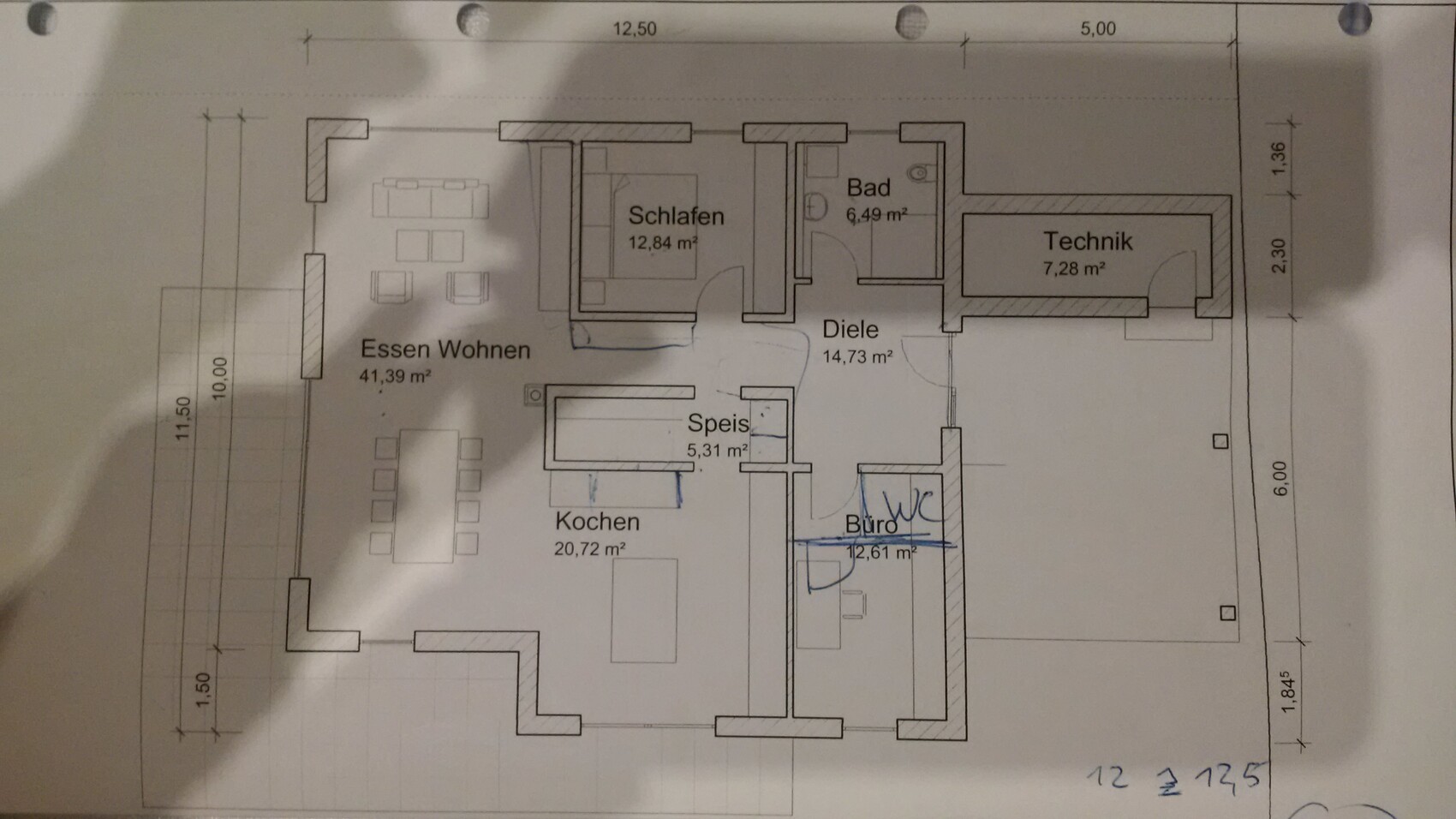
ᐅ Floor plan of a bungalow on a slab foundation, approximately 110 square meters
Created on: 5 Feb 2016 19:28
P
Portoalegre
Hello everyone
I am opening this for discussion.
The utility room is integrated into the carport and is located on the boundary. Apparently, this is not an issue.
Best regards, Portoalegre
I am opening this for discussion.
The utility room is integrated into the carport and is located on the boundary. Apparently, this is not an issue.
Best regards, Portoalegre
Bauexperte schrieb:
I see it differently because this room must be insulated—more or less like living space; living areas are only allowed to be built very close to the property boundary under strict conditions.
This is how it is handled in North Rhine-Westphalia (NRW); I can hardly imagine that different regulations apply in Bavaria, although I am aware that things can sometimes work differently there 😉
Best regards, BauexperteFrom when is a room considered insulated? I mean, why is (presumably) a 36.5 cm (14.4 inches) brick wall regarded as insulated, and a 17.5 cm (6.9 inches) wall not?B
Bauexperte5 Feb 2016 22:00merlin83 schrieb:
From when is a room considered insulated? I mean, why is a 36.5 cm (14 inch) brick wall presumably considered insulated, but a 17.5 cm (7 inch) one is not? The energy saving regulations can be quite tricky.
Using 36.5 cm (14 inch) or 17.5 cm (7 inch) bricks with an exterior insulation and finish system (EIFS) alone is not enough. Even in a single-family house built this way, the masonry by itself would not meet the energy saving standards. Even if the bungalow is built with a basement and the technical installations are logically located there, the utility room must be insulated both from the outside and on the walls adjacent to the interior rooms. Since few builders want insulation on the interior walls (including in the basement), the whole basement is often wrapped with 12 cm (5 inch) insulation; this can sometimes be a significant cost factor.
Regards, Bauexperte
What kind of oddball is this?
If you subtract the guest WC and hallway from the 12-something area, only 6-something remains for the office. The T-shape layout is not feasible space-wise, and the pantry, given its proportions, is too shallow to be walk-in, let alone for operating a washing machine there.
The hallway is unnecessarily large.
Considering the room proportions, the living areas and kitchen are thoughtlessly oversized – it seems the planner doesn’t really understand appropriate room sizes, does he?
Whether studied or not, practical experience should be applicable. Even if geography was the only subject on the curriculum.
If you subtract the guest WC and hallway from the 12-something area, only 6-something remains for the office. The T-shape layout is not feasible space-wise, and the pantry, given its proportions, is too shallow to be walk-in, let alone for operating a washing machine there.
The hallway is unnecessarily large.
Considering the room proportions, the living areas and kitchen are thoughtlessly oversized – it seems the planner doesn’t really understand appropriate room sizes, does he?
Whether studied or not, practical experience should be applicable. Even if geography was the only subject on the curriculum.

Good evening,
everyone has a bad day sometimes. Welcome here, and be sure to be polite to the women. 😉
A bungalow on a building permit/planning permission without a basement and with 110 sqm (1,184 sq ft) is ambitious, basically like our ground floor. I’d have to check, but it should be roughly that size. You can take a look at our ground floor plan; besides the usual living/dining/kitchen areas, we’ve also included a bathroom, bedroom, and office.
Having the entrance under the carport wouldn’t work for me. Is the carport on the property boundary? Then there are probably regulations regarding the technical installations; I have my doubts about that. Even a garage with a roof terrace loses its status and is not allowed to be built right on the boundary.
If you’re going with a bungalow, plan everything to be accessible without barriers — we all get older. That means at least 1m (3 ft 3 in) wide doors for the main passages.
A lot has already been said about the room layout.
everyone has a bad day sometimes. Welcome here, and be sure to be polite to the women. 😉
A bungalow on a building permit/planning permission without a basement and with 110 sqm (1,184 sq ft) is ambitious, basically like our ground floor. I’d have to check, but it should be roughly that size. You can take a look at our ground floor plan; besides the usual living/dining/kitchen areas, we’ve also included a bathroom, bedroom, and office.
Having the entrance under the carport wouldn’t work for me. Is the carport on the property boundary? Then there are probably regulations regarding the technical installations; I have my doubts about that. Even a garage with a roof terrace loses its status and is not allowed to be built right on the boundary.
If you’re going with a bungalow, plan everything to be accessible without barriers — we all get older. That means at least 1m (3 ft 3 in) wide doors for the main passages.
A lot has already been said about the room layout.
P
Portoalegre5 Feb 2016 22:48ypg schrieb:
What kind of character is this?
If you subtract the guest bathroom plus hallway from the total 12 point something, 6 remain for the office. The T-layout simply doesn't work in terms of space, and the pantry is not deep enough to walk into based on the proportions. It's even less practical to operate a washing machine there.
The hallway is unnecessarily large.
Considering the room proportions, the living areas and kitchen are thoughtlessly too big — it seems the master builder isn’t familiar with proper room sizes, right?
Whether educated or not: practical experience should be applied. Even if geography was the only subject studied.
Don’t call me a character, you clown.
Bauexperte schrieb:
The energy-saving regulation has its challenges.
Using 36.5 or 17.5 plus external thermal insulation composite system (ETICS) alone is not enough. Even in a single-family house built this way, the masonry by itself would not comply with the energy-saving regulation. Even if the bungalow had a basement and the technical equipment was reasonably installed there, the utility room would need to be insulated both from the outside and on the sides adjacent to the interior rooms. Since hardly any builder wants insulation on the inner wall (not even in the basement), the entire basement is then insulated with 12 cm (5 inches) of insulation—a cost factor that can be quite significant.
Best regards, Bauexperte I think we may have been talking past each other. I’ll try to be more specific: My garage is built with 17.5 cm (7 inches) masonry on the boundary line and is allowed. Would masonry of 36.5 cm (14 inches) have been prohibited—because of insulation? If so, where is the limit?
If 36.5 cm (14 inches) is not forbidden, then technically I would have a sufficiently insulated room for the technical equipment. Or where is my misunderstanding?
Similar topics