
Hello everyone,
we are currently planning the ceiling spotlights but are having a hard time making a decision.
Here are our ideas.
What do you think, or do you have better suggestions?
Option 1

Option 2
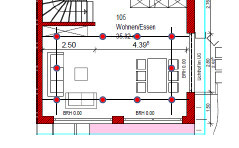
Option 3
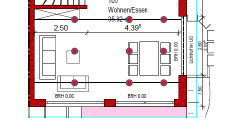
Thank you.
we are currently planning the ceiling spotlights but are having a hard time making a decision.
Here are our ideas.
What do you think, or do you have better suggestions?
Option 1
Option 2
Option 3
Thank you.

They already provide quite a lot of power and, in my opinion, should be sufficient in the planned quantity for the room.
The question of arrangement can only be answered here if your furniture layout and usage scenarios are clear. What can also be important are the colors of the walls, floors, and ceilings. If you have a color that “absorbs” the light, it will quickly become dark.
For example, in our living area, we installed 10 recessed spotlights (5W, 360 lumens, 90° beam angle), which we can partly control separately. In the evening while watching TV, the inner ring is off. When I read, only the inner lights are on. When we have guests or are cleaning, etc., all lights are on.
Above our dining table, we have a regular pendant lamp. Positioning the ceiling outlet was even more difficult than that of the spots and unfortunately ended up being 30cm (12 inches) off.
The question of arrangement can only be answered here if your furniture layout and usage scenarios are clear. What can also be important are the colors of the walls, floors, and ceilings. If you have a color that “absorbs” the light, it will quickly become dark.
For example, in our living area, we installed 10 recessed spotlights (5W, 360 lumens, 90° beam angle), which we can partly control separately. In the evening while watching TV, the inner ring is off. When I read, only the inner lights are on. When we have guests or are cleaning, etc., all lights are on.
Above our dining table, we have a regular pendant lamp. Positioning the ceiling outlet was even more difficult than that of the spots and unfortunately ended up being 30cm (12 inches) off.

I believe there was once a helpful thread here about calculating the illuminated area.
Short version:
Using the tangent function, you can determine the radius on the floor based on the beam angle and the distance from the floor to the ceiling or from the surface of the furniture to the ceiling. Then simply draw a circle with that radius around your spotlights, and you can see if there are any unlit spots in the room. I imagine that with examples 1 and 2, there are unlit areas in the center.
Short version:
Using the tangent function, you can determine the radius on the floor based on the beam angle and the distance from the floor to the ceiling or from the surface of the furniture to the ceiling. Then simply draw a circle with that radius around your spotlights, and you can see if there are any unlit spots in the room. I imagine that with examples 1 and 2, there are unlit areas in the center.

A few days ago, I also had to decide on our spotlights. In the living room, as we were advised, it’s actually the play of uneven lighting that creates a cozy atmosphere. An even lighting with spotlights, on the other hand, would feel less inviting.
Therefore, we planned lamps above the sofa area and dining area, and only established a basic or minimal level of lighting with spotlights.
Spotlights also seem to work well directly in front of large windows. In your case, I could easily imagine placing two or three spotlights directly in front of the large windows.
Therefore, we planned lamps above the sofa area and dining area, and only established a basic or minimal level of lighting with spotlights.
Spotlights also seem to work well directly in front of large windows. In your case, I could easily imagine placing two or three spotlights directly in front of the large windows.
@echti25 ... this won’t work.
It is more important to address the points that Jochen104 mentioned in post 5 here as well.
I also find a continuous carpet of recessed ceiling lights in the living area to be uncomfortable. I personally have spotlights to highlight special pieces of furniture, along with pendant lamps over the dining table and individual lamps in various places. Everything should also be switchable independently.
It is more important to address the points that Jochen104 mentioned in post 5 here as well.
I also find a continuous carpet of recessed ceiling lights in the living area to be uncomfortable. I personally have spotlights to highlight special pieces of furniture, along with pendant lamps over the dining table and individual lamps in various places. Everything should also be switchable independently.
Similar topics