
ᐅ Single-family house with a small footprint, attic, and basement; neighbor approval required
Created on: 2 Oct 2015 13:52
S
sirhc
Hello everyone,
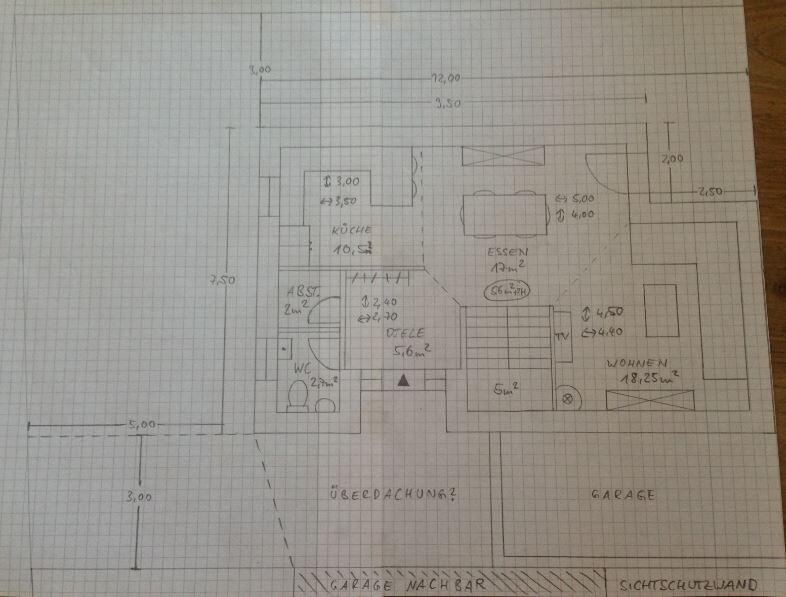
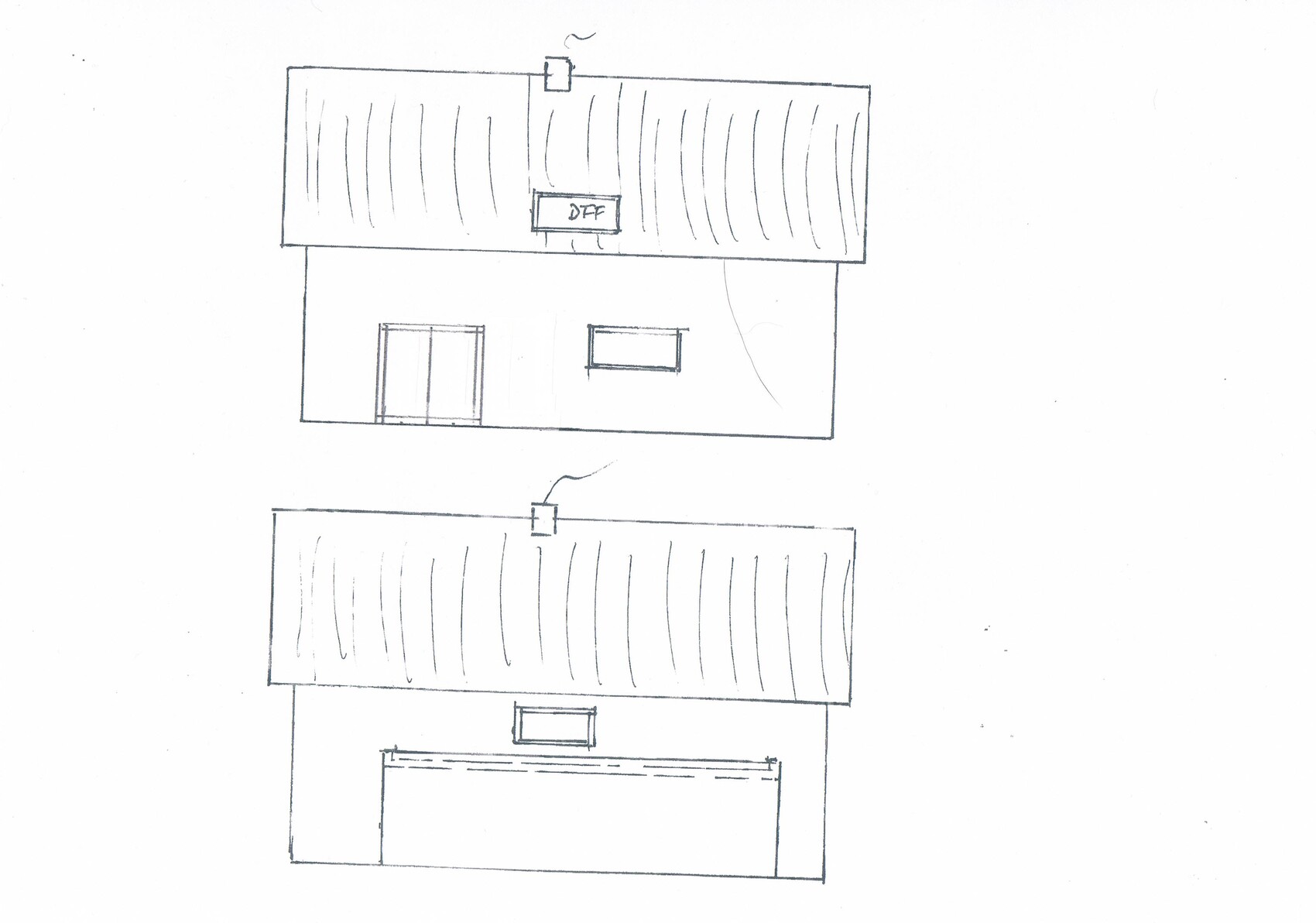
Some time ago, I shared hand-drawn sketches here for discussion. The biggest change since then is that I moved the entrance from the front to the side. I plan to review this design with a professional next week, but until then, I would like your help to identify and fix any potential weaknesses. A special feature is the significant deviation from the "square optimum," so many other interesting topics only helped me to a limited extent. Therefore, my question is: where are the major issues, what could I solve in a more elegant way, and of course, I’m also interested in what you find successful. Please excuse the pen and paper approach, but that’s how I work best on the design. Based on this, I will draw the basement, first floor, and attic over the weekend—unless the feedback turns out to be too negative.
We could build 3m (10 feet) deeper, but that would further reduce the already small garden, so we prefer not to. The roofed area in front of the garage probably requires the neighbor’s approval, right?
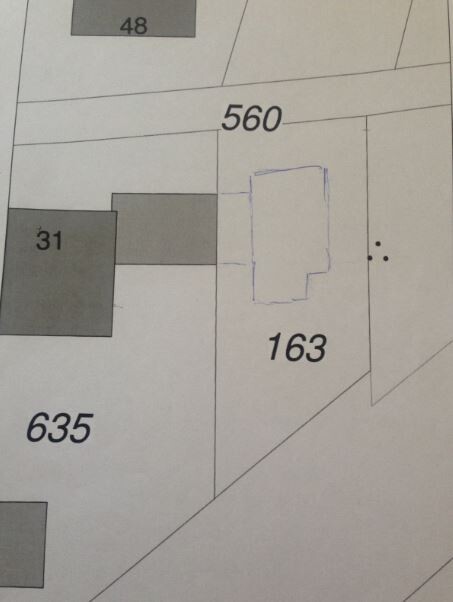
To the north is the access road (a dead-end street ending at our plot); to the south, behind the garden, runs a rail line for regional and freight trains (6 trains per hour during the day). The western neighbor built a long time ago; on the east side is a triangular plot currently covered with forest. We expect garages along the property boundary there, but a house probably won’t fit due to setback requirements.
Edit: very important — I know the windows are only partially shown. I’m still undecided about their arrangement on the east and south sides.
Development plan/restrictions
Plot size 372 sqm (front approx. 13.50m (44 feet), rear boundary beveled)
Slope none
Floor space ratio 0.4
Floor area ratio not defined
Building envelope, building line and boundary 7.50m (25 feet) wide x 15.00m (49 feet) deep, 5.00m (16 feet) setback to the street in front
Boundary construction House with 3.00m (10 feet) side setbacks each, garage on the property boundary
Number of parking spaces 3
Number of floors 1
Roof type gable roof or half-hip roof with 43° to 47° pitch
Architectural style not defined
Orientation not defined
Maximum heights/restrictions not defined
Other requirements not defined
Homeowner requirements
Style, roof type, building type classic, gable roof, solid construction, plaster finish
Basement, floors yes (basement, ground floor, first floor, attic)
Number of occupants, age 2 adults early 30s; 2 children planned
Space requirements on ground and first floors difficult to answer now; on the ground floor I have 56 sqm (600 sq ft) excluding stairs, which sounds small but looks sufficient
Office: family use or home office? no office
Overnight guests per year 10
Open or closed architecture open
Conservative or modern construction conservative
Open kitchen, cooking island yes, cooking peninsula
Number of dining seats 6-8
Fireplace yes
Music/sound wall no
Balcony, roof terrace no
Garage, carport yes, yes
Vegetable garden, greenhouse possibly, no
Other wishes/features/daily routine none
House design
Who designed it do-it-yourself
What do I like most? openness from kitchen through dining to living area; central staircase connects all floors with minimal hallway/traffic space
What do I dislike? the limitation to 7.50m (25 feet) house width causes more problems than expected; doubts whether the central staircase in the living room will be a problem
Cost estimate according to architect/designer not yet defined
Personal price limit for house including fittings not yet defined
Preferred heating system air-to-water heat pump
If you have to give up something, which details/extras
-can you give up? canopy/carport, possibly fireplace
-can you not give up? basement, garage
Best regards
sirhc
Some time ago, I shared hand-drawn sketches here for discussion. The biggest change since then is that I moved the entrance from the front to the side. I plan to review this design with a professional next week, but until then, I would like your help to identify and fix any potential weaknesses. A special feature is the significant deviation from the "square optimum," so many other interesting topics only helped me to a limited extent. Therefore, my question is: where are the major issues, what could I solve in a more elegant way, and of course, I’m also interested in what you find successful. Please excuse the pen and paper approach, but that’s how I work best on the design. Based on this, I will draw the basement, first floor, and attic over the weekend—unless the feedback turns out to be too negative.
We could build 3m (10 feet) deeper, but that would further reduce the already small garden, so we prefer not to. The roofed area in front of the garage probably requires the neighbor’s approval, right?
To the north is the access road (a dead-end street ending at our plot); to the south, behind the garden, runs a rail line for regional and freight trains (6 trains per hour during the day). The western neighbor built a long time ago; on the east side is a triangular plot currently covered with forest. We expect garages along the property boundary there, but a house probably won’t fit due to setback requirements.
Edit: very important — I know the windows are only partially shown. I’m still undecided about their arrangement on the east and south sides.
Development plan/restrictions
Plot size 372 sqm (front approx. 13.50m (44 feet), rear boundary beveled)
Slope none
Floor space ratio 0.4
Floor area ratio not defined
Building envelope, building line and boundary 7.50m (25 feet) wide x 15.00m (49 feet) deep, 5.00m (16 feet) setback to the street in front
Boundary construction House with 3.00m (10 feet) side setbacks each, garage on the property boundary
Number of parking spaces 3
Number of floors 1
Roof type gable roof or half-hip roof with 43° to 47° pitch
Architectural style not defined
Orientation not defined
Maximum heights/restrictions not defined
Other requirements not defined
Homeowner requirements
Style, roof type, building type classic, gable roof, solid construction, plaster finish
Basement, floors yes (basement, ground floor, first floor, attic)
Number of occupants, age 2 adults early 30s; 2 children planned
Space requirements on ground and first floors difficult to answer now; on the ground floor I have 56 sqm (600 sq ft) excluding stairs, which sounds small but looks sufficient
Office: family use or home office? no office
Overnight guests per year 10
Open or closed architecture open
Conservative or modern construction conservative
Open kitchen, cooking island yes, cooking peninsula
Number of dining seats 6-8
Fireplace yes
Music/sound wall no
Balcony, roof terrace no
Garage, carport yes, yes
Vegetable garden, greenhouse possibly, no
Other wishes/features/daily routine none
House design
Who designed it do-it-yourself
What do I like most? openness from kitchen through dining to living area; central staircase connects all floors with minimal hallway/traffic space
What do I dislike? the limitation to 7.50m (25 feet) house width causes more problems than expected; doubts whether the central staircase in the living room will be a problem
Cost estimate according to architect/designer not yet defined
Personal price limit for house including fittings not yet defined
Preferred heating system air-to-water heat pump
If you have to give up something, which details/extras
-can you give up? canopy/carport, possibly fireplace
-can you not give up? basement, garage
Best regards
sirhc

Hello everyone,
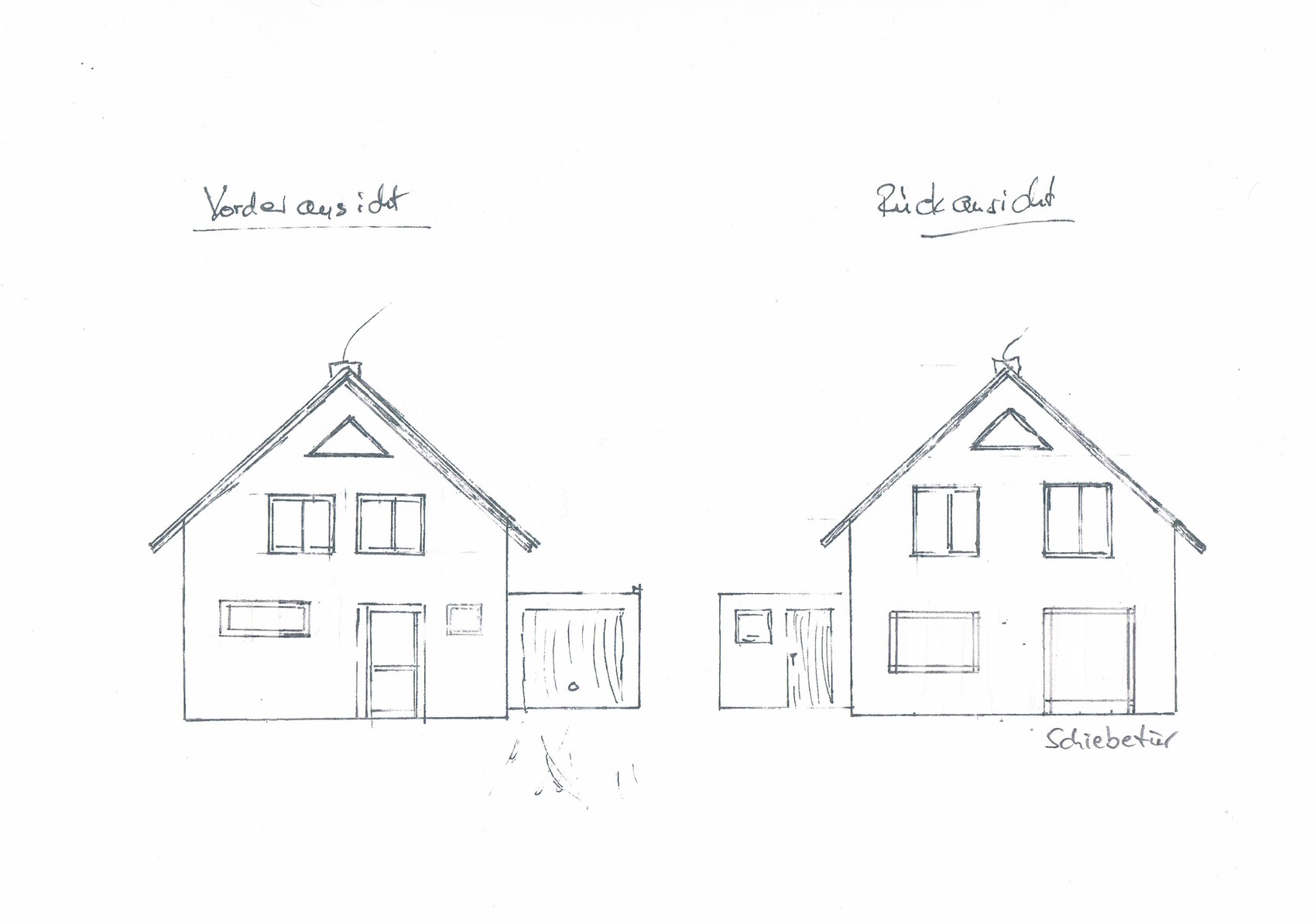
I would like to share with you the results of several weeks of planning.
Although it’s still rather rough and sketchy, this is likely the direction we will go.
Still, I’m very interested to hear where you see weaknesses or potential for improvement.
Edit: since the whole thing is a bit faint:
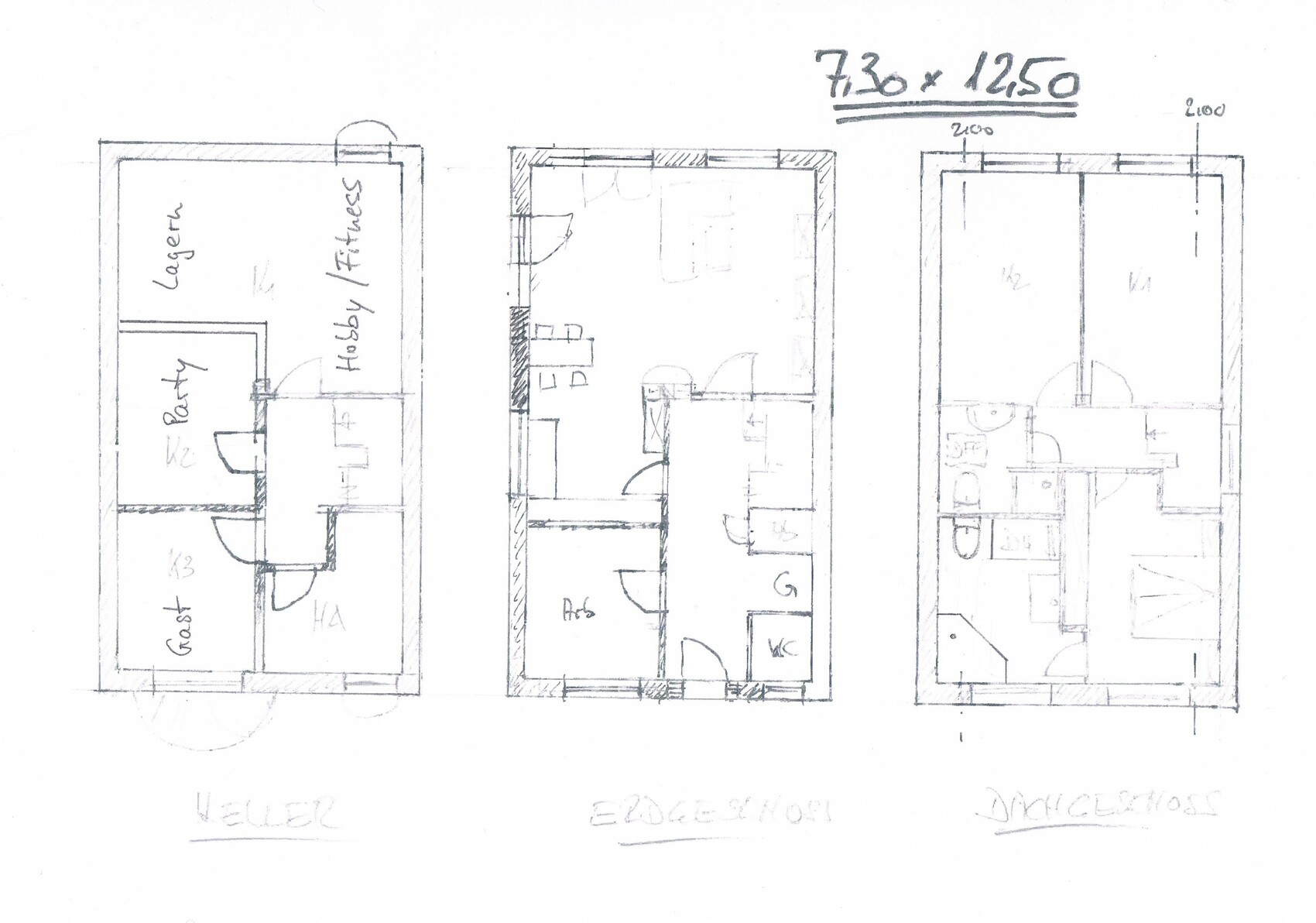
On the ground floor, there is a home office at the front, adjacent to the kitchen.
On the other side, we have a WC, cloakroom, storage room, and then the staircase.
The basement includes three rooms plus a utility room/house connection room with laundry facilities.
On the upper floor, there are two identical children’s bedrooms, a bathroom for the children, and a master area consisting of a bedroom and its own bathroom.
A loft studio is no longer planned because we have changed the roof orientation. The knee wall height will be about 140–145 cm (55–57 inches).
Thanks and best regards
I would like to share with you the results of several weeks of planning.
Although it’s still rather rough and sketchy, this is likely the direction we will go.
Still, I’m very interested to hear where you see weaknesses or potential for improvement.
Edit: since the whole thing is a bit faint:
On the ground floor, there is a home office at the front, adjacent to the kitchen.
On the other side, we have a WC, cloakroom, storage room, and then the staircase.
The basement includes three rooms plus a utility room/house connection room with laundry facilities.
On the upper floor, there are two identical children’s bedrooms, a bathroom for the children, and a master area consisting of a bedroom and its own bathroom.
A loft studio is no longer planned because we have changed the roof orientation. The knee wall height will be about 140–145 cm (55–57 inches).
Thanks and best regards

The floor plans could be optimized based on your preliminary design; fundamentally, they can work. However, I would suggest returning to the original idea of a side entrance and placing it where the storage room is, directly next to the staircase. The garage location can be adjusted. This way, the ground floor layout remains unified, and the proximity to the garage is preserved. With a covered walkway, you can reach the car without getting wet.
The kitchen and bathrooms need to be detailed in terms of plumbing routing from the top floor down to the basement, and the arrangement of sanitary fixtures should be drawn at scale 1:50/1:20; there will likely be some tight spots and probably further changes to the floor plan.
What are the cardinal directions? Is there already a geotechnical report including information on the groundwater level and the requirements for basement waterproofing (e.g., tanked waterproofing / integral waterproofing)?
The kitchen and bathrooms need to be detailed in terms of plumbing routing from the top floor down to the basement, and the arrangement of sanitary fixtures should be drawn at scale 1:50/1:20; there will likely be some tight spots and probably further changes to the floor plan.
What are the cardinal directions? Is there already a geotechnical report including information on the groundwater level and the requirements for basement waterproofing (e.g., tanked waterproofing / integral waterproofing)?
Hello W. Pickartz,
Thank you for your feedback.
First about the cardinal directions:
Street side / main entrance = North
Garage side = West
Kitchen side = East
Back side = South
Personally, I also like a side entrance (West) because it generally allows for a narrower floor plan, but we decided against it for two reasons:
1. The plot is narrow (13.30 m (44 feet)), so there is only the legally required 3 m (10 feet) setback on both sides of the house. This means the driveway and garage are also narrow. If a car is parked in front of the garage, you would have to squeeze past it to get to the front door.
2. The house is set back 5 m (16 feet) from the street (planning permission requirement), and the neighbor’s garage is attached to ours and set back about 6 m (20 feet). We don’t find it visually appealing if our garage would be pushed farther back than the neighbor’s garage to allow the side entrance. Also, coming out of the house, you would be looking directly at the plain wall of the neighbor’s garage.
One possible option would be a 45-degree chamfered main entrance at the northwest corner (close to our own garage, which could align flush with the neighbor’s garage).
Could you describe the “creaking” more precisely? Where exactly do you see problems? Do you mean that some things are complicated to resolve or even impossible?
There is no soil survey available for our plot. However, there are no issues with groundwater in this area. The soil is clayey, and the excavated material cannot be reused for backfilling or compaction later. The various contractors generally cast the basement as a concrete “white tank” (watertight structure). The basement was appraised several times at around 40,000 EUR.
Thank you again and best regards
Thank you for your feedback.
First about the cardinal directions:
Street side / main entrance = North
Garage side = West
Kitchen side = East
Back side = South
Personally, I also like a side entrance (West) because it generally allows for a narrower floor plan, but we decided against it for two reasons:
1. The plot is narrow (13.30 m (44 feet)), so there is only the legally required 3 m (10 feet) setback on both sides of the house. This means the driveway and garage are also narrow. If a car is parked in front of the garage, you would have to squeeze past it to get to the front door.
2. The house is set back 5 m (16 feet) from the street (planning permission requirement), and the neighbor’s garage is attached to ours and set back about 6 m (20 feet). We don’t find it visually appealing if our garage would be pushed farther back than the neighbor’s garage to allow the side entrance. Also, coming out of the house, you would be looking directly at the plain wall of the neighbor’s garage.
One possible option would be a 45-degree chamfered main entrance at the northwest corner (close to our own garage, which could align flush with the neighbor’s garage).
Could you describe the “creaking” more precisely? Where exactly do you see problems? Do you mean that some things are complicated to resolve or even impossible?
There is no soil survey available for our plot. However, there are no issues with groundwater in this area. The soil is clayey, and the excavated material cannot be reused for backfilling or compaction later. The various contractors generally cast the basement as a concrete “white tank” (watertight structure). The basement was appraised several times at around 40,000 EUR.
Thank you again and best regards
I’m confused: I thought the roof needed to be planned the other way around. I had sat down to draw it back then but got stuck because of the roof.
Anyway, if you search for narrow lot on Google, you’ll find house design ideas. My drawing can be compared to the Weberhaus Sunshine 110...
I would also prefer a side entrance and would leave about 4 meters (13 feet) of space at the front of the house along the property line. Thanks to the neighbor’s garage, a nice sheltered courtyard could then be created in front of the garage.
Anyway, if you search for narrow lot on Google, you’ll find house design ideas. My drawing can be compared to the Weberhaus Sunshine 110...
I would also prefer a side entrance and would leave about 4 meters (13 feet) of space at the front of the house along the property line. Thanks to the neighbor’s garage, a nice sheltered courtyard could then be created in front of the garage.
The routing of installations (heating, sanitary, electrical, ventilation) should ideally be planned as realistically as possible from the very beginning. This prevents having to reconsider the floor plan concept later during the detailed or working planning phase, due to insufficient space for installation walls, boxed-in areas—in short, for concealed horizontal and vertical piping routes—not being taken into account.
For example, you may have two soil pipes that need to be connected under the ceiling in the basement or linked to the house drainage in the utility room. The soil pipe from the bathrooms on the upper floor runs right through the kitchen area. How, then, should the bathtub or a walk-in shower be connected, especially if the shower has a linear drain embedded in the screed (minimum build-up height about 90mm (3.5 inches)) or is drained inside an installation wall or vertically? In the latter case, it would require an opening in the structural ceiling and possibly a boxed-in structure hanging below the ceiling—which is unacceptable.
A technically sound solution should not be left solely to the specialist contractors or builders. Complaints and defects then become the norm. Furthermore, the size and spacing of sanitary fixtures should be accurately entered in the floor plan according to current general rules of technology or personal needs for single-family home construction. Sometimes, when planning at a large scale, missing just a few centimeters at a critical point can lead to complicated, unattractive compromises or makeshift solutions on site.
A soil investigation report is a prerequisite for construction planning (responsibility of the client). The building’s waterproofing system is designed based on this report; the structural engineer requires it for foundation design, and any potential soil loads must be identified. The design groundwater level should also be clearly stated, along with an infiltration coefficient describing the soil permeability, if drainage water is intended to seep away. In your region, the ground must also be examined for remnants from World War II (checking for unexploded ordnance).
I also see no immediate reason to accept the neighbor’s arbitrary decision as a fixed requirement for garage placement. You may also have parking spaces in front of the house thanks to the 5m (16 feet) setback from the property boundary. I would see more advantages than disadvantages in having a side entrance to the house.
For example, you may have two soil pipes that need to be connected under the ceiling in the basement or linked to the house drainage in the utility room. The soil pipe from the bathrooms on the upper floor runs right through the kitchen area. How, then, should the bathtub or a walk-in shower be connected, especially if the shower has a linear drain embedded in the screed (minimum build-up height about 90mm (3.5 inches)) or is drained inside an installation wall or vertically? In the latter case, it would require an opening in the structural ceiling and possibly a boxed-in structure hanging below the ceiling—which is unacceptable.
A technically sound solution should not be left solely to the specialist contractors or builders. Complaints and defects then become the norm. Furthermore, the size and spacing of sanitary fixtures should be accurately entered in the floor plan according to current general rules of technology or personal needs for single-family home construction. Sometimes, when planning at a large scale, missing just a few centimeters at a critical point can lead to complicated, unattractive compromises or makeshift solutions on site.
A soil investigation report is a prerequisite for construction planning (responsibility of the client). The building’s waterproofing system is designed based on this report; the structural engineer requires it for foundation design, and any potential soil loads must be identified. The design groundwater level should also be clearly stated, along with an infiltration coefficient describing the soil permeability, if drainage water is intended to seep away. In your region, the ground must also be examined for remnants from World War II (checking for unexploded ordnance).
I also see no immediate reason to accept the neighbor’s arbitrary decision as a fixed requirement for garage placement. You may also have parking spaces in front of the house thanks to the 5m (16 feet) setback from the property boundary. I would see more advantages than disadvantages in having a side entrance to the house.
ypg schrieb:
I'm confused: I understood that the roof needed to be planned the other way around. I sat down to draw it back then but got stuck because of the roof.
Anyway, if you search for narrow lots on Google, you’ll find house ideas. My drawing can be compared to the Weberhaus Sunshine 110...
I would also prefer a side entrance and give the little house 4 meters (13 feet) of space at the front border. Thanks to the neighbor's garage, a nice sheltered courtyard can be created in front of the garage.Maybe we misunderstood each other, or I didn’t express myself clearly. We definitely wanted to position the roof the other way to create a loft studio because we believed we needed that space.
I already googled many narrow floor plans. None really fit, usually because of the staircase. It has now become clear that all the rooms we want on the upper floor can actually be placed on the level below.
What exactly do you mean by 4 meters (13 feet) of space at the border? At the front (north side), we must keep a 5-meter (16 feet) setback. Since all others have respected this distance and we are the last to build there, no exceptions will be allowed—this has already been clarified. I understand that pushing the garage back protects the area in front of it. However, we don’t like that at all.
W. Pickartz schrieb:
The routing of installations (heating, sanitary, electrical, ventilation) should preferably be planned as realistically as possible from the start, so that during construction and detailed planning the floor plan concept doesn’t have to be questioned again because necessary space—for example, for installation walls, soffits, in short: for concealed horizontal and vertical pipe runs—was not taken into account.
I also see no immediate obligation to accept the neighbor’s garage arrangement as a given. You may have parking spaces in front of your house due to the 5-meter (16 feet) setback from the property boundary. I see more advantages than disadvantages to a side entrance.At least I can say the required routes from basement to roof for the chimney and heating boiler work. Regarding the other installations, I haven’t gone into as much detail yet but so far haven’t heard any objections suggesting something might not fit.
The issue of the entrance still occupies me somewhat. I will try some versions with a 45-degree chamfered entrance on the northwest corner as well as a side entrance between the guest toilet and the staircase.
The keyword “concealed horizontal and vertical pipe runs” is something I will look into further and educate myself about.
Thank you both very much for your feedback!
Similar topics