
B
Bauexperte2 Nov 2015 22:48About Earthships
Earthships are buildings constructed using a specific design approach that relies solely on passive solar heat gain and thermal mass storage for heating, as well as natural air circulation for cooling. They are characterized by extensive use of natural and recycled building materials and complete self-sufficiency in terms of heating, electrical power, water, and wastewater management.
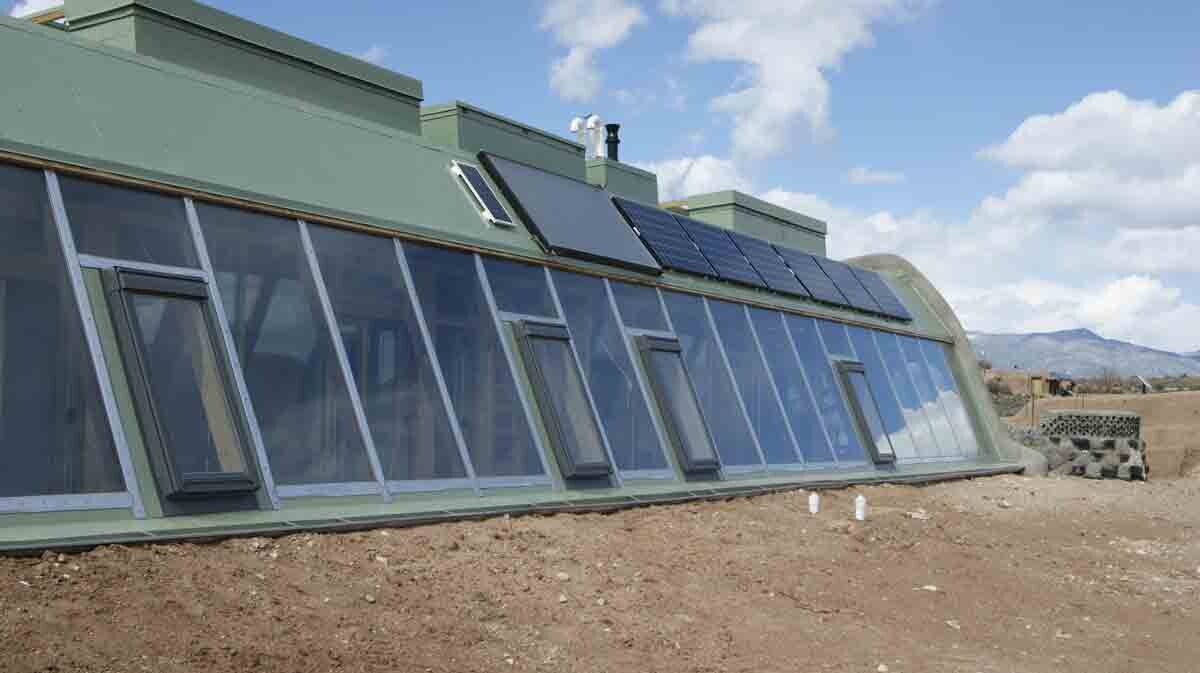
A distinctive feature is the use of waste materials from modern civilization as building components. For example, the sealed north, east, and west walls are almost always made from used car tires. These tires are stacked like bricks and filled with compacted earth. The resulting wall serves as a structural element and, due to its large mass—often weighing several tons—as a thermal storage unit. The south-facing façade, which receives sunlight, is nearly entirely glazed. Solar heat gained here is stored in the massive structure over days and weeks, eliminating the need for conventional heating systems.
For self-sufficient water supply, rainwater is collected from the roof and stored in cisterns. A sophisticated system allows each drop of water to be reused up to four times. This enables autonomous water supply even in arid regions with very low annual precipitation, without any external water input. The rainwater is filtered and used as drinking water or for flushing. Afterwards, it irrigates an indoor planter bed where it is naturally purified. This treated water is then used for toilet flushing and finally directed through a septic tank to a planted bed next to the house, where remaining impurities are filtered out by plants.
The Earthship concept was developed in the 1970s by American architect Michael Reynolds. Approximately 30 years later, growing awareness of climate protection and sustainable construction methods helped spread the idea beyond the United States. Today, the buildings are designed and marketed by Reynolds’ company Earthship Biotecture in Taos, New Mexico. Besides designing and constructing Earthships, plans and books for self-builders are also offered.
By 2006, about 2,000 Earthships had been built—almost all in the United States except for two exceptions. At least 1,000 other buildings based on the same principles but without involvement from Michael Reynolds or Earthship Biotecture have also been constructed. Since then, projects have appeared in Canada, South America, the Caribbean, India, and Africa. Besides residential buildings, accommodations for natural disaster victims in Haiti and India, as well as a Waldorf school in Sierra Leone, have been built. These structures take into account the distinct climatic conditions of their locations.
In Europe, Earthships have been realized in the Netherlands, Belgium, France, Spain, Portugal, the United Kingdom, Sweden, Iceland, Estonia, and the Czech Republic. The first project in a German-speaking country is planned in the Tempelhof community (Baden-Württemberg, Germany). Construction of the prototype started in late September 2015 and is being scientifically monitored by the University of Stuttgart, especially regarding building physics. To achieve an approvable design, unlike a classic Earthship, the full use of rain and wastewater was omitted. However, all technical systems typical for an Earthship have been installed despite this restriction in water use to allow a complete functional analysis. Additionally, the building, unlike previous Earthships, features a full capillary-breaking subfloor insulation made from foam glass gravel.
Adapting the Earthship principle to the damp, cold climate of Northern Europe has led to technical challenges in early projects, especially concerning condensation. The construction and operation of the Earthship in Brighton (UK) have therefore been scientifically supported and documented by the Centre for Sustainable Construction at the University of Brighton. A bachelor thesis at Denmark’s Via University College addresses the question of how well the building principle can be applied in Denmark’s Nordic climate.
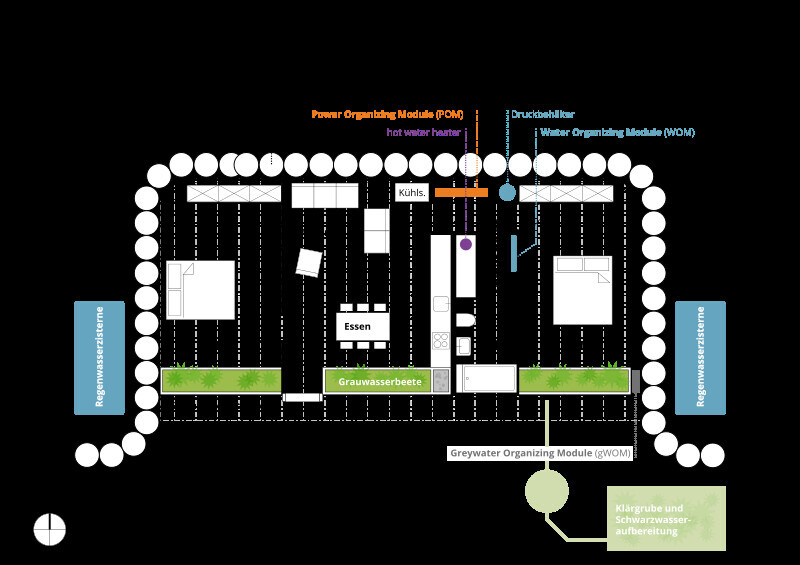
The roofs of Earthships are designed so that all precipitation (rain, snow, dew, and condensation) drains into an underground cistern. First, the water passes through a gravel filter to prevent coarse impurities from entering the cistern. The cisterns are usually positioned in terrain mounded on the north side—approximately at the level of the interior spaces. This elevated position allows water to flow downhill into the indoor “Water Organization Module” (WOM) without the need for additional pumps.
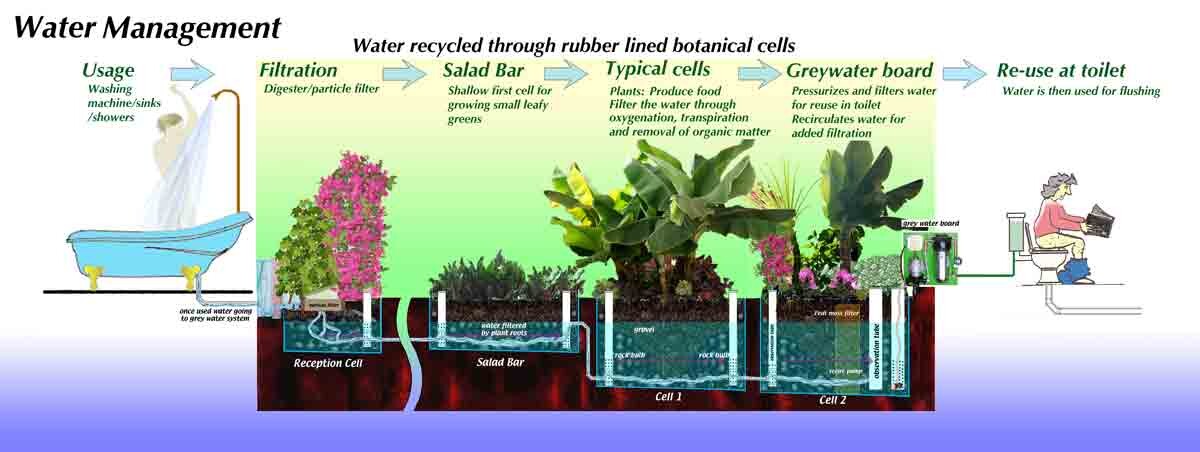
The WOM consists of a direct-current pump and a series of filters. Only water that is intended for drinking passes through all filtration stages. Therefore, each sink is equipped with an additional faucet specifically for drinking water. The pump pressurizes the water into a pressure tank, supplying the household plumbing with standard water pressure. The treated water is used for all domestic applications except the toilet. For the toilet, only previously used water from sinks, showers, or washing machines is used, which has been filtered in “greywater” planter beds beforehand.
*Source: Earthship Deutschland.de
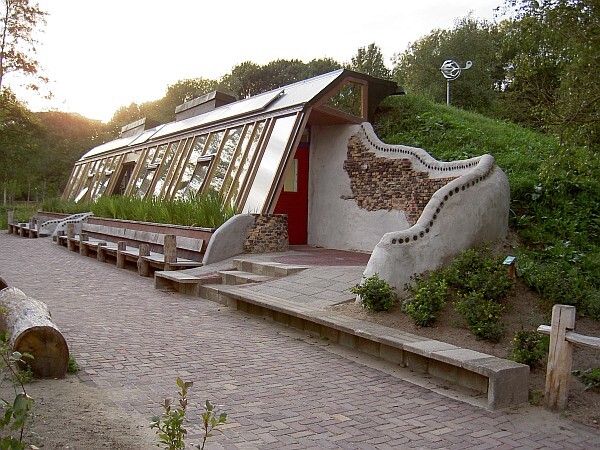
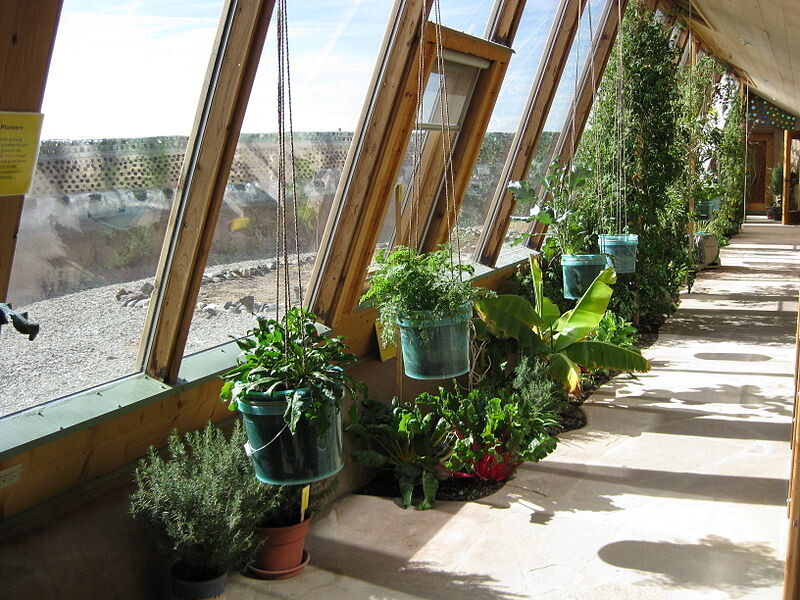
**Images Water Management, Earthship located in Taos N.M, Earthship inside greenhouse + Copyright: Amzi Smith (This file is licensed under the Creative Commons License “Attribution-ShareAlike 3.0 Unported”)
Best regards, Bauexperte
Earthships are buildings constructed using a specific design approach that relies solely on passive solar heat gain and thermal mass storage for heating, as well as natural air circulation for cooling. They are characterized by extensive use of natural and recycled building materials and complete self-sufficiency in terms of heating, electrical power, water, and wastewater management.
A distinctive feature is the use of waste materials from modern civilization as building components. For example, the sealed north, east, and west walls are almost always made from used car tires. These tires are stacked like bricks and filled with compacted earth. The resulting wall serves as a structural element and, due to its large mass—often weighing several tons—as a thermal storage unit. The south-facing façade, which receives sunlight, is nearly entirely glazed. Solar heat gained here is stored in the massive structure over days and weeks, eliminating the need for conventional heating systems.
For self-sufficient water supply, rainwater is collected from the roof and stored in cisterns. A sophisticated system allows each drop of water to be reused up to four times. This enables autonomous water supply even in arid regions with very low annual precipitation, without any external water input. The rainwater is filtered and used as drinking water or for flushing. Afterwards, it irrigates an indoor planter bed where it is naturally purified. This treated water is then used for toilet flushing and finally directed through a septic tank to a planted bed next to the house, where remaining impurities are filtered out by plants.
The Earthship concept was developed in the 1970s by American architect Michael Reynolds. Approximately 30 years later, growing awareness of climate protection and sustainable construction methods helped spread the idea beyond the United States. Today, the buildings are designed and marketed by Reynolds’ company Earthship Biotecture in Taos, New Mexico. Besides designing and constructing Earthships, plans and books for self-builders are also offered.
By 2006, about 2,000 Earthships had been built—almost all in the United States except for two exceptions. At least 1,000 other buildings based on the same principles but without involvement from Michael Reynolds or Earthship Biotecture have also been constructed. Since then, projects have appeared in Canada, South America, the Caribbean, India, and Africa. Besides residential buildings, accommodations for natural disaster victims in Haiti and India, as well as a Waldorf school in Sierra Leone, have been built. These structures take into account the distinct climatic conditions of their locations.
In Europe, Earthships have been realized in the Netherlands, Belgium, France, Spain, Portugal, the United Kingdom, Sweden, Iceland, Estonia, and the Czech Republic. The first project in a German-speaking country is planned in the Tempelhof community (Baden-Württemberg, Germany). Construction of the prototype started in late September 2015 and is being scientifically monitored by the University of Stuttgart, especially regarding building physics. To achieve an approvable design, unlike a classic Earthship, the full use of rain and wastewater was omitted. However, all technical systems typical for an Earthship have been installed despite this restriction in water use to allow a complete functional analysis. Additionally, the building, unlike previous Earthships, features a full capillary-breaking subfloor insulation made from foam glass gravel.
Adapting the Earthship principle to the damp, cold climate of Northern Europe has led to technical challenges in early projects, especially concerning condensation. The construction and operation of the Earthship in Brighton (UK) have therefore been scientifically supported and documented by the Centre for Sustainable Construction at the University of Brighton. A bachelor thesis at Denmark’s Via University College addresses the question of how well the building principle can be applied in Denmark’s Nordic climate.
The roofs of Earthships are designed so that all precipitation (rain, snow, dew, and condensation) drains into an underground cistern. First, the water passes through a gravel filter to prevent coarse impurities from entering the cistern. The cisterns are usually positioned in terrain mounded on the north side—approximately at the level of the interior spaces. This elevated position allows water to flow downhill into the indoor “Water Organization Module” (WOM) without the need for additional pumps.
The WOM consists of a direct-current pump and a series of filters. Only water that is intended for drinking passes through all filtration stages. Therefore, each sink is equipped with an additional faucet specifically for drinking water. The pump pressurizes the water into a pressure tank, supplying the household plumbing with standard water pressure. The treated water is used for all domestic applications except the toilet. For the toilet, only previously used water from sinks, showers, or washing machines is used, which has been filtered in “greywater” planter beds beforehand.
*Source: Earthship Deutschland.de
**Images Water Management, Earthship located in Taos N.M, Earthship inside greenhouse + Copyright: Amzi Smith (This file is licensed under the Creative Commons License “Attribution-ShareAlike 3.0 Unported”)
Best regards, Bauexperte
B
Bauexperte2 Nov 2015 22:50Cross section through a greywater planted bed (installation)
Greywater refers to water that is already contaminated but not with fecal matter and is no longer suitable for drinking. This contamination usually consists of non-toxic substances such as soap, skin particles, or hair. In the Earthship, greywater is roughly filtered to remove fats and solids and then directed into planted beds up to 150 cm (59 inches) deep. These beds are located inside the building, directly below the glazed south-facing facade. The plants, together with microorganisms in the soil, filter the water and use any nutrients from, for example, detergents—such as phosphates and nitrogen—for their growth. They also enrich the indoor air with oxygen and water vapor, and if edible plants or dwarf fruit trees are grown, they can contribute to food production.
When the greywater reaches the end of the planted bed, it collects in a reservoir and, after passing through another filter, is used for flushing the toilets.
After initial experiments with composting toilets, all newer Earthships now use this system with standard water-flushed toilets. The wastewater contaminated with fecal matter is called blackwater. This is directed outside, where it is broken down by anaerobic bacteria in an insulated, solar-heated multi-chamber septic tank. From there, it flows into a constructed wetland where it can be used, for example, to irrigate ornamental plants or fruit trees.
Earthships generate all their electrical energy through photovoltaics and, in some cases, small-scale wind power. The electricity is stored in batteries, distributed through the so-called “Power Organizing Module” (POM), and converted to alternating current when necessary. Ideally, the main appliances such as pumps, refrigerator, and at least some lighting use direct current. This ensures that basic house functions remain operational even if the inverter fails. Alternating current is used for other devices such as computers, internet connection, or the washing machine. To achieve complete autonomy with relatively small battery capacity, electricity is not used for heating or cooling. Instead, domestic hot water is heated using solar energy and, only during extended cloudy periods, by a wood stove or gas boiler.
Most Earthships do not use mechanical ventilation but simply vent warm air through skylights. These are usually simple sealed panels operated by an internal rope system and held open with a counterweight. The rising warm air creates a chimney effect that draws cooler air in through windows or earth tubes. This provides a constant light breeze in summer and removes excess heat. In winter, air moderately warmed by passing through the ground flows into the house, or the air inlets are closed during the cold months.
Depending on the climate and occupants’ ventilation habits, this form of air exchange can lead to moisture problems, which can be exacerbated by the large number of plants indoors. Some Earthships have therefore been retrofitted with mechanical ventilation systems with heat recovery.
How much does an Earthship cost?*
The total cost of an Earthship mainly depends on how much work you can (or want to) invest yourself and which materials you use. Since Earthships are not yet common in Germany, we can only refer to experiences from abroad. We believe that an Earthship costs roughly the same per m² as a typical passive solar house. Although Earthships use a lot of material that society usually discards, certain items still have to be purchased or at least sourced and transported. Unavoidable costs mainly arise from the systems (photovoltaics, wind energy, water pumps, water treatment, water tanks, etc.). Depending on the requirements, these systems must be professionally installed. For example, if many electrical devices are to be used simultaneously, the systems must be sized accordingly to ensure reliable energy supply.
In the USA, a Simple Survival Earthship with approximately 50 m² (538 sq ft) of living space can be built for around $50,000 with high self-labor input. A Global Model Earthship with about 120 m² (1,292 sq ft) of living space costs around $300,000 turnkey with very little self-labor. These figures are guidelines.
How are the costs distributed?
Materials (40%)
Construction costs (40%)
Costs arise not only from the actual construction work performed but also from preparation and planning. Although building Earthships is our passion, we cannot yet live on love and enthusiasm alone. To provide the best possible support, costs arise for:
Systems (20%)
What are the ongoing costs?
An Earthship incurs no costs for water, heating, or electricity. Excess electricity can be sold via grid connection.
There are costs for cooking gas and system and battery maintenance.
*Source: Earthship Deutschland.de
Image Earthship Zwolle + rights holder: Erik Wannee (This file is provided under the Creative Commons license “CC0 1.0 Universal Public Domain Dedication”).
Regards, Bauexperte
Greywater refers to water that is already contaminated but not with fecal matter and is no longer suitable for drinking. This contamination usually consists of non-toxic substances such as soap, skin particles, or hair. In the Earthship, greywater is roughly filtered to remove fats and solids and then directed into planted beds up to 150 cm (59 inches) deep. These beds are located inside the building, directly below the glazed south-facing facade. The plants, together with microorganisms in the soil, filter the water and use any nutrients from, for example, detergents—such as phosphates and nitrogen—for their growth. They also enrich the indoor air with oxygen and water vapor, and if edible plants or dwarf fruit trees are grown, they can contribute to food production.
When the greywater reaches the end of the planted bed, it collects in a reservoir and, after passing through another filter, is used for flushing the toilets.
After initial experiments with composting toilets, all newer Earthships now use this system with standard water-flushed toilets. The wastewater contaminated with fecal matter is called blackwater. This is directed outside, where it is broken down by anaerobic bacteria in an insulated, solar-heated multi-chamber septic tank. From there, it flows into a constructed wetland where it can be used, for example, to irrigate ornamental plants or fruit trees.
Earthships generate all their electrical energy through photovoltaics and, in some cases, small-scale wind power. The electricity is stored in batteries, distributed through the so-called “Power Organizing Module” (POM), and converted to alternating current when necessary. Ideally, the main appliances such as pumps, refrigerator, and at least some lighting use direct current. This ensures that basic house functions remain operational even if the inverter fails. Alternating current is used for other devices such as computers, internet connection, or the washing machine. To achieve complete autonomy with relatively small battery capacity, electricity is not used for heating or cooling. Instead, domestic hot water is heated using solar energy and, only during extended cloudy periods, by a wood stove or gas boiler.
Most Earthships do not use mechanical ventilation but simply vent warm air through skylights. These are usually simple sealed panels operated by an internal rope system and held open with a counterweight. The rising warm air creates a chimney effect that draws cooler air in through windows or earth tubes. This provides a constant light breeze in summer and removes excess heat. In winter, air moderately warmed by passing through the ground flows into the house, or the air inlets are closed during the cold months.
Depending on the climate and occupants’ ventilation habits, this form of air exchange can lead to moisture problems, which can be exacerbated by the large number of plants indoors. Some Earthships have therefore been retrofitted with mechanical ventilation systems with heat recovery.
How much does an Earthship cost?*
The total cost of an Earthship mainly depends on how much work you can (or want to) invest yourself and which materials you use. Since Earthships are not yet common in Germany, we can only refer to experiences from abroad. We believe that an Earthship costs roughly the same per m² as a typical passive solar house. Although Earthships use a lot of material that society usually discards, certain items still have to be purchased or at least sourced and transported. Unavoidable costs mainly arise from the systems (photovoltaics, wind energy, water pumps, water treatment, water tanks, etc.). Depending on the requirements, these systems must be professionally installed. For example, if many electrical devices are to be used simultaneously, the systems must be sized accordingly to ensure reliable energy supply.
In the USA, a Simple Survival Earthship with approximately 50 m² (538 sq ft) of living space can be built for around $50,000 with high self-labor input. A Global Model Earthship with about 120 m² (1,292 sq ft) of living space costs around $300,000 turnkey with very little self-labor. These figures are guidelines.
How are the costs distributed?
Materials (40%)
- Many materials, like car tires, glass bottles, and cans, can be upcycled. However, acquiring them may still incur costs.
- Wood, cement, sand, gravel, reinforcing steel, insulation, and many other building materials usually have to be purchased.
- Windows and doors can involve significant expenses when bought new.
Construction costs (40%)
Costs arise not only from the actual construction work performed but also from preparation and planning. Although building Earthships is our passion, we cannot yet live on love and enthusiasm alone. To provide the best possible support, costs arise for:
- Project supervision
- Architectural planning
- Specialized craftsmen’s expert knowledge on site
- Training and further education
- Travel expenses
- Technical infrastructure
- Tools
- Feeding helpers (up to 40 people for 6 weeks, depending on project size)
Systems (20%)
- Photovoltaics
- Wind power
- Electronics and batteries
- Water management
- Botanical cells
What are the ongoing costs?
An Earthship incurs no costs for water, heating, or electricity. Excess electricity can be sold via grid connection.
There are costs for cooking gas and system and battery maintenance.
*Source: Earthship Deutschland.de
Image Earthship Zwolle + rights holder: Erik Wannee (This file is provided under the Creative Commons license “CC0 1.0 Universal Public Domain Dedication”).
Regards, Bauexperte
The idea sounds interesting, but I would be cautious about the recycling aspect. Car tires also contain a lot of chemicals. Batteries probably don’t have the best environmental footprint either. The pictures don’t really look like they represent a 50,000 USD budget—of course, appearances can be deceiving, and there might truly be someone with a lot of skill doing the work themselves.
In hindsight, I definitely would have used the Styrodur panels (if anyone still remembers them) and wouldn’t have insisted on new ones.
In hindsight, I definitely would have used the Styrodur panels (if anyone still remembers them) and wouldn’t have insisted on new ones.

Interesting project.
If we ever want to build a house again in the future and the children have already moved out, I would consider revisiting this. By that time, developments will have progressed further, new insights regarding such a project will be available, and some key issues might have been resolved, possibly allowing the concept to be further optimized.
I would be particularly interested in the developments and research in Denmark and Sweden concerning cooler climates, as Norway is somewhat like my dream country.
I am not really an "environmentalist," though. However, I am fascinated by the possibility of a largely self-sufficient lifestyle.
In terms of cost – well, it was about the same price as our current KfW 70 house – but with 170 sqm (1830 sq ft).
The only thing that bothers me a bit about the pictures is that the entire complex seems to be one large room, with separation mainly through cabinets and similar elements – or did I miss something here?
If we ever want to build a house again in the future and the children have already moved out, I would consider revisiting this. By that time, developments will have progressed further, new insights regarding such a project will be available, and some key issues might have been resolved, possibly allowing the concept to be further optimized.
I would be particularly interested in the developments and research in Denmark and Sweden concerning cooler climates, as Norway is somewhat like my dream country.
I am not really an "environmentalist," though. However, I am fascinated by the possibility of a largely self-sufficient lifestyle.
In terms of cost – well, it was about the same price as our current KfW 70 house – but with 170 sqm (1830 sq ft).
The only thing that bothers me a bit about the pictures is that the entire complex seems to be one large room, with separation mainly through cabinets and similar elements – or did I miss something here?
Such a construction method is currently never feasible in Germany. All building materials require official building approval, and there is usually a mandatory connection to the drinking water supply and sewage system – there are certainly about 100 other reasons as well.
I might consider living like that somewhere in the middle of nowhere, but otherwise… no.
I might consider living like that somewhere in the middle of nowhere, but otherwise… no.
SirSydom schrieb:
This type of construction is currently impossible to implement in Germany.
All building materials require official approval, there is usually a mandatory connection to drinking water and sewage systems – and there are probably 100 other reasons as well. Bauexperte schrieb:
As the first project in the German-speaking region, an Earthship is planned in the Tempelhof community (Baden-Württemberg). Construction of the prototype began at the end of September 2015 and is being scientifically monitored by the University of Stuttgart, especially with regard to building physics properties. To achieve an approvable design, unlike a traditional Earthship, the full use of rainwater and wastewater was omitted. However, all technical systems typical of an Earthship are still installed, despite the water use limitations, to allow a complete functional analysis. In addition, unlike previous Earthships, the building features a full capillary-breaking floor insulation made of foam glass gravel. Well – German bureaucracy and regulatory strictness could indeed pose a problem here. Although they often provide legal certainty for citizens.
On the other hand, the pilot project was approved. Once it is completed and further data and facts have been collected, a change in administrative attitudes might be possible in the future. It usually works like this – when a reference case exists, eventually a “courageous” official steps forward and sets a precedent (approval). Once approval is granted, subsequent permitting processes become easier, as a precedent already exists.
By the way, in my thought experiment, we still have about 20 to 30 years ahead of us.
Similar topics